. 2023 Sep 13;6(1):55.
doi: 10.5334/joc.320. eCollection 2023.

The Pleasurable Urge to Move to Music Through the Lens of Learning Progress

Affiliations

The Pleasurable Urge to Move to Music Through the Lens of Learning Progress

Tomas E Matthews et al. J Cogn. .

Abstract

Interacting with music is a uniquely pleasurable activity that is ubiquitous across human cultures. Current theories suggest that a prominent driver of musical pleasure responses is the violation and confirmation of temporal predictions. For example, the pleasurable urge to move to music (PLUMM), which is associated with the broader concept of groove, is higher for moderately complex rhythms compared to simple and complex rhythms. This inverted U-shaped relation between PLUMM and rhythmic complexity is thought to result from a balance between predictability and uncertainty. That is, moderately complex rhythms lead to strongly weighted prediction errors which elicit an urge to move to reinforce the predictive model (i.e., the meter). However, the details of these processes and how they bring about positive affective responses are currently underspecified. We propose that the intrinsic motivation for learning progress drives PLUMM and informs the music humans choose to listen to, dance to, and create. Here, learning progress reflects the rate of prediction error minimization over time. Accordingly, reducible prediction errors signal the potential for learning progress, producing a pleasurable, curious state characterized by the mobilization of attentional and memory resources. We discuss this hypothesis in the context of current psychological and neuroscientific research on musical pleasure and PLUMM. We propose a theoretical neuroscientific model focusing on the roles of dopamine and norepinephrine within a feedback loop linking prediction-based learning, curiosity, and memory. This perspective provides testable predictions that will motivate future research to further illuminate the fundamental relation between predictions, movement, and reward.

Keywords: PLUMM; curiosity; dopamine; groove; learning; norepinephrine; pleasure; predictive processing.


Conflict of interest statement

The authors have no competing interests to declare.

Figures
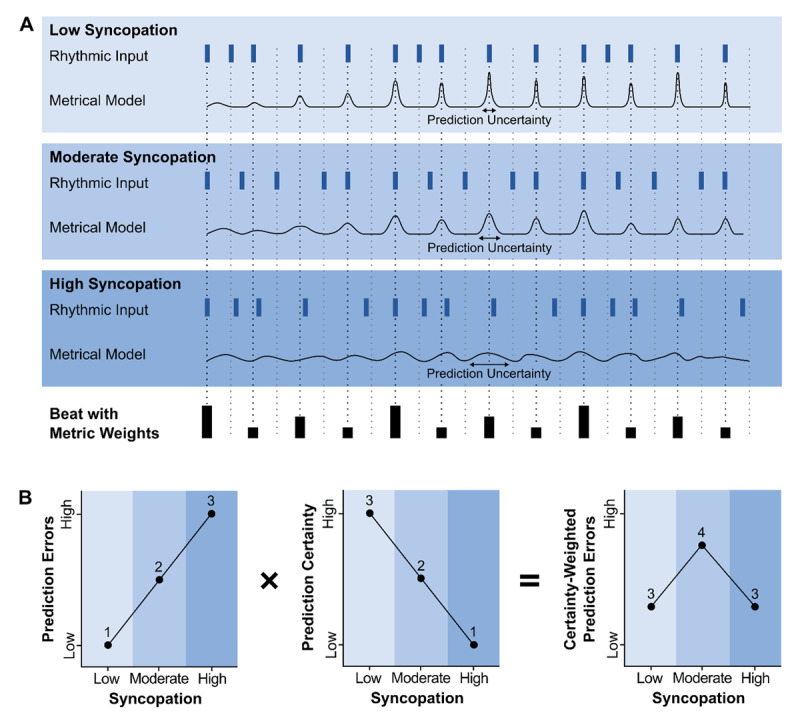
A figure with two plots depicting the predictive processing account of the pleasurable urge to move to music
Figure 1
The predictive processing account of PLUMM. A) Rhythms with three levels of syncopation lead to meter-based predictions whose uncertainty depend on both the position in the meter and the strength of the metrical model. B) Moderately syncopated rhythms maximize the number of strongly weighted prediction errors. Adapted from Stupacher et al., 2022.
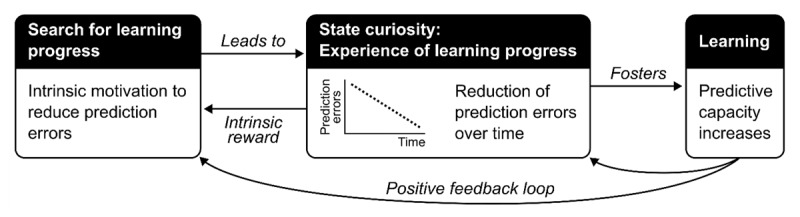
A figure using boxes and arrows to depict the learning progress hypothesis
Figure 2
The learning progress hypothesis. Humans are intrinsically motivated for learning progress, which is operationalized as the rate of prediction error minimization over time. The detection of reducible prediction errors mobilizes resources associated with state curiosity to maximally capitalize on the learning potential. Learning progress is registered as pleasure and enhances memory encoding, which in turn facilitates further learning progress, setting up a feedback loop. Adapted from Oudeyer et al., 2016.
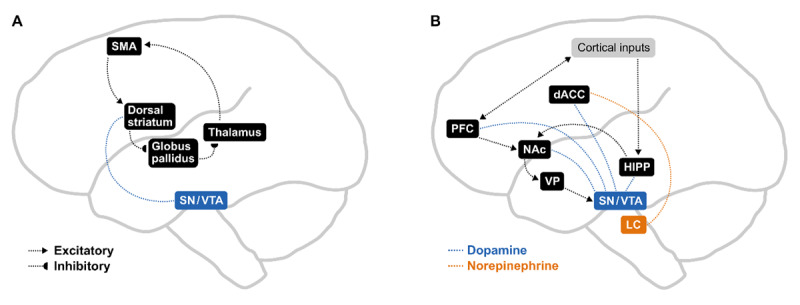
A figure with two cartoon brains showing the regions underlying the metrical model and learning progress
Figure 3
A neuroscientific model of the LP account of PLUMM. A) Phasic pulses of nigrostriatal dopamine into the dorsal striatum initiate cycles of meter-based timing mechanisms via excitatory and inhibitory signals within the motor corticostriatal loop. Adapted from Cannon & Patel, 2020. B) The detection of reducible prediction errors relative to the metrical model leads to mesolimbic dopamine signals to the hippocampus to enhance memory, and to the dACC which in turn activates the LC to release norepinephrine, leading to the mobilization of attentional resources. The PFC updates metrical models along with higher level schemas. Adapted from Ripollés et al., 2016 and Silvetti et al., 2018. dACC, dorsal anterior cingulate cortex; Hipp, hippocampus; LC, locus coeruleus; NAc, nucleus accumbens; PFC, prefrontal cortex; SMA, supplementary motor area; SN/VTA, substantia nigra/ventral tegmental area; VP, ventral pallidum.

Similar articles

Cited by

References

    1. Abuhamdeh, S., & Csikszentmihalyi, M. (2012). The Importance of Challenge for the Enjoyment of Intrinsically Motivated, Goal-Directed Activities. Personality and Social Psychology Bulletin, 38(3), 317–330. DOI: 10.1177/0146167211427147 - DOI - PubMed
    1. Alexander, G., DeLong, M. R., & Strick, P. L. (1986). Parallel Organization of Functionally Segregated Circuits Linking Basal Ganglia and Cortex. Annual Review of Neuroscience, 9(1), 357–381. DOI: 10.1146/annurev.neuro.9.1.357 - DOI - PubMed
    1. Barto, A. G., & Şimşek, Ö. (2005). Intrinsic motivation for reinforcement learning systems. Proceedings of the Thirteenth Yale Workshop on Adaptive and Learning Systems, 113–118.
    1. Belfi, A. M., Kasdan, A., Rowland, J., Vessel, E. A., Starr, G. G., & Poeppel, D. (2018). Rapid Timing of Musical Aesthetic Judgments. Journal of Experimental Psychology: General, 147(10), 1531–1543. DOI: 10.1037/xge0000474.supp - DOI - PubMed
    1. Belfi, A. M., & Loui, P. (2020). Musical anhedonia and rewards of music listening: current advances and a proposed model. Annals of the New York Academy of Sciences, 1464(1), 99–114. DOI: 10.1111/nyas.14241 - DOI - PubMed

LinkOut - more resources