


Tapping your inner psychotherapist: The effects of a growth writing for military cadets on mental health
- PMID: 37722833
- PMCID: PMC11622626
- DOI: 10.1080/08995605.2023.2259780
Tapping your inner psychotherapist: The effects of a growth writing for military cadets on mental health
Abstract
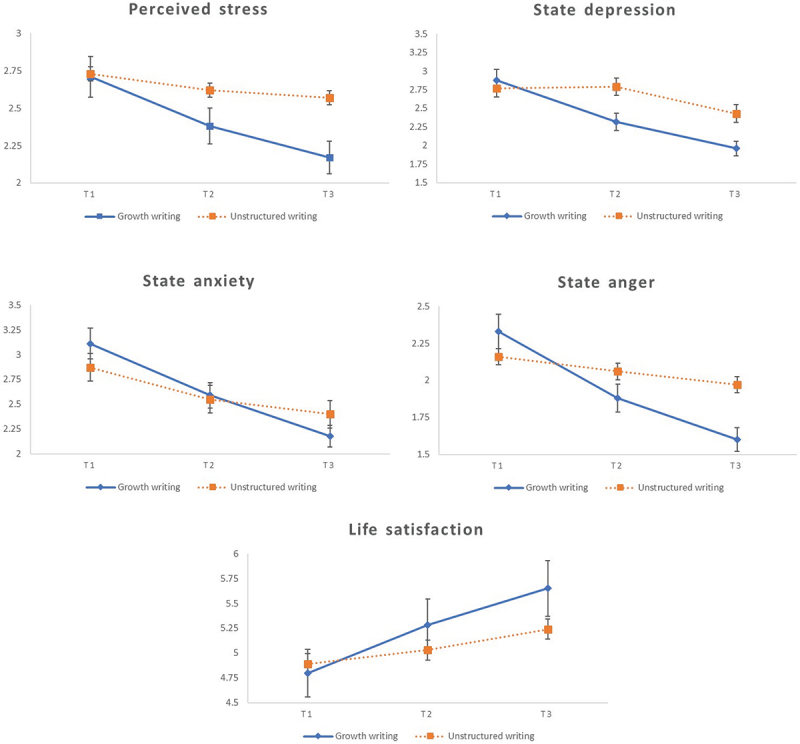
Although growth writing has been verified to be effective in addressing psychological maladjustment through sequential shifts in emotion-processing strategies, there have been no further findings extending these preliminary observations to applications in the military field. This study aimed to investigate whether growth writing can serve as a novel intervention in enhancing the mental health of cadets. A total of 103 cadets (Sex ratio: 68.9% male, Age: 20.602.16 years) participated in an 8-week writing program and were randomly assigned to either the growth writing group or the unstructured writing group. The growth writing group wrote structured narratives on the themes of exposure, devaluation, and benefit-finding for 30 minutes per week, focusing on the most stressful event in cadet lives. The unstructured writing group freely wrote about their feelings and thoughts regarding the most stressful event in cadet lives for 30 minutes every week. We found that growth writing resulted in greater benefits compared to unstructured writing, as indicated by a more significant reduction in stress, depression, anxiety, and anger, as well as a stronger increase in life satisfaction at the five-week follow-up. Moreover, significant changes were observed in stress, depression, anxiety, anger, and life satisfaction over the three assessment points among cadets in the growth writing group. Overall, the current findings highlight that the growth writing process can serve as a valuable form of self-psychotherapy for cadets who will face challenging battlefields in the future.
Keywords: Growth writing; cadet; mental health; military; stress.
Conflict of interest statement
No potential conflict of interest was reported by the author(s).
Figures

References
-
- Atwater, L. E., Dionne, S. D., Avolio, B., Camobreco, J. E., & Lau, A. W. (1999). A longitudinal study of the leadership development process: Individual differences predicting leader effectiveness. Human Relations, 52(12), 1543–1562. 10.1177/001872679905201203 - DOI
-
- Bolton, G. (2004). Introduction: Writing cure. In Bolton G., Howlett S., Lago C., & Wright J. K. (Eds.), Writing cures: An introductory handbook of writing in counseling and psychotherapy (pp. 1–3). Brunner-Routledge.
-
- Bryant, R. A., Moulds, M. L., Guthrie, R. M., Dang, S. T., & Nixon, R. D. (2003). Imaginal exposure alone and imaginal exposure with cognitive restructuring in treatment of posttraumatic stress disorder. Journal of Consulting and Clinical Psychology, 71(4), 706–712. 10.1037/0022-006X.71.4.706 - DOI - PubMed
-
- Burt, M. R., & Katz, B. L. (1987). Dimensions of recovery from rape focus on growth outcomes. Journal of Interpersonal Violence, 2(1), 57–81. 10.1177/088626087002001004 - DOI
Publication types
MeSH terms
LinkOut - more resources
Full Text Sources
Medical
