. 2023 Sep 18;14(1):5284.
doi: 10.1038/s41467-023-40871-0.

Chemical evolution of primordial salts and organic sulfur molecules in the asteroid 162173 Ryugu

Collaborators, Affiliations

Chemical evolution of primordial salts and organic sulfur molecules in the asteroid 162173 Ryugu

Toshihiro Yoshimura et al. Nat Commun. .

Abstract

Samples from the carbonaceous asteroid (162173) Ryugu provide information on the chemical evolution of organic molecules in the early solar system. Here we show the element partitioning of the major component ions by sequential extractions of salts, carbonates, and phyllosilicate-bearing fractions to reveal primordial brine composition of the primitive asteroid. Sodium is the dominant electrolyte of the salt fraction extract. Anions and NH4+ are more abundant in the salt fraction than in the carbonate and phyllosilicate fractions, with molar concentrations in the order SO42- > Cl- > S2O32- > NO3- > NH4+. The salt fraction extracts contain anionic soluble sulfur-bearing species such as Sn-polythionic acids (n < 6), Cn-alkylsulfonates, alkylthiosulfonates, hydroxyalkylsulfonates, and hydroxyalkylthiosulfonates (n < 7). The sulfur-bearing soluble compounds may have driven the molecular evolution of prebiotic organic material transforming simple organic molecules into hydrophilic, amphiphilic, and refractory S allotropes.


Conflict of interest statement

The authors declare no competing interests.

Figures
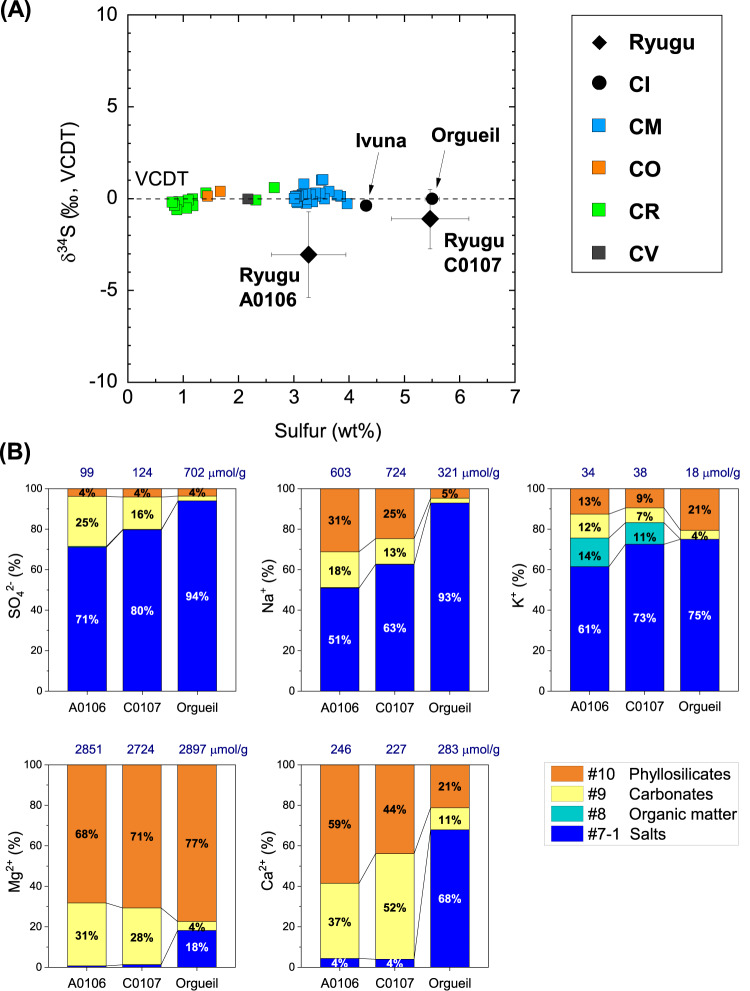
Fig. 1
Fig. 1. Element compositions of the Ryugu samples.
A Total sulfur content (wt%) and isotopic profiles of the Ryugu samples (A0106, C0107) and of representative carbonaceous groups (CI, CM, CO, CR, and CV). Sulfur (S, wt%) and δ34S (‰ vs. VCDT) values are from the literature, , and references therein. Error bars are one standard deviation (1 SD) values of multiple particles. B Relative amounts of sulfate, sodium, potassium, magnesium, and calcium in sequential solvent extracts of the samples collected at the first touchdown site (A0106) and the second touchdown site (C0107) on the asteroid Ryugu (Supplementary Fig. 1), and in a sample from Orgueil (values less than 3% were omitted). C0107 may contain subsurface samples from ejecta associated with the artificially made impact crater. We used fine-grained samples and carried out the sequential solvent extraction in a clean room (Supplementary Fig. 1). We measured evaporitic salts (via #7-1 hot water extraction, see IDs in Supplementary Fig. 1 and Naraoka et al.); ions bound to soluble organic matter (via #8 dichloromethane and methanol, DCM+MeOH); exchangeable ions and highly soluble minerals such as carbonates (via #9 formic acid, HCOOH); and clays and residual soluble minerals (via #10 hydrochloric acid, HCl). Navy numbers are the sum of extractable solute contents for each solute. Data are provided as a Source Data file.
Fig. 2
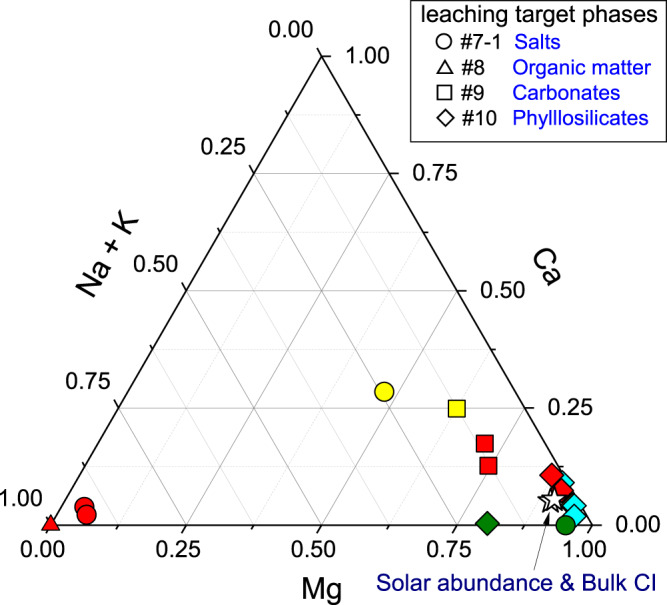
Fig. 2. Ternary diagram illustrating the molar proportions of Mg, Ca, and Na + K in the sequential extracts.
Samples include Ryugu A0106 and C0107 (red), Orgueil (yellow), Tarda, Aguas Zarcas, Jbilet Winselwan (blue), and serpentine (olive), with the bulk compositions of CI chondrite and solar abundance (stars) also plotted for ref. . The types of solvents and the main target phases of the leaching experiments are documented in Supplementary Fig. 1B. Data are provided as a Source Data file.
Fig. 3
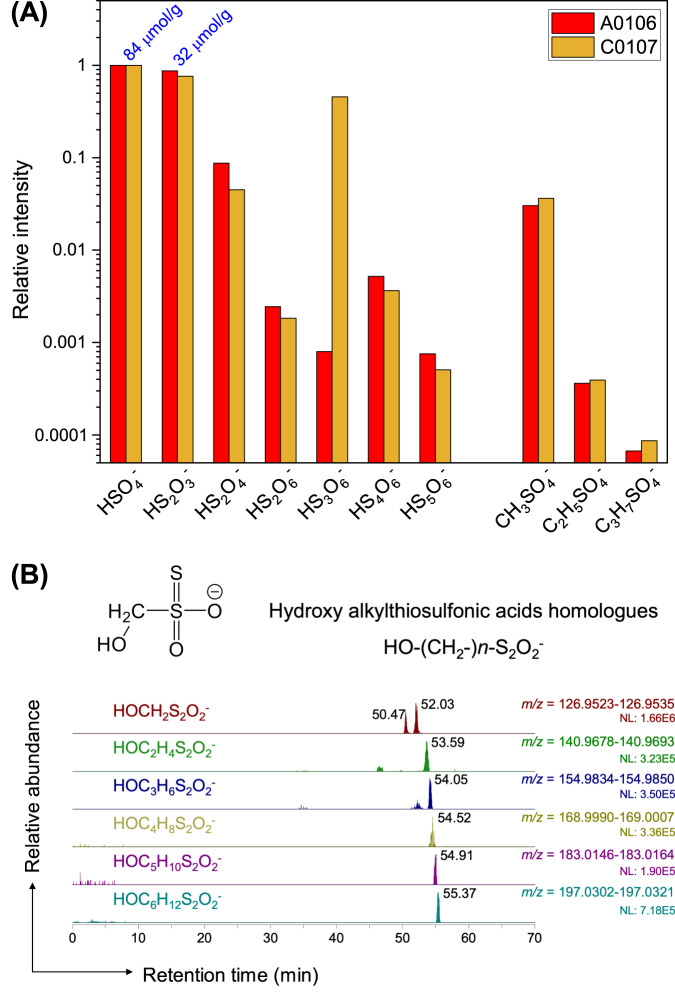
Fig. 3. Anionic soluble sulfur-bearing species.
A Relative intensity of major anion species detected by ion chromatography / Orbitrap mass spectrometry (IC/Orbitrap MS) of the water extracts of A0106 and C0107 (#5, Supplementary Fig. 1B). The intensities are normalized to sulfuric acids and shown on a logarithmic scale. Average sulfate and thiosulfate concentrations of A0106 and C0107 quantified by conductivity detection of ion chromatography analysis are shown above the bars (blue). B Representative nano-flow LC/Orbitrap MS chromatograms of water-extractable (#5) organic sulfur homologs. Here we show hydroxy alkylthiosulfonic acid HO–(CH2-)n–S2O2 obtained from Ryugu sample A0106. Other organosulfur compounds are shown in Supplementary Figs. 4 and 8. Data are provided as a Source Data file.
Fig. 4
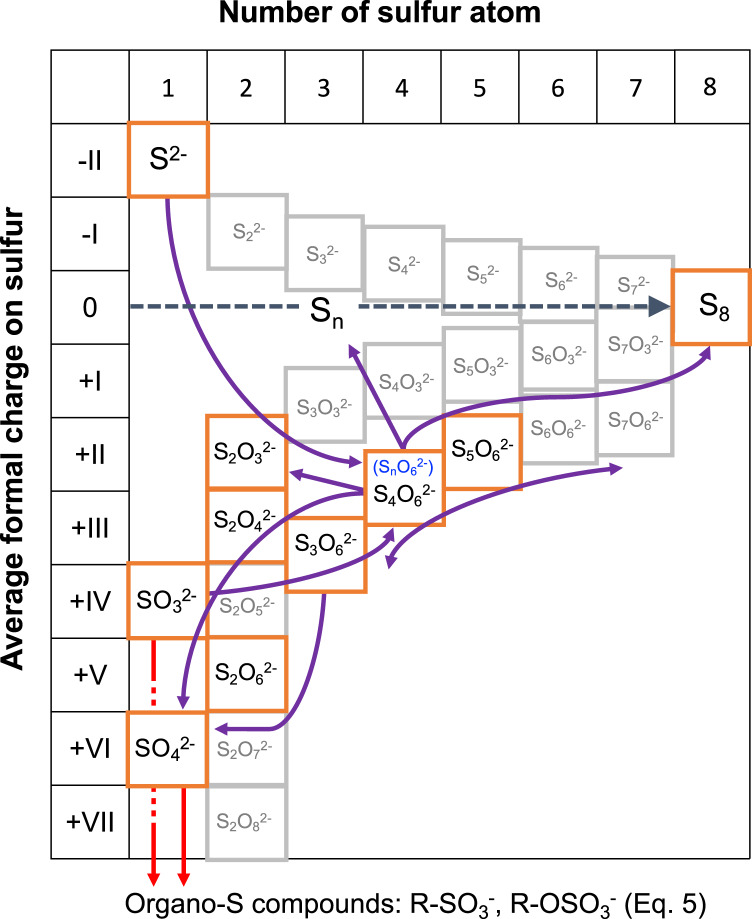
Fig. 4. Reactions along with the oxidation state of sulfur.
Sulfur species and reaction pathways described by Eqs. 1–4 (after Williamson and Rimstidt, 1992). Two dominant species of organosulfur compounds (R–SO3 and R–OSO3) were reported previously and are documented in this study. The red line shows the reaction path from inorganic ions to these sulfur-containing organics, such as esterification (Eq. 4). The purple line shows the reaction path of sulfur allotropes stabilizing to S8. Sulfur species detected by our ion chromatography and mass spectrometry analyses are shown in the orange squares. Note that organosulfur compounds with various alkyl side chains have been detected, (Fig. 3, Supplementary Fig. 8). For Eq. 1, the presence of SO2 has been suggested by spectroscopic observations, and both H2S and SO2 are generally involved in astrochemical models. See also Supplementary Tables 1, 3 and their references for sulfur abundance in the Ryugu sample.
Fig. 5
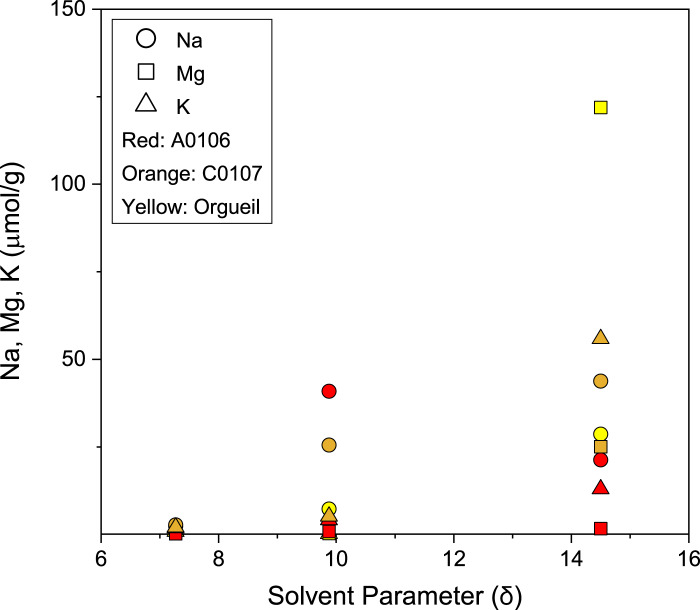
Fig. 5. Sodium (Na), magnesium (Mg), and potassium (K) concentrations in sequential organic solvent extracts vs. solvent solubility parameters (δ).
The solutes were extracted sequentially from lower to higher δ values; hexane (δ = 7.3), dichloromethane (δ = 9.9), and methanol (δ = 14.5). For reference, the δ value of water is 23.5. Data are provided as a Source Data file.

References

    1. Tachibana S, et al. Pebbles and sand on asteroid (162173) Ryugu: In situ observation and particles returned to Earth. Science. 2022;375:1011–1016. - PubMed
    1. Yada T, et al. Preliminary analysis of the Hayabusa2 samples returned from C-type asteroid Ryugu. Nat. Astron. 2022;6:214–220.
    1. Pilorget C, et al. First compositional analysis of Ryugu samples by the MicrOmega hyperspectral microscope. Nat. Astron. 2022;6:221–225.
    1. Naraoka H, et al. Soluble organic molecules in samples of the carbonaceous asteroid (162173) Ryugu. Science. 2023;379:abn9033. - PubMed
    1. Ehrenfreund P, Glavin DP, Botta O, Cooper G, Bada JL. Extraterrestrial amino acids in Orgueil and Ivuna: Tracing the parent body of CI type carbonaceous chondrites. Proc. Natl. Acad. Sci. USA. 2001;98:2138–2141. - PMC - PubMed