. 2023 Sep 18;14(1):5533.
doi: 10.1038/s41467-023-41008-z.

Ecophysiology and interactions of a taurine-respiring bacterium in the mouse gut

Affiliations

Ecophysiology and interactions of a taurine-respiring bacterium in the mouse gut

Huimin Ye et al. Nat Commun. .

Abstract

Taurine-respiring gut bacteria produce H2S with ambivalent impact on host health. We report the isolation and ecophysiological characterization of a taurine-respiring mouse gut bacterium. Taurinivorans muris strain LT0009 represents a new widespread species that differs from the human gut sulfidogen Bilophila wadsworthia in its sulfur metabolism pathways and host distribution. T. muris specializes in taurine respiration in vivo, seemingly unaffected by mouse diet and genotype, but is dependent on other bacteria for release of taurine from bile acids. Colonization of T. muris in gnotobiotic mice increased deconjugation of taurine-conjugated bile acids and transcriptional activity of a sulfur metabolism gene-encoding prophage in other commensals, and slightly decreased the abundance of Salmonella enterica, which showed reduced expression of galactonate catabolism genes. Re-analysis of metagenome data from a previous study further suggested that T. muris can contribute to protection against pathogens by the commensal mouse gut microbiota. Together, we show the realized physiological niche of a key murine gut sulfidogen and its interactions with selected gut microbiota members.


Conflict of interest statement

The authors declare no competing interests.

Figures
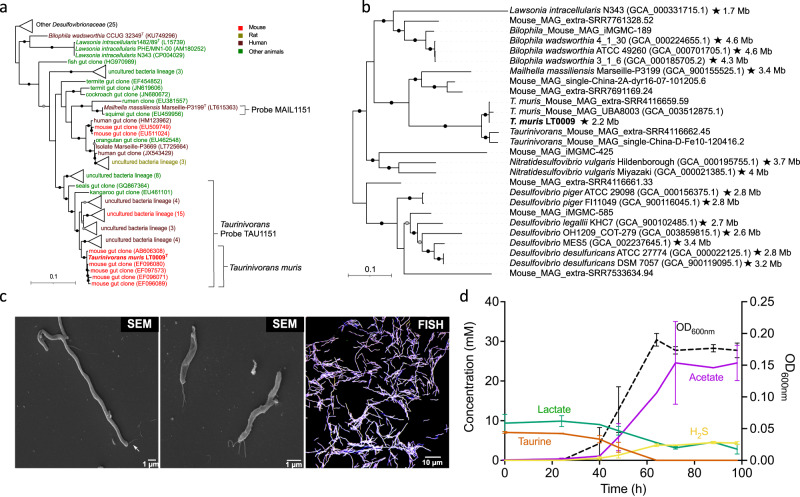
Fig. 1
Fig. 1. Phylogeny and morphology of the mouse gut-derived taurine-respiring strain LT0009 that represents the new genus/species Taurinivorans muris in the family Desulfovibrionaceae.
a 16 S rRNA gene tree and FISH probe coverage. Maximum likelihood branch supports (1000 resamplings) equal to or greater than 95% and 80% are indicated by black and gray circles, respectively. The scale bar indicates 0.1 estimated substitutions per residue. Accession numbers are shown in parentheses. Strain LT0009 is shown in bold and type strains are marked with a superscript ‘T’. Sequence sources are indicated with different colors (Supplementary Data 2). Sequences were assigned to Taurinivorans and Taurinivorans muris based on the genus-level similarity cutoff of 94.5% and species-level similarity cutoff of 98.7%, respectively. The perfect-match coverage of probes TAU1151 for Taurinivorans and MAIL1151 for Mailhella is indicated. b Phylogenomic tree. Ultrafast bootstrap support values equal to or greater than 95% and 80% for the maximum likelihood tree are indicated with black and gray circles, respectively. Accession numbers are shown in parentheses. Strain LT0009 is shown in bold. Strains with complete genomes (genome size is indicated) are marked with a star. Genomes were assigned to Taurinivorans based on the genus-level AAI cutoff value of 63.4%. The scale bar indicates 0.1 estimated substitutions per residue. c Representative morphology of LT0009 cells in pure culture (n = 3 independent cultures). SEM: Scanning electron microscopy images of cells of varying lengths. White arrows indicate the flagella. FISH: Cells hybridized with Cy3-labeled probe TAU1151 and Fluos-labeled probe EUB338mix and counterstained by DAPI. d Growth of strain LT0009 in modified Desulfovibrio medium confirmed complete utilization of taurine as electron acceptor concomitant with nearly stoichiometric production of sulfide. Electron donors L-lactate and pyruvate were provided in excess, and their utilization also contributed to acetate formation. Pyruvate in the medium and ammonia released from the deamination of taurine were not analyzed in this experiment. Lines represent averages of measures in triplicate cultures. Error bars represent one standard deviation (n = 3 biologically independent cultures). Source data are provided as a Source Data file.
Fig. 2
Fig. 2. Sulfur-based energy metabolism of Taurinivorans muris LT0009.
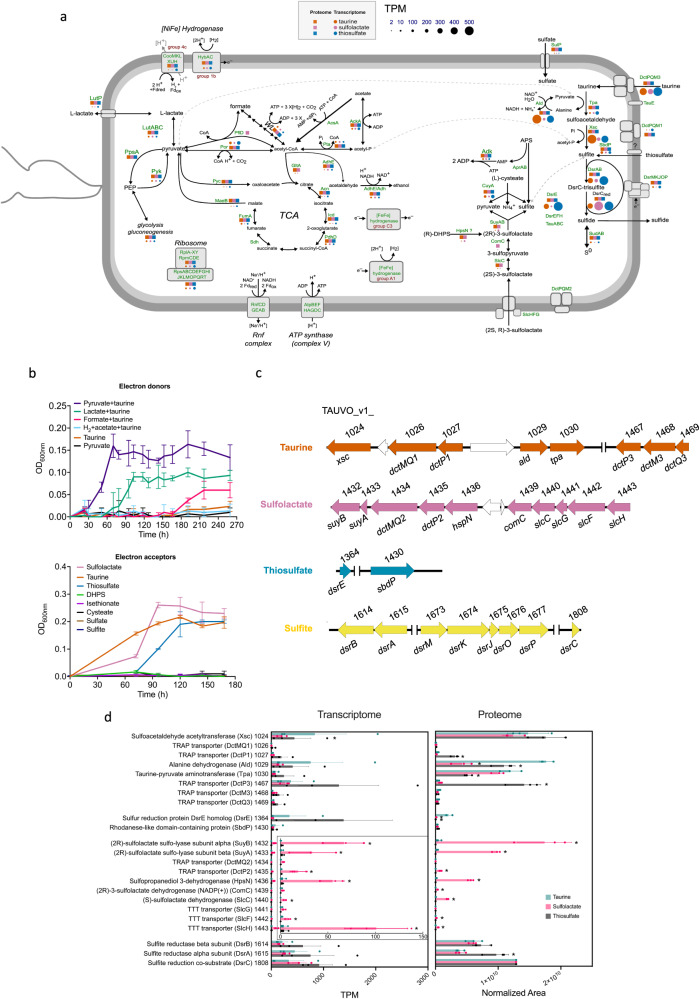
a Cell cartoon of the central sulfur and energy metabolism of LT0009 as determined by genome, transcriptome, and proteome analyses. Genes/proteins detected in the transcriptome and proteome of LT0009 grown with taurine, sulfolactate, or thiosulfate as electron acceptor are shown by colored circles and squares, respectively. Circle size indicates gene transcription level normalized as TPM. Proteins of all transcribed genes were also detected in the proteome, with the exception of AprAB, TauA (TAU_v1_0027, TAU_v1_1344), TauB, TauC, TauE, DctMQ2, SlcG, DsrEFH, AscA, two [FeFe] hydrogenases (TAU_v1_1126, TAU_v1_1901), cytochrome c and Sdh. Protein complexes (e.g., Rnf, SlcFGH, DctPMQ2, Atp) are not shown with transcriptome and proteome data because at least one gene/protein of the complex units was not detected. The gene annotations are listed in Supplementary Data 7. b Anaerobic growth tests of strain LT0009 with various substrates (n = 3 biologically independent cultures). Electron donors: All substrates were added at 10 mmol/l concentration, except acetate (20 mmol/l), which was added as carbon source together with H2. Electron acceptors: The different sulfur compounds were added at 10 mmol/l concentration together with pyruvate, lactate, and 1,4-naphthoquinone. OD600: optical density at 600 nm. c Organization of sulfur metabolism genes in the LT0009 genome. Numbers show the RefSeq locus tag with the prefix TAUVO_v1. d Comparative transcriptome and proteome analysis of LT0009 grown with lactate and taurine, sulfolactate, or thiosulfate as electron acceptor. Numbers following protein names refer to RefSeq locus tag numbers (prefix TAUVO_v1). Protein expression was normalized to DsrC for each growth condition. Bars represent averages and error bars represent one standard deviation (n = 3 biologically independent cultures). Asterisk indicates significant (p < 0.05, exact p values are provided in Supplementary Data 1) differences in gene transcription/protein expression compared to growth with taurine (5% false discovery rate, DESeq2 Wald test). TCA, tricarboxylic acid cycle; WL, Wood-Ljungdahl pathway; PEP, phosphoenolpyruvate; DHPS, 2,3-dihydroxypropane-1-sulfonate; TPM, transcripts per million. Source data are provided as a Source Data file.
Fig. 3
Fig. 3. Taurinivorans muris and Bilophila wadsworthia have distinct host distribution patterns.
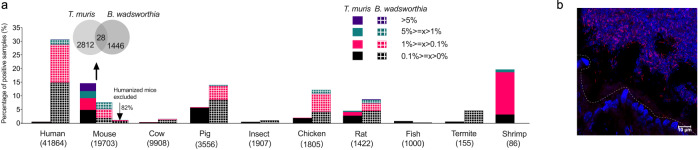
a Occurrence and prevalence of Taurinivorans muris- and Bilophila wadsworthia-related sequences in 16 S rRNA gene amplicon datasets of human and animal guts. T. muris- and B. wadsworthia-like sequences at 97% similarity cutoff are expressed as percentages of positive samples in each host (the numbers of samples used for the analysis are shown in parenthesis) and different colors indicate percentages of samples positive for T. muris and B. wadsworthia at different relative abundance ranges. Hosts with less than 20 amplicon samples are not shown. T. muris- and B. wadsworthia-related sequences co-occur in only 28 mouse gut samples as shown by the Venn diagram. For comparison, the abundance of B. wadsworthia-positive mouse gut samples is also shown after removal of data from mice that were ‘humanized’ by receiving human feces transplants or human strain consortia. b Visualization of Taurinivorans in a colon tissue section of a mouse (n = 1) fed a polysaccharide- and fiber-deficient diet by FISH. TAU1151-Cy3-labeled Taurinivorans cells appear in pink and the remaining bacterial cells and tissue in blue due to DAPI-staining. The dashed line indicates the border between epithelial cells and the gut lumen. Source data are provided as a Source Data file.
Fig. 4
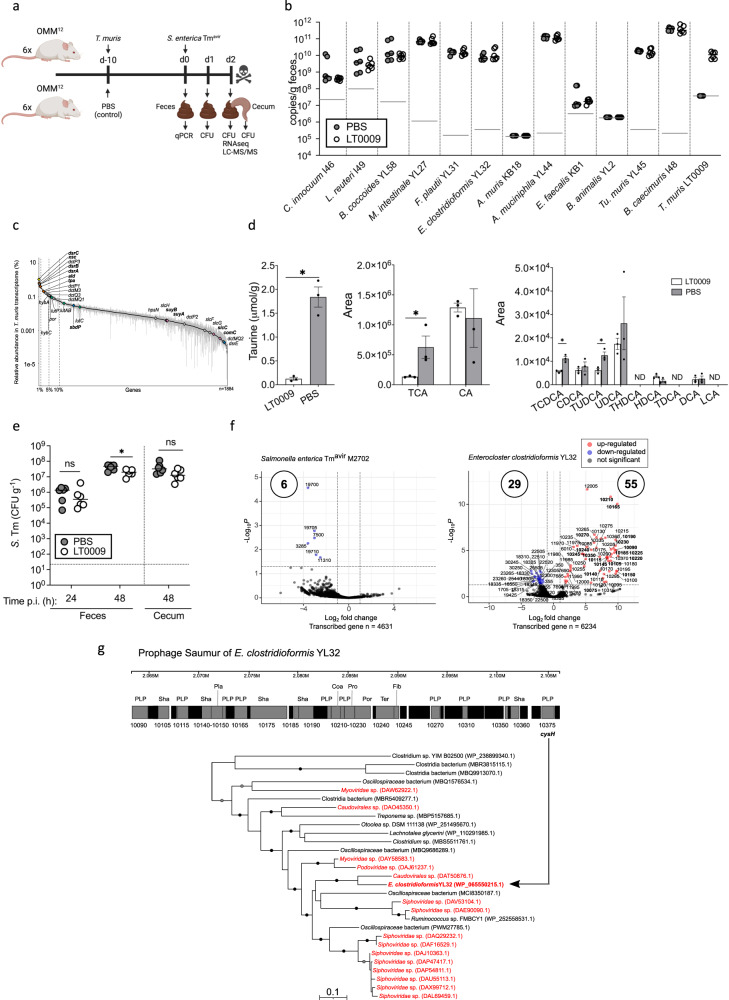
Fig. 4. Taurinivorans muris mainly respires taurine released from taurine-conjugated bile acids by other bacteria and slightly enhances colonization resistance against Salmonella enterica in a gnotobiotic mouse model.
a Schematic outline of the gnotobiotic mouse experiment. Created with Biorender.com. Mice stably colonized with the 12-strain Oligo-Mouse-Microbiota (OMM12) were inoculated with T. muris LT0009 (n = 6 mice) or sterile phosphate-buffered saline (PBS) as control (n = 6 mice) and, after 10 days, orally and rectally infected with S. enterica Tmavir M2702. Mice were sacrificed two days post infection (p.i.). Fecal samples were used for strain-specific 16 S rRNA gene-targeted quantitative PCR (qPCR). Fecal and cecal samples at 24 h and 48 h p.i. were used to analyze colony forming units (CFU) of S. enterica Tm. Fecal samples at 48 h p.i. were used for metatranscriptomics (RNAseq) and taurine and bile acids quantification (LC-MS/MS). b Absolute abundances (16 S rRNA gene copy numbers per gram feces) of each OMM12 strain and strain LT0009 on day 10 in feces of mice with and without LT0009 (PBS). Small horizontal lines indicate median values. Gray horizontal lines indicate the detection limit of each strain-specific qPCR assay. c Ranked relative transcript abundance of LT0009 genes in OMM12 mice fecal metatranscriptomes. Each point is the mean relative abundance of a gene and error bars correspond to the 95% confidence interval of the mean (n = 3 mice). The total number of transcribed LT0009 genes is shown (n = 1884). Genes for taurine (tpa, xsc, ald), sulfite (dsrAB, dsrC), sulfolactate (suyAB, sclC, comC) thiosulfate (sbdP, dsrE), pyruvate (por), lactate (lutABC), and hydrogen (hybA, hybC) metabolism are shown in different colors. Sulfur metabolism genes are further highlighted in bold font. Vertical dashed lines delineate the top 1%, 5%, and 10% expression rank of all 2059 protein-coding genes in the LT0009 genome. d Absolute concentration of taurine in feces of OMM12 mice treated with LT0009 (n = 3 mice) or PBS (n = 3 mice). Semi-quantitative analyses of high abundant (TCA and CA) and low abundant bile acids. Colonization of LT0009 significantly reduced the concentrations of taurine (p = 0.01), TCA (p = 0.04), TCDCA (p = 0.005), and TUDCA (p = 0.02) in the feces of OMM12 mice. THDCA, TDCA, and LCA were not detected. Mean values ± SD are plotted. *p < 0.05, Student’s t test, two-sided. CA, cholic acid; CDCA, chenodeoxycholic acid; UDCA, ursodeoxycholic acid; HDCA, hyodeoxycholic acid; DCA, deoxycholic acid; LCA, lithocholic acid; prefix T indicates taurine-conjugated bile acid species; ND, not detected. e. CFU of S. enterica Tm at 24 h and 48 h p.i. in the feces and at 48 h p.i. in the cecal content. Small horizontal lines indicate median values. The dotted horizontal line shows the CFU detection limit. The asterisk indicates significant differences (p = 0.01; student t test, two-sided) between S. enterica Tmavir CFU in mice with LT0009 and the PBS-control mice at 48 h. ns, not significant. f. Volcano plots of differential gene transcription (5% false discovery rate, DESeq2 Wald test) of S. enterica Tmavir M2702 and E. clostridioformis YL32 in OMM12 mice with (n = 3 mice) and without LT0009 (n = 3 mice). The x axis shows log-fold-change in transcription and the y axis shows the negative logarithm10-transformed adjusted p values. Blue dots show significantly downregulated genes (adjusted p value < 0.05, log2 fold change < −1) in mice with LT0009 and are labeled with locus tag numbers. Upregulated E. clostridioformis YL32 prophage genes in I5Q83_10075-10390 are highlighted in bold. g. Structure of the activated prophage gene cluster of E. clostridioformis YL32 and phylogeny of its encoded phosphoadenosine-phosphosulfate reductase (CysH). Virus- and bacteria-encoded sequences are shown in red and black, respectively. The maximum likelihood CysH tree is midpoint rooted. Ultrafast bootstrap support values equal to or >95% and 80% for the maximum likelihood tree are indicated with black and gray circles, respectively. The identity of the 61 genes in the prophage region (I5Q83_10075-10390) of E. clostridioformis YL32 as predicted by PHASTER. Genes encoding hypothetical proteins are in black and annotated genes are in gray. Numbers indicate the locus tag. PLP phage-like protein, Sha tail shaft, Pla plate protein, Coa coat protein, Pro protease, Por portal protein, Ter terminase, Fib fiber protein. Source data are provided as a Source Data file.
Fig. 5
Fig. 5. Taurinivorans muris is the dominant sulfidogen in wild-mouse-microbiota-derived wildR mice that provided H2S-mediated protection against Klebsiella pneumoniae.
Re-analysis of mouse gut metagenome and 16 S rRNA gene amplicon data from Stacy et al.. a Identity and relative abundance of dsrAB-encoding taxa in different mouse models. Relative abundance was calculated with mapped dsrA and dsrB read counts. Samples with less than ten total mapped read counts were not displayed. Each column shows a sample from an individual mouse. Taurine-treated mice: specific-pathogen-free (SPF) mice that received taurine in drinking water and showed enhanced resistance to Klebsiella pneumoniae and Citrobacter rodentium; ΔyopM mice: SPF mice that were previously infected with the attenuated strain ΔyopM of the food-borne pathogen Yersinia pseudotuberculosis and showed enhanced resistance to K. pneumoniae; SPF mice were used as control for taurine-treated and ΔyopM mice; lab mice: laboratory SPF mice; wild mice: wild-caught mice; F2 LabR mice: the second generation offspring of SPF mice whose germ-free founders received the microbiota of labR mice; F2 wildR mice: the second generation offspring of SPF mice whose germ-free founders received the microbiota of wild mice and showed enhanced resistance to K. pneumoniae. b Relative 16 S rRNA gene abundance of Desulfovibrionaceae species in the 2nd (animal. Ordinary one-way ANOVA with Holm-Sidak’s multiple comparisons test, *p < 0.05. Source data are provided as a Source Data file.
Fig. 6
Fig. 6. Sulfur energy metabolism and proposed interaction scheme of Taurinivorans muris in the mouse gut.
T. muris mainly utilizes taurine as the main electron acceptor for anaerobic respiration in the gut but is also capable of thiosulfate and sulfolactate respiration. Pyruvate, lactate, and likely hydrogen are the main electron donors of T. muris, while formate could also be used. Taurine is cleaved from host-derived taurine-conjugated bile acids by other gut bacteria via bile salt hydrolase (BSH). Thiosulfate derives from mitochondrial oxidation of H2S in the gut epithelium. T. muris produces H2S from taurine via pyruvate-dependent taurine transaminase (Tpa), sulfoacetaldehyde (SA) acetyltransferase (Xsc), and dissimilatory sulfite reductase (DsrAB). H2S can have various effects on the gut microbiota and host health. For example, excess H2S can impair mucus integrity. H2S can enhance resistance against enteropathogens by directly inhibiting enzymes in aerobically respiring Klebsiella pneumoniae. T. muris could further impact microbial interactions and intestinal metabolism by stimulating the transcriptional activity of prophages that encode auxiliary metabolic genes, such as those involved in sulfur metabolism (S-AMG). Created with Biorender.com.

References

    1. Blachier F, et al. Production of hydrogen sulfide by the intestinal microbiota and epithelial cells and consequences for the colonic and rectal mucosa. Am. J. Physiol. Gastrointest. Liver Physiol. 2021;320:G125–G135. - PubMed
    1. Blachier F, Beaumont M, Kim E. Cysteine-derived hydrogen sulfide and gut health: a matter of endogenous or bacterial origin. Curr. Opin. Clin. Nutr. Metab. Care. 2019;22:68–75. - PubMed
    1. Ijssennagger N, et al. Gut microbiota facilitates dietary heme-induced epithelial hyperproliferation by opening the mucus barrier in colon. Proc. Natl Acad. Sci. USA. 2015;112:10038–10043. - PMC - PubMed
    1. Attene-Ramos MS, Wagner ED, Rex Gaskins H, Plewa MJ. Hydrogen sulfide induces direct radical-associated DNA damage. Mol. Cancer Res. 2007;5:455–459. - PubMed
    1. Babidge W, Millard S, Roediger W. Sulfides impair short chain fatty acid beta-oxidation at acyl-CoA dehydrogenase level in colonocytes: implications for ulcerative colitis. Mol. Cell. Biochem. 1998;181:117–124. - PubMed

Publication types

LinkOut - more resources