Evolution of a functionally intact but antigenically distinct DENV fusion loop
- PMID: 37725085
- PMCID: PMC10508882
- DOI: 10.7554/eLife.87555
Evolution of a functionally intact but antigenically distinct DENV fusion loop
Abstract
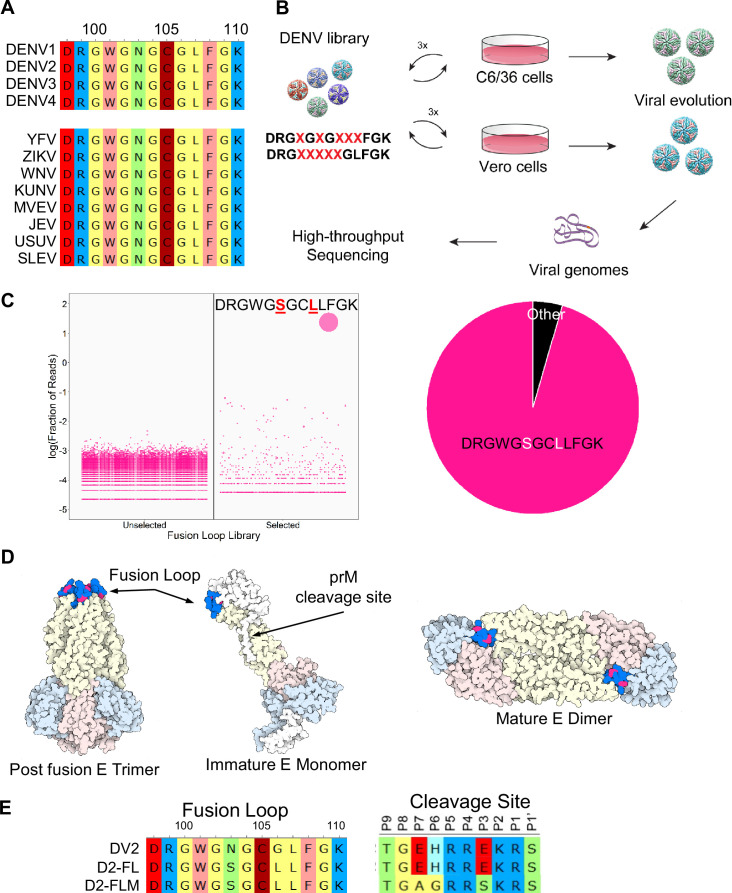
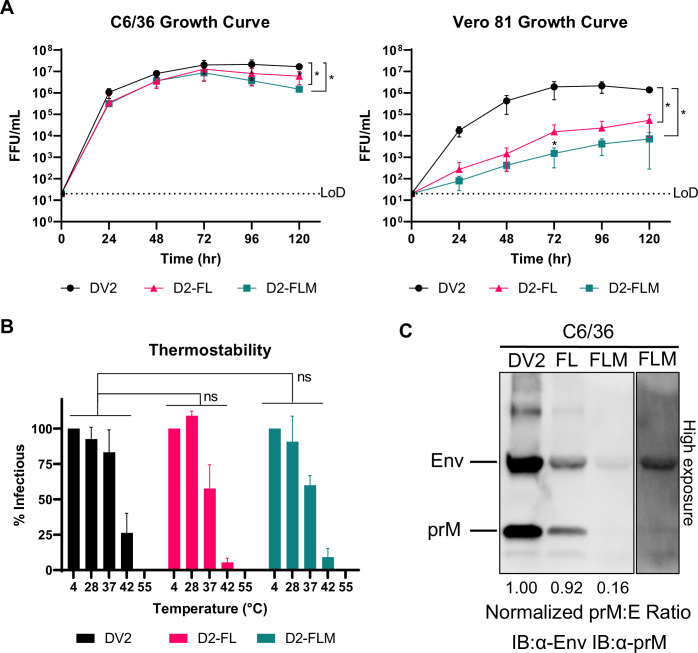
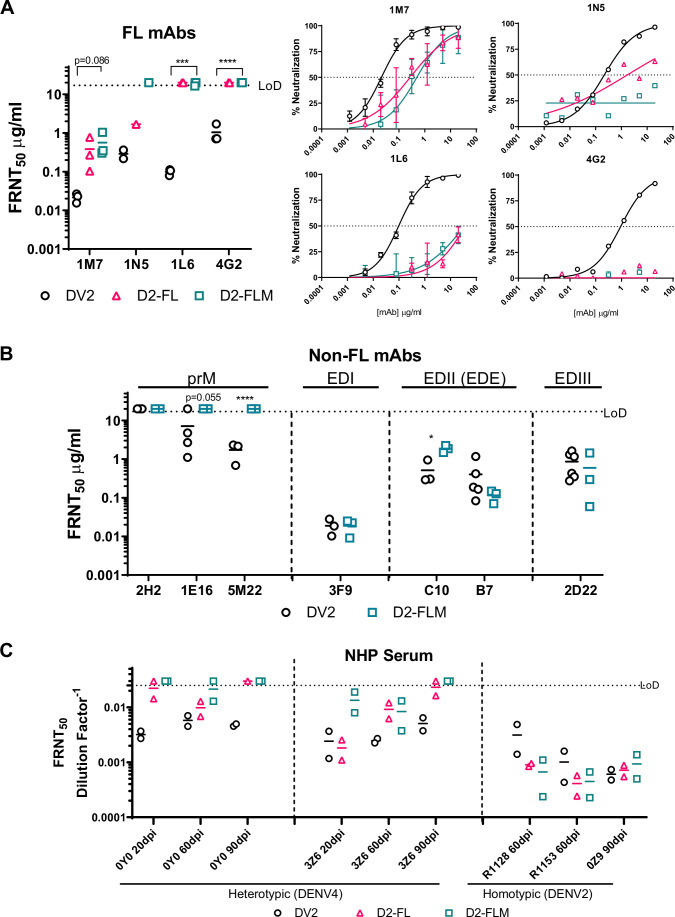
A hallmark of dengue virus (DENV) pathogenesis is the potential for antibody-dependent enhancement, which is associated with deadly DENV secondary infection, complicates the identification of correlates of protection, and negatively impacts the safety and efficacy of DENV vaccines. Antibody-dependent enhancement is linked to antibodies targeting the fusion loop (FL) motif of the envelope protein, which is completely conserved in mosquito-borne flaviviruses and required for viral entry and fusion. In the current study, we utilized saturation mutagenesis and directed evolution to engineer a functional variant with a mutated FL (D2-FL), which is not neutralized by FL-targeting monoclonal antibodies. The FL mutations were combined with our previously evolved prM cleavage site to create a mature version of D2-FL (D2-FLM), which evades both prM- and FL-Abs but retains sensitivity to other type-specific and quaternary cross-reactive (CR) Abs. CR serum from heterotypic (DENV4)-infected non-human primates (NHP) showed lower neutralization titers against D2-FL and D2-FLM than isogenic wildtype DENV2 while similar neutralization titers were observed in serum from homotypic (DENV2)-infected NHP. We propose D2-FL and D2-FLM as valuable tools to delineate CR Ab subtypes in serum as well as an exciting platform for safer live-attenuated DENV vaccines suitable for naïve individuals and children.
Keywords: dengue virus; evolution; fusion loop; infectious disease; microbiology; saturation mutagenesis; serum; vaccine; viruses.
© 2023, Meganck et al.
Conflict of interest statement
RM inventor on a patent application (#63/320,922) filed on the subject matter of the manuscript, DZ, SD, LS, YD, DT, LW, AD No competing interests declared, RB member of the advisory board of VaxArt and Invivyd and has collaborations with Takeda, Pfizer, Moderna, Ridgeback Biosciences, Gilead, and Eli Lily. Inventor on a patent application (#63/320,922) filed on the subject matter of the manuscript, LT Inventor on a patent application (#63/320,922) filed on the subject matter of the manuscript
Figures
Update of
-
Evolution of a Functionally Intact but Antigenically Distinct DENV Fusion Loop.bioRxiv [Preprint]. 2023 Aug 4:2023.03.22.533803. doi: 10.1101/2023.03.22.533803. bioRxiv. 2023. Update in: Elife. 2023 Sep 19;12:RP87555. doi: 10.7554/eLife.87555. PMID: 37034784 Free PMC article. Updated. Preprint.
References
-
- Andrade DV, Warnes C, Young E, Katzelnick LC, Balmaseda A, de Silva AM, Baric RS, Harris E. Tracking the polyclonal neutralizing antibody response to a dengue virus serotype 1 type-specific epitope across two populations in Asia and the Americas. Scientific Reports. 2019;9:16258. doi: 10.1038/s41598-019-52511-z. - DOI - PMC - PubMed
-
- Barba-Spaeth G, Dejnirattisai W, Rouvinski A, Vaney M-C, Medits I, Sharma A, Simon-Lorière E, Sakuntabhai A, Cao-Lormeau V-M, Haouz A, England P, Stiasny K, Mongkolsapaya J, Heinz FX, Screaton GR, Rey FA. Structural basis of potent Zika-dengue virus antibody cross-neutralization. Nature. 2016;536:48–53. doi: 10.1038/nature18938. - DOI - PubMed
-
- Beltramello M, Williams KL, Simmons CP, Macagno A, Simonelli L, Quyen NTH, Sukupolvi-Petty S, Navarro-Sanchez E, Young PR, de Silva AM, Rey FA, Varani L, Whitehead SS, Diamond MS, Harris E, Lanzavecchia A, Sallusto F. The human immune response to Dengue virus is dominated by highly cross-reactive antibodies endowed with neutralizing and enhancing activity. Cell Host & Microbe. 2010;8:271–283. doi: 10.1016/j.chom.2010.08.007. - DOI - PMC - PubMed
Publication types
MeSH terms
Substances
Grants and funding
LinkOut - more resources
Full Text Sources
Other Literature Sources
Medical