. 2023 Aug 21:25:100575.
doi: 10.1016/j.lana.2023.100575. eCollection 2023 Sep.

Preconceptional and prenatal exposure to air pollutants and risk of gestational diabetes in the MADRES prospective pregnancy cohort study

Affiliations

Preconceptional and prenatal exposure to air pollutants and risk of gestational diabetes in the MADRES prospective pregnancy cohort study

Zhongzheng Niu et al. Lancet Reg Health Am. .

Abstract

Background: Air pollution has been associated with gestational diabetes mellitus (GDM). We aim to investigate susceptible windows of air pollution exposure and factors determining population vulnerability.

Methods: We ascertained GDM status in the prospective Maternal and Developmental Risks from Environmental and Social Stressors (MADRES) pregnancy cohort from Los Angeles, California, USA. We calculated the relative risk of GDM by exposure to ambient particulate matter (PM10; PM2.5), nitrogen dioxide (NO2), and ozone (O3) in each week from 12 weeks before to 24 weeks after conception, adjusting for potential confounders, with distributed lag models to identify susceptible exposure windows. We examined effect modification by prenatal depression, median-split pre-pregnancy BMI (ppBMI) and age.

Findings: Sixty (9.7%) participants were diagnosed with GDM among 617 participants (mean age: 28.2 years, SD: 5.9; 78.6% Hispanic, 11.8% non-Hispanic Black). GDM risk increased with exposure to PM2.5, PM10, and NO2 in a periconceptional window ranging from 5 weeks before to 5 weeks after conception: interquartile-range increases in PM2.5, PM10, and NO2 during this window were associated with increased GDM risk by 5.7% (95% CI: 4.6-6.8), 8.9% (8.1-9.6), and 15.0% (13.9-16.2), respectively. These sensitive windows generally widened, with greater effects, among those with prenatal depression, with age ≥28 years, or with ppBMI ≥27.5 kg/m2, than their counterparts.

Interpretation: Preconception and early-pregnancy are susceptible windows of air pollutants exposure that increased GDM risk. Prenatal depression, higher age, or higher ppBMI may increase one's vulnerability to air pollution-associated GDM risk.

Funding: National Institutes of Health, Environmental Protection Agency.

Keywords: Air pollution; Depression; Gestational diabetes; Pre-conception; Sensitive windows; Susceptibility.


Conflict of interest statement

The authors declare they have no actual or potential competing financial interests.

Figures
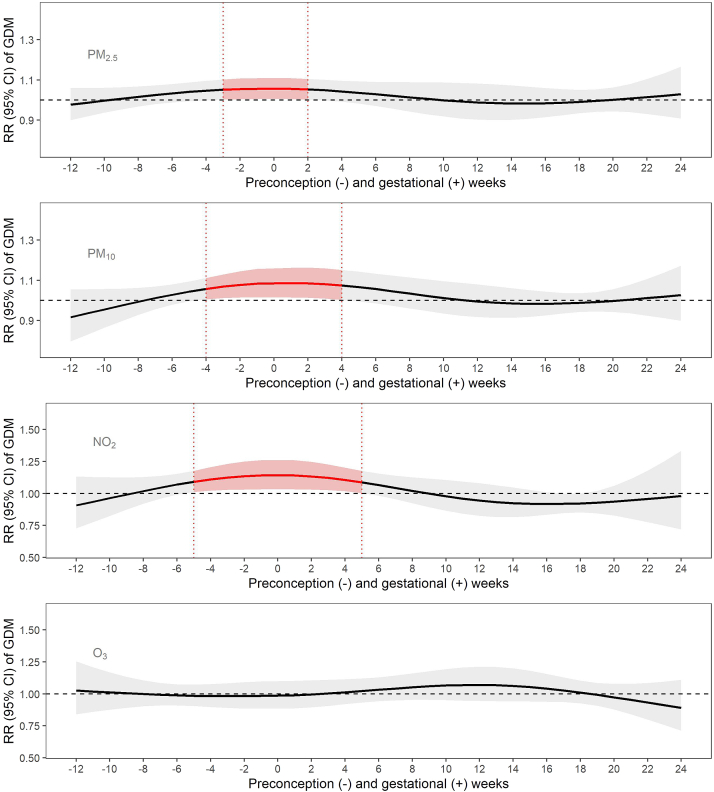
Fig. 1
Fig. 1
Associations of pre-conception and prenatal weekly exposure to PM2.5, PM10, NO2, and O3with risk of gestational diabetes among 617 pregnant women in the MADRES cohort. All results were from DLMs adjusted for year, season of conception, weekly temperature, household income, maternal age, pre-pregnancy body mass index, maternal ethnicity and nativity, parity, and enrollment timepoint. Effect estimation was based on per IQR increases in weekly air pollutant concentrations (i.e., 5 μg/m3, 12 μg/m3, 11 ppb, and 15 ppb for PM2.5, PM10, NO2, and O3 (8 hr max), respectively). Gray bands indicate 95% CI. Week 0 indicates conception.
Fig. 2
Fig. 2
Stratified analysis by prenatal depression for pre-conception and prenatal weekly exposure to PM2.5, PM10, NO2, and O3with risk of gestational diabetes. Left panels show the associations among 385 participants without prenatal depression; right panels show the associations among 179 participants with prenatal depression. Associations were adjusted for year, season of conception, weekly temperature, household income, maternal age, pre-pregnancy body mass index, maternal ethnicity and nativity, parity, and enrollment timepoint. Effect estimation was based on per IQR increases in each air pollutant (i.e., 5 μg/m3, 12 μg/m3, 11 ppb, and 15 ppb for PM2.5, and PM10, NO2, and O3, respectively). Gray bands indicate 95% CI. Week 0 indicates conception.
Fig. 3
Fig. 3
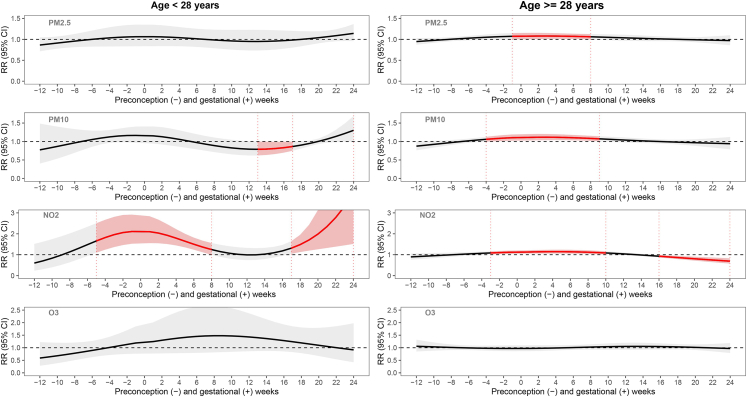
Stratified analysis by age at gestation for pre-conception and prenatal weekly exposure to PM2.5, PM10, NO2, and O3with risk of gestational diabetes. Left panels show the associations among 297 participants aged <28 years; right panels show the associations among 320 participants aged ≥28 years. Associations were adjusted for year, season of conception, weekly temperature, household income, pre-pregnancy body mass index, maternal ethnicity and nativity, parity, and enrollment timepoint. Effect estimation was based on per IQR increases in each air pollutant (i.e., 5 μg/m3, 12 μg/m3, 11 ppb, and 15 ppb for PM2.5, and PM10, NO2, and O3, respectively). Gray bands indicate 95% CI. Week 0 indicates conception.
Fig. 4
Fig. 4
Stratified analysis by pre-pregnancy BMI for pre-conception and prenatal weekly exposure to PM2.5, PM10, NO2, and O3with risk of gestational diabetes. Left panels show the associations among 306 participants aged <27.5 kg/m2; right panels show the associations among 312 participants aged ≥27.5 kg/m2. All results were from DLM adjusted for year, season of conception, weekly temperature, household income, maternal age, maternal ethnicity and nativity, parity, and enrollment timepoint. Effect estimation was based on per IQR increases in each air pollutant (i.e., 5 μg/m3, 12 μg/m3, 11 ppb, and 15 ppb for PM2.5, PM10, NO2, and O3, respectively). Week 0 indicates conception.

References

    1. Gregory E.C.W.E., Danielle M. 2022. Trends and characteristics in gestational diabetes: United States, 2016–2020; p. 71. - DOI - PubMed
    1. Kim C., Newton K.M., Knopp R.H. Gestational diabetes and the incidence of type 2 diabetes: a systematic review. Diabetes Care. 2002;25(10):1862–1868. - PubMed
    1. Farahvar S., Walfisch A., Sheiner E. Gestational diabetes risk factors and long-term consequences for both mother and offspring: a literature review. Expert Rev Endocrinol Metab. 2019;14(1):63–74. - PubMed
    1. Shah N.S., Wang M.C., Freaney P.M., et al. Trends in gestational diabetes at first live birth by race and ethnicity in the US, 2011-2019. JAMA. 2021;326(7):660–669. - PMC - PubMed
    1. Zhang H., Wang Q., He S., et al. Ambient air pollution and gestational diabetes mellitus: a review of evidence from biological mechanisms to population epidemiology. Sci Total Environ. 2020;719 - PubMed

LinkOut - more resources