Caesarean Scar Pregnancy: Single Dose of Intrasac Ultrasound-Guided Methotrexate Injection Seems to be a Safe Option for Treatment
- PMID: 37727679
- PMCID: PMC10506866
- DOI: 10.1055/a-2137-8318
Caesarean Scar Pregnancy: Single Dose of Intrasac Ultrasound-Guided Methotrexate Injection Seems to be a Safe Option for Treatment
Abstract
Objective: The purpose of the study was to assess the efficacy of local ultrasound-guided methotrexate injection in patients with caesarean section scar pregnancy, to chart the course of beta-human chorionic gonadotropin levels (HCG) after treatment, and to see if HCG levels are correlated with clinical presentation.
Methods: Between May 2018 and January 2021, data were collected retrospectively from the Early Pregnancy Unit of a tertiary hospital.
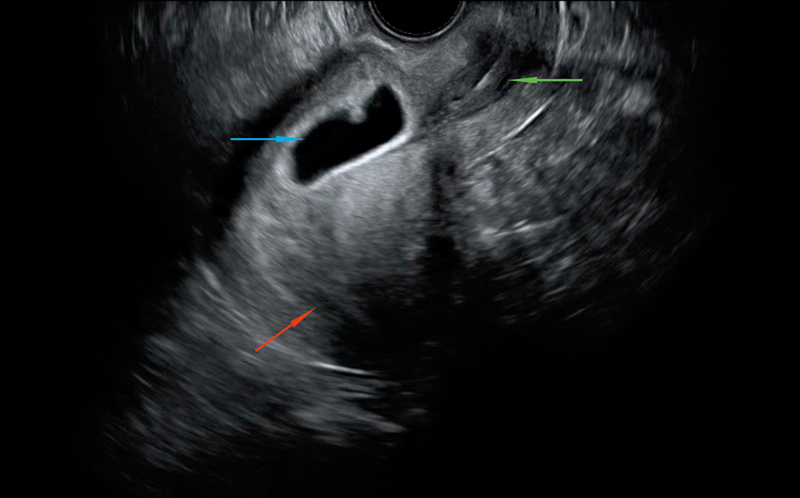
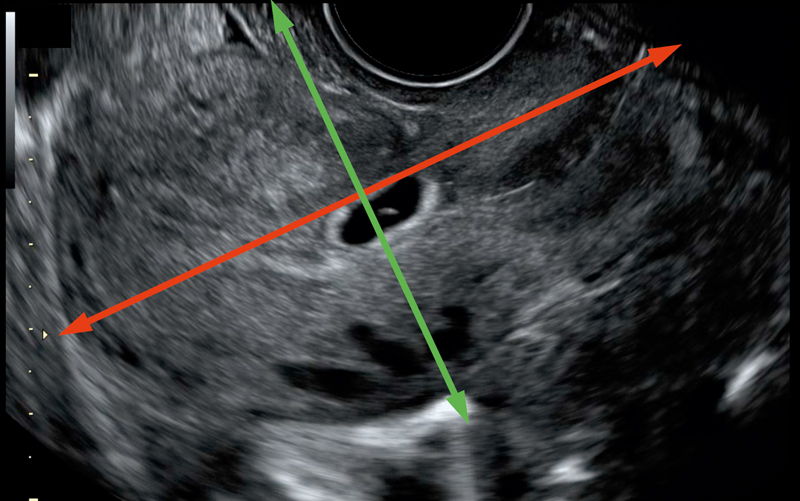
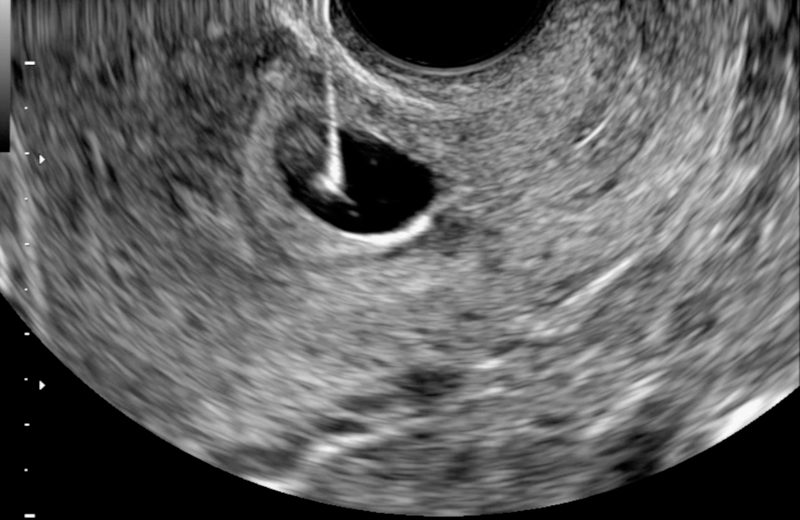
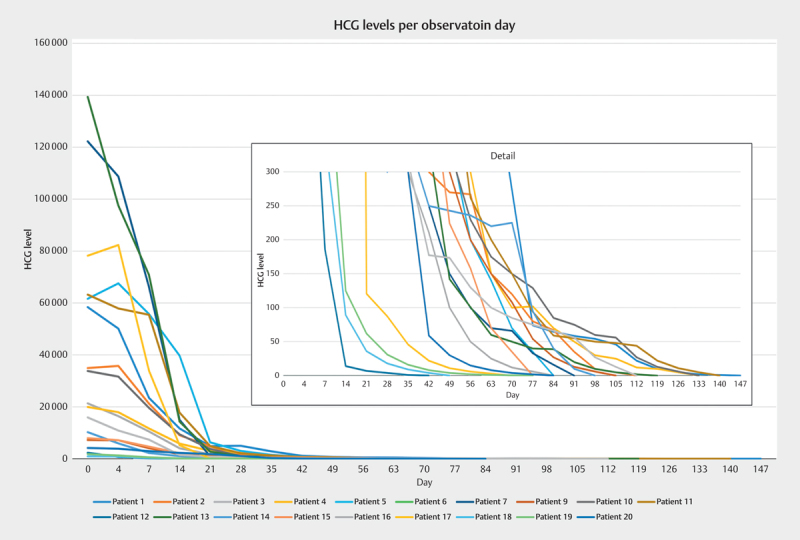
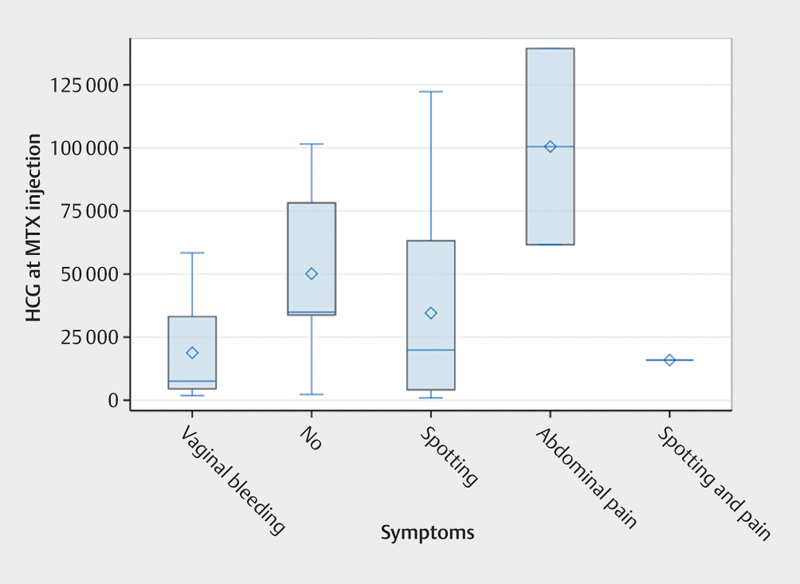
Results: Our clinic assessed 20 patients; one disputed terminating the pregnancy and was not included in the research. The remaining 19 patients, with a median age of 34 years, received intragestational sac methotrexate injection under ultrasound guidance. 7w3d was the median gestational age. These women had one to four previous caesarean sections, with a mean of 1.60±9. Patients with caesarean scar pregnancy most typically presented with spotting (42.1%), whereas 26.3% were asymptomatic. Except in cases of pain, the symptomatic women's HCG levels were lower than in the non-symptomatic women. The level of HCG in patients with pain was approximately double that of non-pain patients (p=0.2557). In our series, intragestational sac methotrexate injection was effective in 17/19 women, or 89.5% (95%CI: 75.7-100%). HCG levels were undetectable in 97.6±30 days on average (minimum: 42 days, maximum: 147 days).
Conclusion: Caesarean scar pregnancy is a rare possibly fatal condition with no consensus on the optimal treatment. An experienced Early Pregnancy Unit member performing local methotrexate injections under ultrasound guidance is a feasible and successful strategy in clinically stable patients.
Keywords: cesarean scar pregnancy; ectopic pregnancy; gynecology; methotrexate; transvaginal ultrasound.
The Author(s). This is an open access article published by Thieme under the terms of the Creative Commons Attribution-NonDerivative-NonCommercial-License, permitting copying and reproduction so long as the original work is given appropriate credit. Contents may not be used for commercial purposes, or adapted, remixed, transformed or built upon. (https://creativecommons.org/licenses/by-nc-nd/4.0/).
Conflict of interest statement
Conflict of Interest The authors declare that they have no conflict of interest.
Figures
References
-
- Larsen J V, Solomon M H. Pregnancy in a uterine scar sacculus – an unusual cause of postabortal haemorrhage. A case report. S Afr Med J. 1978;53:142–143. - PubMed
-
- WHO H. WHO statement on caesarean section rates 2015 [Available from:https://www.who.int/reproductivehealth/publications/maternal_perinatal_h... - PubMed
-
- Harb H M, Knight M, Bottomley C, Overton C, Tobias A, Gallos I D et al.Caesarean scar pregnancy in the UK: a national cohort study. Bjog. 2018;125:1663–70. - PubMed
-
- Osborn D A, Williams T R, Craig B M. Cesarean scar pregnancy: sonographic and magnetic resonance imaging findings, complications, and treatment. J Ultrasound Med. 2012;31:1449–1456. - PubMed
-
- Jurkovic D, Jauniaux E, Kurjak A, Hustin J, Campbell S, Nicolaides K H. Transvaginal color Doppler assessment of the uteroplacental circulation in early pregnancy. Obstet Gynecol. 1991;77:365–369. - PubMed
LinkOut - more resources
Full Text Sources