


[Treatment of acute myocardial infarction in Peru and its relationship with in-hospital adverse events: results from the second peruvian registry of ST-segment elevation myocardial infarction (PERSTEMI-II)]
- PMID: 37727802
- PMCID: PMC10506574
- DOI: 10.47487/apcyccv.v2i2.132
[Treatment of acute myocardial infarction in Peru and its relationship with in-hospital adverse events: results from the second peruvian registry of ST-segment elevation myocardial infarction (PERSTEMI-II)]
Abstract
Background: ST-segment elevation myocardial infarction (STEMI), is an important cause of morbidity and mortality worldwide, and myocardial reperfusion, when adequate, reduces the complications of this entity. The aim of the study was to describe the clinical and treatment characteristics of STEMI in Peru and the relationship of successful reperfusion with in-hospital adverse events.
Materials and methods: Prospective, multicenter cohort of STEMI patients attended during 2020 in public hospitals in Peru. We evaluated the clinical, therapeutic characteristics and in-hospital adverse events, also the relationship between successful reperfusion and adverse events.
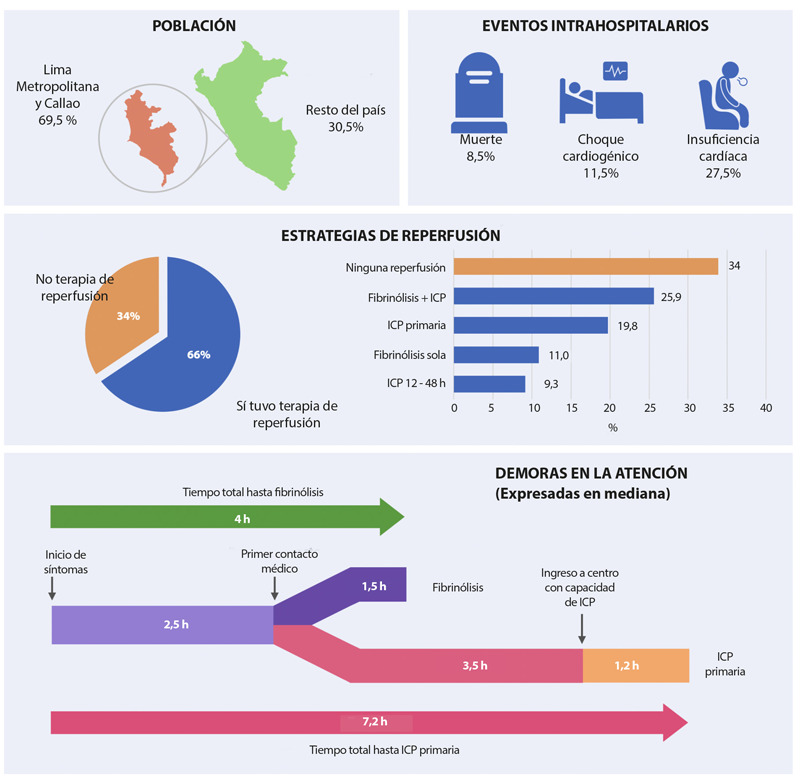
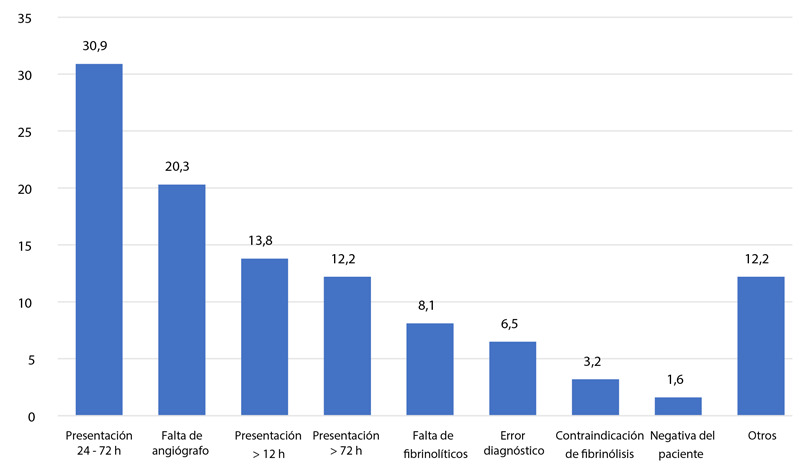
Results: A total of 374 patients were included, 69.5% in Lima and Callao. Fibrinolysis was used in 37% of cases (pharmacoinvasive 26% and fibrinolysis alone 11%), primary angioplasty with < 12 hours of evolution in 20%, late angioplasty in 9% and 34% did not access adequate reperfusion therapies, mainly due to late presentation. Ischemia time was longer in patients with primary angioplasty compared to fibrinolysis (median 7.7 hours (RIQ 5-10) and 4 hours (RIQ 2.3-5.5) respectively). Mortality was 8.5%, the incidence of post-infarction heart failure was 27.8% and of cardiogenic shock 11.5%. Successful reperfusion was associated with lower cardiovascular mortality (RR:0.28; 95%CI: 0.12-0.66, p=0.003) and lower incidence of heart failure during hospitalization (RR: 0.61; 95%CI: 0.43-0.85, p=0.004).
Conclusions: Fibrinolysis continues to be the most frequent reperfusion therapy in public hospitals in Peru. Shorter ischemia-to-reperfusion time was associated with reperfusion success, and in turn with fewer in-hospital adverse events.
Antecedentes.: El infarto de miocardio con elevación del segmento ST (IMCEST), es una de las principales causas de morbimortalidad a nivel global, la reperfusión adecuada del miocardio consigue disminuir las complicaciones de esta entidad. El objetivo del estudio fue describir las características clínicas y terapéuticas del IMCEST en el Perú y la relación de la reperfusión exitosa con los eventos adversos intrahospitalarios.
Materiales y métodos.: Cohorte prospectiva, multicéntrica de pacientes con IMCEST atendidos durante el año 2020 en hospitales públicos del Perú. Se evaluaron las características clínicas, terapéuticas y eventos adversos intrahospitalarios, además de la relación entre la reperfusión exitosa del infarto y los eventos adversos.
Resultados.: Se incluyeron 374 pacientes, 69,5% en Lima y Callao. La fibrinólisis fue usada en 37% de casos (farmacoinvasiva 26% y sola 11%), angioplastia primaria con < 12 h de evolución en 20%, angioplastia tardía en 9% y 34% no accedieron a terapias de reperfusión adecuadas, principalmente por presentación tardía. El tiempo de isquemia fue mayor en pacientes con angioplastia primaria en comparación a fibrinólisis (mediana 7,7 h [RIQ 5-10] y 4 h [RIQ 2,3-5,5] respectivamente). La mortalidad fue de 8,5%, la incidencia de insuficiencia cardiaca posinfarto fue de 27,8% y de choque cardiogénico de 11,5%. El éxito de la reperfusión se asoció con menor mortalidad cardiovascular (RR: 0,28; IC95%: 0,12-0,66, p=0,003) y menor incidencia de insuficiencia cardiaca (RR: 0,61; IC95%: 0,43-0,85, p=0,004).
Conclusiones.: La fibrinólisis sigue siendo la terapia de reperfusión más frecuente en hospitales públicos del Perú. El menor tiempo de isquemia a reperfusión se asoció con el éxito de esta y, a su vez, a menores eventos adversos intrahospitalarios.
Keywords: Angioplasty; Fibrinolysis; Mortality; Myocardial Infarction; Peru.
Figures
References
-
- World Health Organization . World Health Statistics 2011.WHO's annual compilation of data from its 193 Member States, including a summary of progress towards the health-related Millennium Development Goals and Targets. Geneva: WHO; 2011.
-
- Lloyd-Jones D, Adams R, Carnethon M, De Simone G, Ferguson TB, Flegal K, et al. Heart disease and stroke statistics-2009 update a report from the American Heart Association Statistics Committee and Stroke Statistics Subcommittee. Circulation. 2009;119(3):e21–181. doi: 10.1161/CIRCULATIONAHA.108.191261. - DOI - PubMed
-
- O'Gara PT, Kushner FG, Ascheim DD, Casey DE, Jr, Chung MK, De Lemos JA, et al. 2013 ACCF/AHA guideline for the management of ST-elevation myocardial infarction a report of the American College of Cardiology Foundation/American Heart Association Task Force on Practice Guidelines. J Am Coll Cardiol. 2013;61(4):e78–e140. doi: 10.1016/j.jacc.2012.11.019. - DOI - PubMed
-
- Gharacholou SM, Alexander KP, Chen AY, Wang TY, Melloni C, Gibler WB, et al. Implications and reasons for the lack of use of reperfusion therapy in patients with ST-segment elevation myocardial infarction findings from the CRUSADE initiative. Am Heart J. 2010;159(5):757–763. doi: 10.1016/j.ahj.2010.02.009. - DOI - PubMed
Publication types
LinkOut - more resources
Full Text Sources