


Lifestyle and patterns of physical activity in Hadza foragers
- PMID: 37728135
- PMCID: PMC10720916
- DOI: 10.1002/ajpa.24846
Lifestyle and patterns of physical activity in Hadza foragers
Abstract
Objectives: Physically active lifestyles are associated with several health benefits. Physical activity (PA) levels are low in post-industrial populations, but generally high throughout life in subsistence populations. The Hadza are a subsistence-oriented foraging population in Tanzania known for being physically active, but it is unknown how recent increases in market integration may have altered their PA patterns. In this study, we examine PA patterns for Hadza women and men who engage in different amounts of traditional foraging.
Materials and methods: One hundred and seventy seven Hadza participants (51% female, 19-87 years) wore an Axivity accelerometer (dominant wrist) for ~6 days during dry season months. We evaluated the effects of age, sex, and lifestyle measures on four PA measures that capture different aspects of the PA profile.
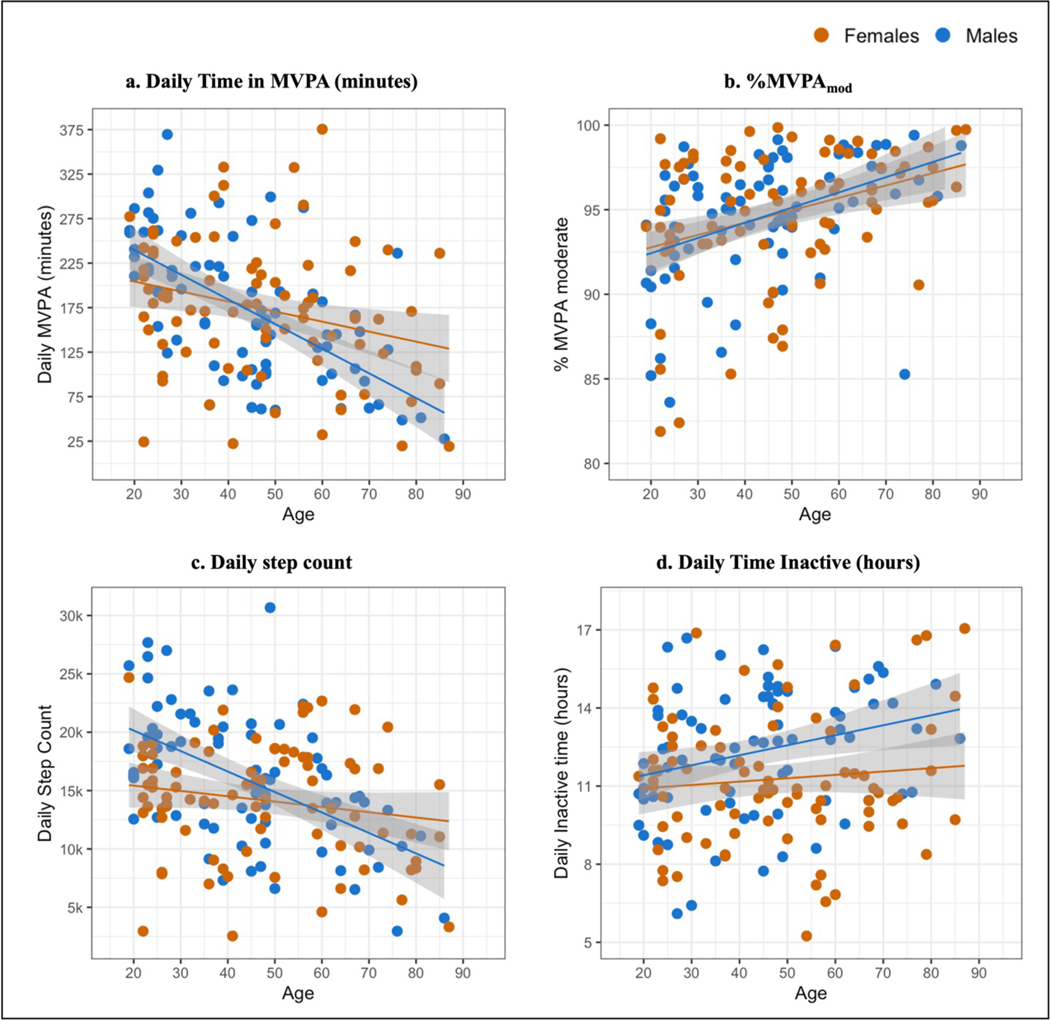
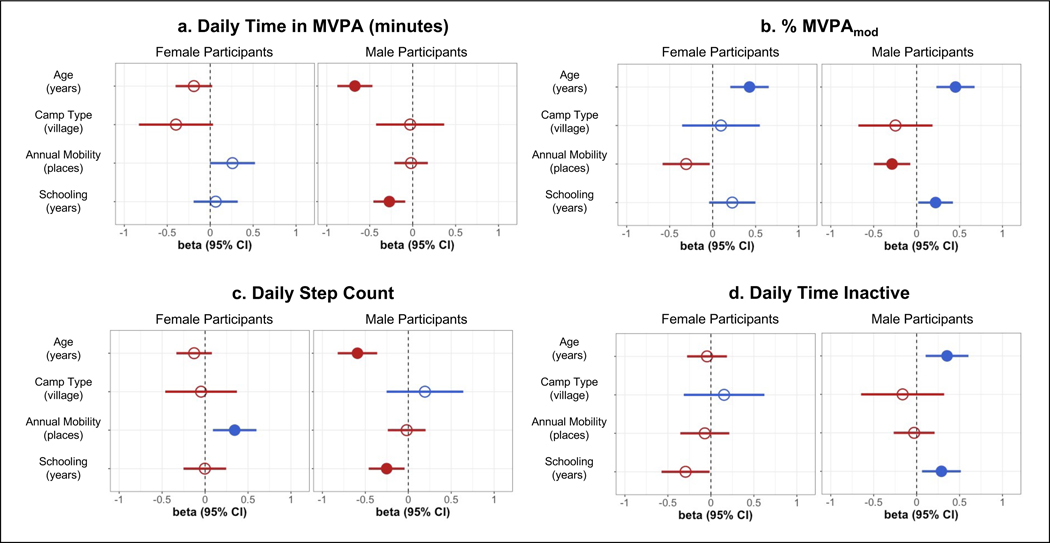
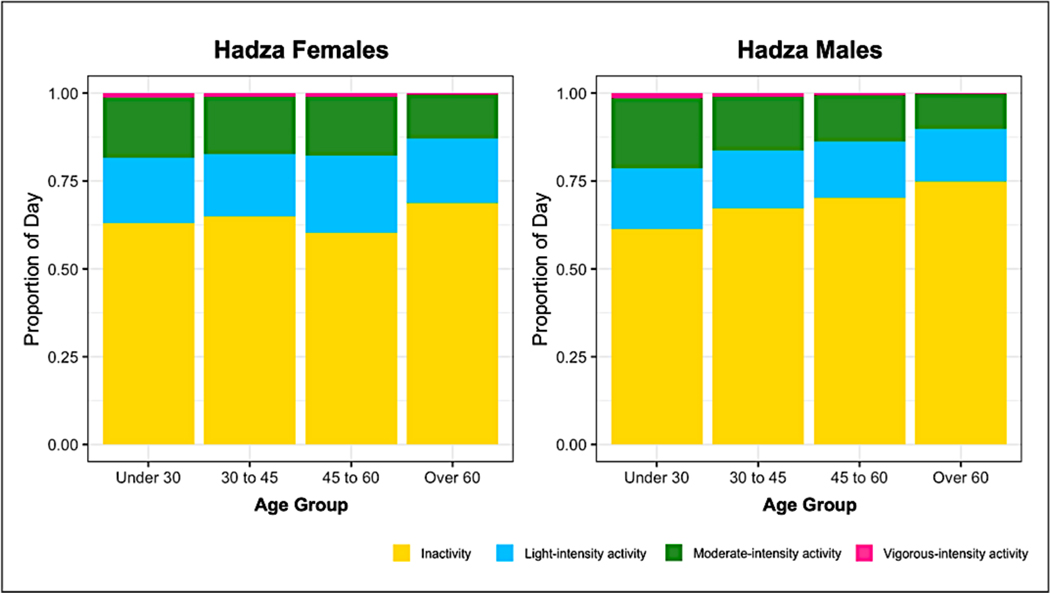
Results: Participants engaged in high levels of both moderate-intensity PA and inactivity. Although PA levels were negatively associated with age, older participants were still highly active. We found no differences in PA between participants living in more traditional "bush" camps and those living in more settled "village" camps. Mobility was positively associated with step counts for female participants, and schooling was positively associated with inactive time for male participants.
Conclusions: The similarity in PA patterns between Hadza participants in different camp types suggests that high PA levels characterize subsistence lifestyles generally. The sex-based difference in the effects of mobility and schooling on PA could be a reflection of the Hadza's gender-based division of labor, or indicate that changes to subsistence-oriented lifestyles impact women and men in different ways.
Keywords: Hadza hunter-gatherers; MVPA; accelerometry; physical activity; step counts.
© 2023 The Authors. American Journal of Biological Anthropology published by Wiley Periodicals LLC.
Conflict of interest statement
Conflict of Interest Statement:
The authors declare no conflicts of interest.
Figures
References
-
- Apicella CL, Azevedo EM, Christakis NA, & Fowler JH (2014). Evolutionary Origins of the Endowment Effect: Evidence from Hunter-Gatherers. American Economic Review, 104(6), 1793–1805. doi: 10.1257/aer.104.6.1793 - DOI
-
- Benjamini Y, & Hochberg Y. (1995). Controlling the false discovery rate: a practical and powerful approach to multiple testing. Journal of the Royal Statistical Society. Series B (Methodological), 57, 289–300.
-
- Biswas A, Oh PI, Faulkner GE, Bajaj RR, Silver MA, Mitchell MS, & Alter DA (2015). Sedentary time and its association with risk for disease incidence, mortality, and hospitalization in adults: a systematic review and meta-analysis. Ann Intern Med, 162(2), 123–132. doi: 10.7326/M14-1651 - DOI - PubMed