


Nasopharyngeal Cancer Incidence and Mortality in 185 Countries in 2020 and the Projected Burden in 2040: Population-Based Global Epidemiological Profiling
- PMID: 37728964
- PMCID: PMC10551785
- DOI: 10.2196/49968
Nasopharyngeal Cancer Incidence and Mortality in 185 Countries in 2020 and the Projected Burden in 2040: Population-Based Global Epidemiological Profiling
Abstract
Background: Nasopharyngeal cancer (NPC) is one of the most common head and neck cancers.
Objective: This study describes the global epidemiological profiles of NPC incidence and mortality in 185 countries in 2020 and the projected burden in 2040.
Methods: The estimated numbers of NPC cases and deaths were retrieved from the GLOBOCAN 2020 data set. Age-standardized incidence rates (ASIRs) and age-standardized mortality rates (ASMRs) were calculated using the world standard. The future number of NPC cases and deaths by 2040 were estimated based on global demographic projections.
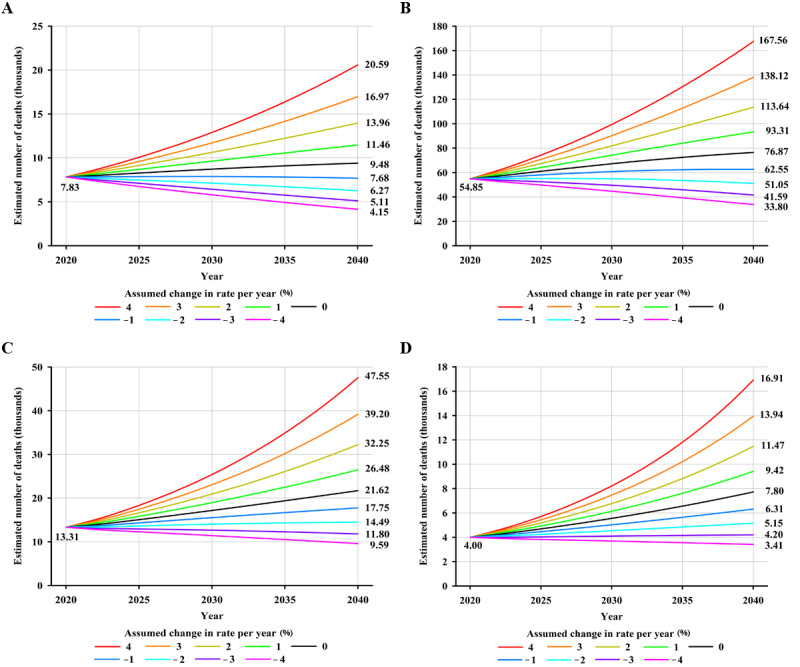
Results: Globally, approximately 133,354 cases and 80,008 deaths from NPC were estimated in 2020 corresponding to ASIRs and ASMRs of 1.5 and 0.9 per 100,000 person-years, respectively. The largest numbers of both global cases and deaths from NPC occurred in Eastern Asia (65,866/133,354, 49.39% and 36,453/80,008, 45.56%, respectively), in which China contributed most to this burden (62,444/133,354, 46.82% and 34,810/80,008, 43.50%, respectively). The ASIRs and ASMRs in men were approximately 3-fold higher than those in women. Incidence rates varied across world regions, with the highest ASIRs for both men and women detected in South-Eastern Asia (7.7 and 2.5 per 100,000 person-years, respectively) and Eastern Asia (3.9 and 1.5 per 100,000 person-years, respectively). The highest ASMRs for both men and women were found in South-Eastern Asia (5.4 and 1.5 per 100,000 person-years, respectively). By 2040, the annual number of cases and deaths will increase to 179,476 (46,122/133,354, a 34.58% increase from the year 2020) and 113,851 (33,843/80,008, a 42.29% increase), respectively.
Conclusions: Disparities in NPC incidence and mortality persist worldwide. Our study highlights the urgent need to develop and accelerate NPC control initiatives to tackle the NPC burden in certain regions and countries (eg, South-Eastern Asia, China).
Keywords: epidemiology; incidence; mortality; nasopharyngeal cancer; worldwide.
©Yanting Zhang, Harriet Rumgay, Mengmeng Li, Sumei Cao, Wanqing Chen. Originally published in JMIR Public Health and Surveillance (https://publichealth.jmir.org), 20.09.2023.
Conflict of interest statement
Conflicts of Interest: None declared.
Figures



References
-
- Parkin D, Bray F, Ferlay J, Pisani P. Global cancer statistics, 2002. CA Cancer J Clin. 2005;55(2):74–108. doi: 10.3322/canjclin.55.2.74. https://onlinelibrary.wiley.com/resolve/openurl?genre=article&sid=nlm:pu... 55/2/74 - DOI - PubMed
-
- Wei K, Zheng R, Zhang S, Liang Z, Li Z, Chen W. Nasopharyngeal carcinoma incidence and mortality in China, 2013. Chin J Cancer. 2017 Nov 09;36(1):90. doi: 10.1186/s40880-017-0257-9. https://cancercommun.biomedcentral.com/articles/10.1186/s40880-017-0257-9 10.1186/s40880-017-0257-9 - DOI - PMC - PubMed
-
- Carioli G, Negri E, Kawakita D, Garavello W, La Vecchia Carlo, Malvezzi M. Global trends in nasopharyngeal cancer mortality since 1970 and predictions for 2020: Focus on low-risk areas. Int J Cancer. 2017 May 15;140(10):2256–2264. doi: 10.1002/ijc.30660. https://air.unimi.it/handle/2434/492081 - DOI - PubMed
Publication types
MeSH terms
Grants and funding
LinkOut - more resources
Full Text Sources
Other Literature Sources
