


Monitoring the abundance of flying insects and atmospheric conditions during a 9-month campaign using an entomological optical sensor
- PMID: 37731042
- PMCID: PMC10511543
- DOI: 10.1038/s41598-023-42884-7
Monitoring the abundance of flying insects and atmospheric conditions during a 9-month campaign using an entomological optical sensor
Abstract
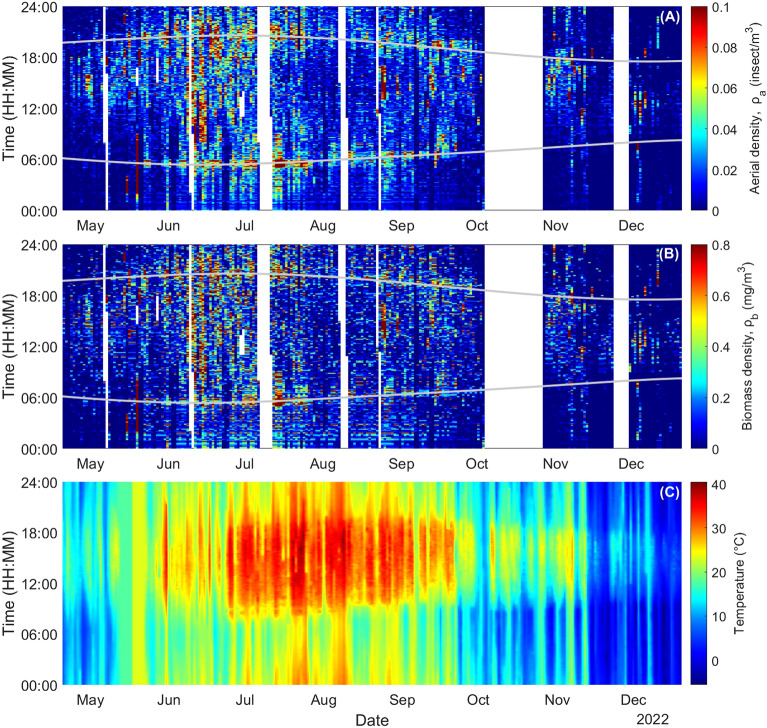
Monitoring the dynamics of insect populations is key to assessing the impact of human activities on insect populations. However, traditional methodologies relying on physical traps have inherent limitations in accurately monitoring insect abundance. Here, we present findings from a 9-month campaign conducted in New Jersey, USA, utilizing a near-infrared optical sensor known as eBoss. From April to December 2022, the eBoss derived the aerial density (insect/m3) and biomass density (mg/m3) with a 1-min resolution from a total of 302,093 insect observations. The data collected were analyzed in relation to air temperature, relative humidity, and wind speed. The results revealed that the abundance of flying insects exhibited an initial increase from April to June, reaching a peak of 0.094 insect/m3 and 1.34 mg/m3, followed by a subsequent decline towards the end of the year. Our investigation showed a surge in insect abundance above 12.5 °C, with particularly high levels observed between 19 and 31 °C. The impact of relative humidity and wind speed on insect populations was also explored. Overall, this campaign demonstrated the efficacy of photonic sensors in gathering novel and extensive data for the field of entomology, paving the way for improved understanding and management of insect populations.
© 2023. Springer Nature Limited.
Conflict of interest statement
The authors declare no competing interests.
Figures



References
-
- Forister ML, Pelton EM, Black SH. Declines in insect abundance and diversity: We know enough to act now. Conserv. Sci. Pract. 2019;1:e80. doi: 10.1111/csp2.80. - DOI
-
- Conrad KF, Warren MS, Fox R, Parsons MS, Woiwod IP. Rapid declines of common, widespread British moths provide evidence of an insect biodiversity crisis. Biol. Conserv. 2006;132:279–291. doi: 10.1016/j.biocon.2006.04.020. - DOI
Publication types
MeSH terms
Grants and funding
LinkOut - more resources
Full Text Sources
Miscellaneous
