. 2023 Aug 21;3(6):100224.
doi: 10.1016/j.xjidi.2023.100224. eCollection 2023 Nov.

Dietary Protein Intake and Associated Risks for Atopic Dermatitis, Intrinsic Eczema, and Allergic Sensitization among Young Chinese Adults in Singapore/Malaysia: Key Findings from a Cross-sectional Study

Affiliations

Dietary Protein Intake and Associated Risks for Atopic Dermatitis, Intrinsic Eczema, and Allergic Sensitization among Young Chinese Adults in Singapore/Malaysia: Key Findings from a Cross-sectional Study

Jun Jie Lim et al. JID Innov. .

Abstract

Through an investigator-administered questionnaire that follows the standard protocol of the International Study of Allergy and Asthma in Childhood, data on symptomatic histories of eczema and dietary habits were collected from 11,494 young Chinese adults in Singapore/Malaysia. Allergic sensitization status was assessed through a skin prick test reactivity to common house dust mites. Using three dietary indices (dietary protein score, animal protein score, and plant protein score), the associations between atopic dermatitis, intrinsic eczema, allergic sensitization, and intake of various proteins were estimated. On average, most subjects frequently eat meat, vegetables, and rice in their diets. Through a multivariable logistic regression adjusted for age, sex, body mass index, and parental eczema, subjects with high dietary protein score (adjusted OR = 1.397; 95% confidence interval = 1.133-1.724; P < 0.003) and high animal protein score (adjusted OR = 1.353; 95% confidence interval = 1.106-1.682; P < 0.003) were associated with increased risk of atopic dermatitis. Interestingly, synergy factor analysis revealed that a higher intake of plant proteins than animal proteins in diets significantly reduced overall associated risks of atopic dermatitis and allergic sensitization but not those of intrinsic eczema. Most importantly, these associations are independent of dietary fat intake. Taken together, frequent adherence to diets rich in plant proteins reduced associated risks of atopic dermatitis in Singapore/Malaysia Chinese adults.


Figures

Figure 1
Figure 1
Flowchart summarizing the classification of AD disease and allergic sensitization status among the SMCGES cohort. AD, atopic dermatitis; SMCGES, Singapore/Malaysia Cross-sectional Genetic Epidemiology Study; SPT, skin prick test.
Figure 2
Figure 2
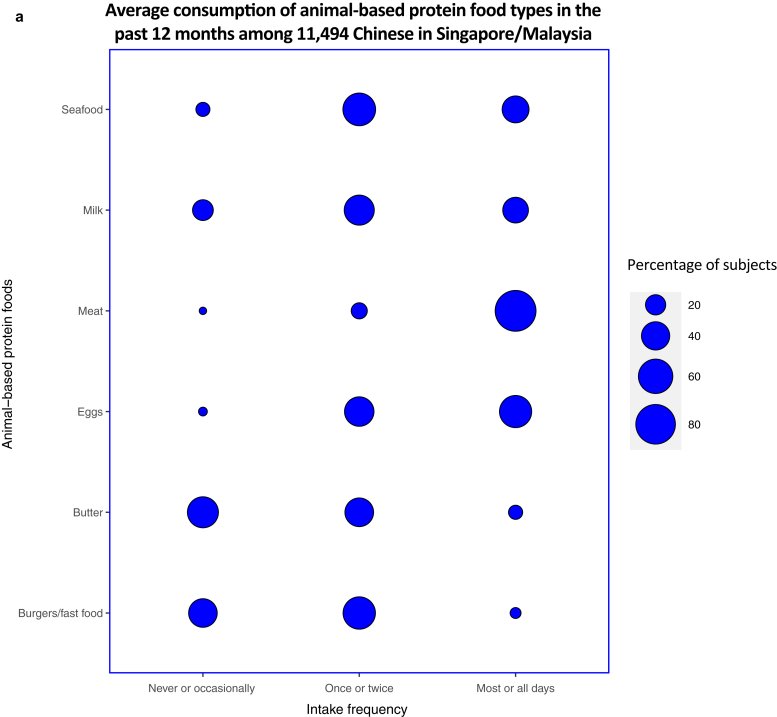
Average consumption of selected food types in the past 12 months among the diets of 11,494 young Chinese adults from the SMCGES cohort. The intake frequencies for each food type are represented in a balloon plot in terms of the percentage of subjects, with the food types classified on the basis of their origin source: (a) animal-based protein foods and (b) plant-based protein foods. SMCGES, Singapore/Malaysia Cross-sectional Genetic Epidemiology Study.
Figure 2
Figure 2
Average consumption of selected food types in the past 12 months among the diets of 11,494 young Chinese adults from the SMCGES cohort. The intake frequencies for each food type are represented in a balloon plot in terms of the percentage of subjects, with the food types classified on the basis of their origin source: (a) animal-based protein foods and (b) plant-based protein foods. SMCGES, Singapore/Malaysia Cross-sectional Genetic Epidemiology Study.
Figure 3
Figure 3
Results obtained from the multivariable logistic regression analysis of protein dietary pattern in terms of the combined protein scores (APS and PPS) in relation to AD presentation (nonallergic noneczema controls vs. AD cases). Age, sex, BMI, and parental eczema were adjusted for in the model, with the values presented in AOR, 95% CI, and P-value. P-values < 0.003 are statistically significant (adjusted by Bonferroni’s correction). A reference dotted line is drawn at the interception point where AOR equals 1.000. The 95% CI for each combined protein class is represented by a single line that cuts the AOR. An SF analysis revealed that APS and PPS in diets interact in an antagonistic manner to reduce the associated odds of AD (SF value < 1.000). AD, atopic dermatitis; AOR, adjusted OR; APS, animal protein score; BMI, body mass index; CI, confidence interval; REF, reference; PPS, plant protein score; SF, synergy factor.
Figure 4
Figure 4
Flowchart illustrating the design of various dietary indices. (a) Dietary protein score to estimate the total protein intake in diets, (b) animal protein score and plant protein score to estimate the animal and plant-based protein intake in diets, respectively.

References

    1. Abdallah A., Elemba E., Zhong Q., Sun Z. Gastrointestinal interaction between dietary amino acids and gut microbiota: with special emphasis on host nutrition. Curr Protein Pept Sci. 2020;21:785–798. - PubMed
    1. Abrahamsson T.R., Jakobsson H.E., Andersson A.F., Björkstén B., Engstrand L., Jenmalm M.C. Low diversity of the gut microbiota in infants with atopic eczema. J Allergy Clin Immunol. 2012;129:434–440.e4402. - PubMed
    1. Ahnen R.T., Jonnalagadda S.S., Slavin J.L. Role of plant protein in nutrition, wellness, and health. Nutr Rev. 2019;77:735–747. - PubMed
    1. Alam M.J., Xie L., Yap Y.A., Marques F.Z., Robert R. Manipulating microbiota to treat atopic dermatitis: functions and therapies. Pathogens. 2022;11:642. - PMC - PubMed
    1. Andiappan A.K., Puan K.J., Lee B., Nardin A., Poidinger M., Connolly J., et al. Allergic airway diseases in a tropical urban environment are driven by dominant mono-specific sensitization against house dust mites. Allergy. 2014;69:501–509. - PMC - PubMed

LinkOut - more resources