


Within subject, double blind, examination of opioid sensitivity in participant-reported, observed, physiologic, and analgesic outcomes
- PMID: 37731966
- PMCID: PMC10507188
- DOI: 10.1016/j.dadr.2023.100188
Within subject, double blind, examination of opioid sensitivity in participant-reported, observed, physiologic, and analgesic outcomes
Abstract
Background: Inter-individual differences in opioid sensitivity may underlie different opioid risk profiles but have often been researched in persons who have current or past opioid use disorder or physical dependence. This study examined how opioid sensitivity manifests across various assessments of opioid effects in a primarily opioid-naïve population.
Procedures: Data were harmonized from two within-subject, double-blind trials wherein healthy participants (N = 123) received placebo and 4 mg oral hydromorphone. Demographics, self-report ratings, observer ratings, physiological, and cold pressor measures were collected. Participants were categorized as being responsive or nonresponsive to the opioid dose tested and compared using mixed-models, Pearson product correlations, and paired t-tests.
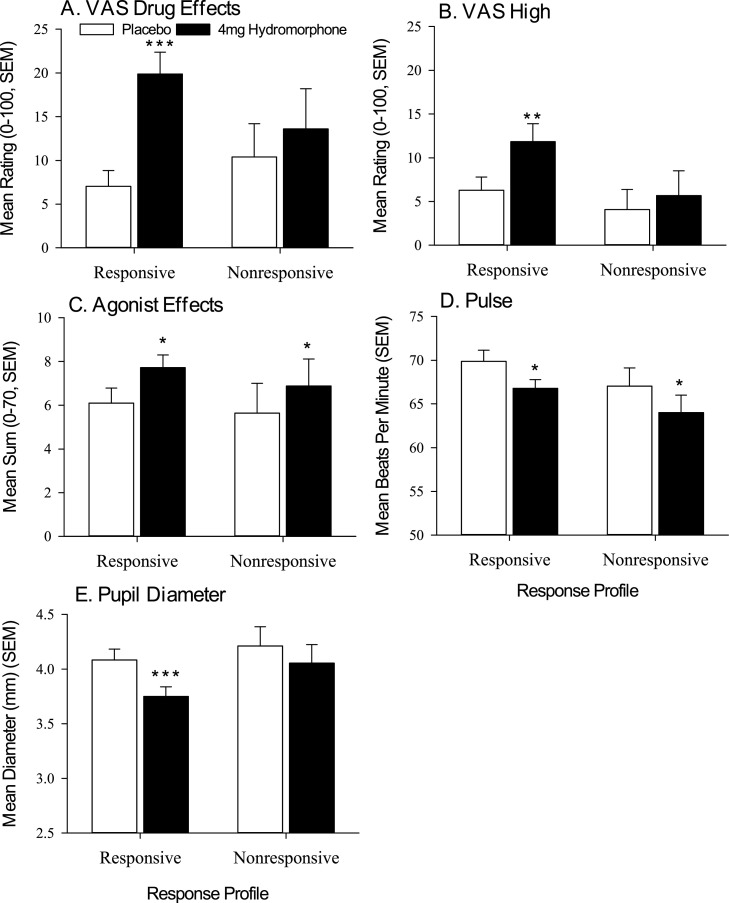
Findings: Participants were 49.6% female, mean 33.0 (SD=9.3) years old, and 44.7% Black/African American and 41.5% White, with 89.4% reporting no prior exposure to opioids. Within-subject sensitivity to opioids varied depending on the measure. One in five participants did not respond subjectively to the 4 mg hydromorphone dose based on their "Drug Effects" rating. Persons who were responsive showed more evidence of drug-dependent effects than did persons who were not responsive on ratings of Bad Effects (p= .03), feeling High (p= .01), Nausea (p= .03), pupil diameter (p< 0.01), and on the circular lights task (p< 0.001).
Conclusions: This study provides initial evidence that the experience of opioids may be domain specific. Data suggest potentially clinically meaningful differences exist regarding opioid response patterns, evident following one dose among opioid inexperienced individuals.
Keywords: Cold pressor; Heroin; Opioid; Opioid naïve; Opioid sensitivity; Personalized medicine.
© 2023 Published by Elsevier B.V.
Conflict of interest statement
No authors have direct conflicts of interest to report. In the past 3 years, KED has consulted with MindMed Inc., DemeRx, and Cessation Therapeutics. ASH receives research funding from Indivior through his university. CLB receives funding from Canopy Growth Corporation and Pear Therapeutics through her university to conduct research studies. PHF is on the Scientific Advisory Board for Ninnion Therapeutics.
Figures
References
-
- Centers for Disease Control and Prevention, N.C.f.H.S., 2021. Drug overdose deaths in the U.S. Top 100,000 annually.
-
- Bieber C.M., Fernandez K., Borsook D., et al. Retrospective accounts of initial subjective effects of opioids in patients treated for pain who do or do not develop opioid addiction: a pilot case-control study. Exp. Clin. Psychopharmacol. 2008;16(5):429–434. doi: 10.1037/1064-1297.16.5.429. - DOI - PMC - PubMed
LinkOut - more resources
Full Text Sources
Research Materials
Miscellaneous
