This is a preprint.
Micro-heterogeneity of transmission shapes the submicroscopic malaria reservoir in coastal Tanzania
- PMID: 37732257
- PMCID: PMC10508794
- DOI: 10.1101/2023.09.06.23295089
Micro-heterogeneity of transmission shapes the submicroscopic malaria reservoir in coastal Tanzania
Update in
-
Microheterogeneity of Transmission Shapes Submicroscopic Malaria Carriage in Coastal Tanzania.J Infect Dis. 2024 Aug 16;230(2):485-496. doi: 10.1093/infdis/jiae276. J Infect Dis. 2024. PMID: 38781438 Free PMC article.
Abstract
Background: Asymptomatic malaria may be patent (visible by microscopy) and detectable by rapid malaria diagnostic tests (RDTs), or it may be submicroscopic and only detectable by polymerase chain reaction (PCR).
Methods: To characterize the submicroscopic reservoir in an area of declining malaria transmission, asymptomatic persons >5 years of age in Bagamoyo District, Tanzania, were screened using RDT, microscopy, and PCR. We investigated the size of the submicroscopic reservoir across villages, determined factors associated with submicroscopic parasitemia, and assessed the natural history of submicroscopic malaria over four weeks.
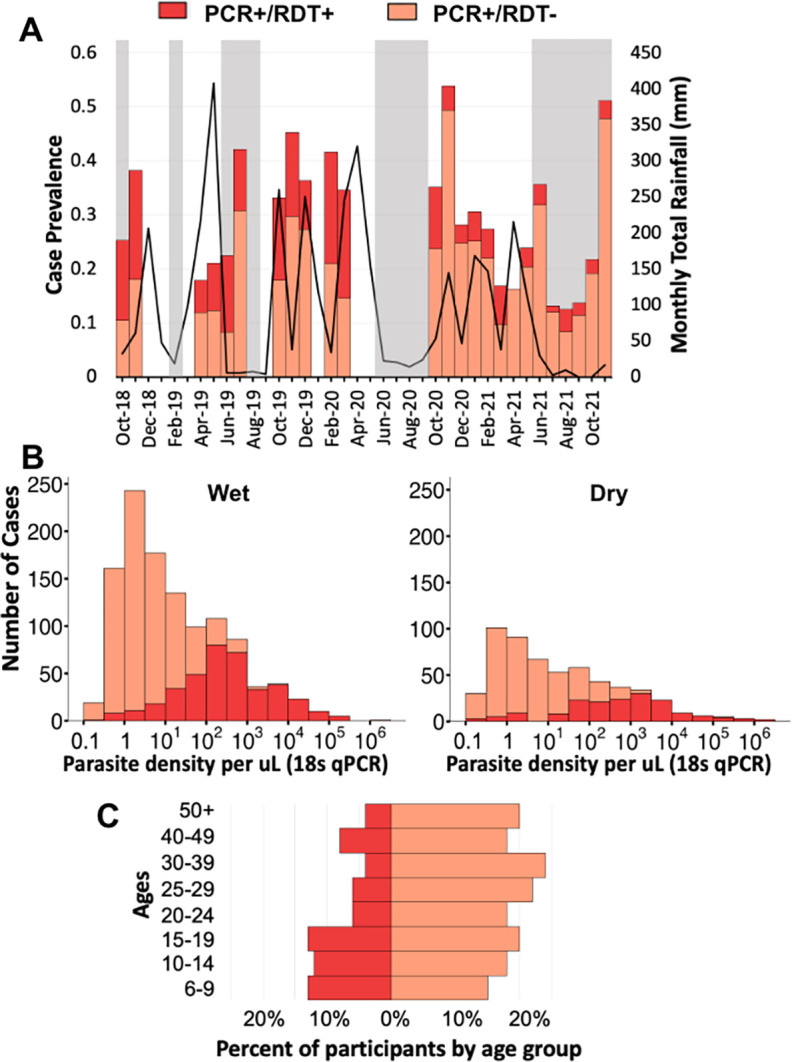
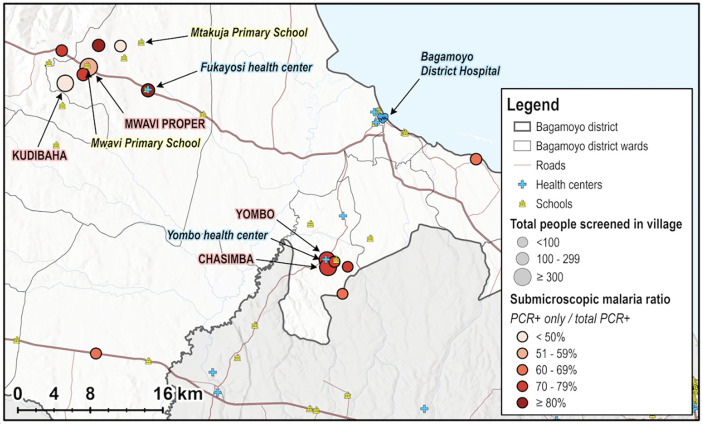
Results: Among 6,076 participants, Plasmodium falciparum prevalence by RDT, microscopy, and PCR was 9%, 9%, and 28%, respectively, with roughly two-thirds of PCR-positive individuals harboring submicroscopic infection. Adult status, female gender, dry season months, screened windows, and bednet use were associated with submicroscopic carriage. Among 15 villages encompassing 80% of participants, the proportion of submicroscopic carriers increased with decreasing village-level malaria prevalence. Over four weeks, 23% (61/266) of submicroscopic carriers became RDT-positive and were treated, with half exhibiting symptoms. This occurred more frequently in villages with higher malaria prevalence.
Conclusions: Micro-heterogeneity in transmission impacts the size of the submicroscopic reservoir and the likelihood of submicroscopic carriers developing patent malaria in coastal Tanzania.
Figures


References
-
- Andagalu B, Watson OJ, Onyango I, Opot B, Okoth R, Chemwor G, Sifuna P, Juma D, Cheruiyot A, Yeda R, Okudo C, Wafubwa J, Yalwala S, Abuom D, Ogutu B, Cowden J, Akala HM, Kamau E. 2022. Malaria Transmission Dynamics in High Transmission Setting of Western Kenya and the Inadequate Treatment Response to Artemether-lumefantrine in an Asymptomatic Population. Clin Infect Dis 76:704–712. - PMC - PubMed
-
- Andolina C, Ramjith J, Rek J, Lanke K, Okoth J, Grignard L, Arinaitwe E, Briggs J, Bailey J, Aydemir O, Kamya MR, Greenhouse B, Dorsey G, Staedke SG, Drakeley C, Jonker M, Bousema T. 2023. Plasmodium falciparum gametocyte carriage in longitudinally monitored incident infections is associated with duration of infection and human host factors. Sci Rep 13:7072. - PMC - PubMed
-
- Andolina C, Rek JC, Briggs J, Okoth J, Musiime A, Ramjith J, Teyssier N, Conrad M, Nankabirwa JI, Lanke K, Rodriguez-Barraquer I, Meerstein-Kessel L, Arinaitwe E, Olwoch P, Rosenthal PJ, Kamya MR, Dorsey G, Greenhouse B, Drakeley C, Staedke SG, Bousema T. 2021. Sources of persistent malaria transmission in a setting with effective malaria control in eastern Uganda: a longitudinal, observational cohort study. Lancet Infect Dis 21:1568–1578. - PMC - PubMed
-
- ASTMH-2022-Annual-Meeting-Program-Book_1.pdf. n.d.
-
- Barry A, Bradley J, Stone W, Guelbeogo MW, Lanke K, Ouedraogo A, Soulama I, Nébié I, Serme SS, Grignard L, Patterson C, Wu L, Briggs JJ, Janson O, Awandu SS, Ouedraogo M, Tarama CW, Kargougou D, Zongo S, Sirima SB, Marti M, Drakeley C, Tiono AB, Bousema T. 2021. Higher gametocyte production and mosquito infectivity in chronic compared to incident Plasmodium falciparum infections. Nat Commun 12:2443. - PMC - PubMed
Publication types
Grants and funding
LinkOut - more resources
Full Text Sources