Review
. 2024 Jan 1;104(1):473-532.
doi: 10.1152/physrev.00021.2023. Epub 2023 Sep 21.

Glucocorticoids, their uses, sexual dimorphisms, and diseases: new concepts, mechanisms, and discoveries

Affiliations
Review

Glucocorticoids, their uses, sexual dimorphisms, and diseases: new concepts, mechanisms, and discoveries

Genesee J Martinez et al. Physiol Rev. .

Abstract

The normal stress response in humans is governed by the hypothalamic-pituitary-adrenal (HPA) axis through heightened mechanisms during stress, raising blood levels of the glucocorticoid hormone cortisol. Glucocorticoids are quintessential compounds that balance the proper functioning of numerous systems in the mammalian body. They are also generated synthetically and are the preeminent therapy for inflammatory diseases. They act by binding to the nuclear receptor transcription factor glucocorticoid receptor (GR), which has two main isoforms (GRα and GRβ). Our classical understanding of glucocorticoid signaling is from the GRα isoform, which binds the hormone, whereas GRβ has no known ligands. With glucocorticoids being involved in many physiological and cellular processes, even small disruptions in their release via the HPA axis, or changes in GR isoform expression, can have dire ramifications on health. Long-term chronic glucocorticoid therapy can lead to a glucocorticoid-resistant state, and we deliberate how this impacts disease treatment. Chronic glucocorticoid treatment can lead to noticeable side effects such as weight gain, adiposity, diabetes, and others that we discuss in detail. There are sexually dimorphic responses to glucocorticoids, and women tend to have a more hyperresponsive HPA axis than men. This review summarizes our understanding of glucocorticoids and critically analyzes the GR isoforms and their beneficial and deleterious mechanisms and the sexual differences that cause a dichotomy in responses. We also discuss the future of glucocorticoid therapy and propose a new concept of dual GR isoform agonist and postulate why activating both isoforms may prevent glucocorticoid resistance.

Keywords: 11β-HSD1; HPA axis; dual GR agonist; glucocorticoid resistance; inflammation.


Conflict of interest statement

T.D.H. has submitted patents on GRβ- and obesity-related disorders. None of the other authors has any conflicts of interest, financial or otherwise, to disclose.

Figures

None
Graphical abstract
FIGURE 1.
FIGURE 1.
The hypothalamic-pituitary-adrenal (HPA) axis. Initiation of cortisol release from the adrenal gland begins with a signaling event, usually a stressor. This signaling event initiates a cascade of events beginning with the release of corticotropin-releasing hormone (CRH, light orange) from the hypothalamus. CRH then signals the release of adrenocorticotropic hormone (ACTH, green) from the pituitary gland into the bloodstream. Once this hormone reaches the adrenal gland it stimulates the production and release of cortisol (yellow). In the blood, almost all cortisol is bound to albumin or cortisol-binding globulin (CBG, red). Cortisol that is not bound is active. Increasing levels of cortisol signal inhibition by CRH can also act as a negative feedback mechanism.
FIGURE 2.
FIGURE 2.
Normal and dysfunctional hypothalamic-pituitary-adrenal (HPA) axis responsiveness. Glucocorticoid-sensitive adults with normal plasma cortisol have a regular functioning HPA axis. The glucocorticoid receptor (GR) suppresses CRH in the hypothalamus and ACTH in the pituitary, to maintain normal cortisol ranges in the blood. Dysfunctional HPA axis responsiveness results in higher circulating cortisol levels, possibly due to the inhibition of GR in the hypothalamus or pituitary and blockade of the negative feedback inhibition that would normally reduce blood cortisol levels.
FIGURE 3.
FIGURE 3.
Hypothalamic-pituitary-adrenal (HPA) axis responsiveness and cortisol negative feedback in women and men. The HPA axis responsiveness in glucocorticoid-sensitive adults may be heightened in females. Obese individuals may display glucocorticoid resistance and reduced cortisol negative feedback indicating abnormal or dysfunctional HPA axis responsiveness. ACTH, adrenocorticotropic hormone. Silhouettes were generated by adapting Adobe Stock photo #553939290 (licensed to the University of Kentucky).
FIGURE 4.
FIGURE 4.
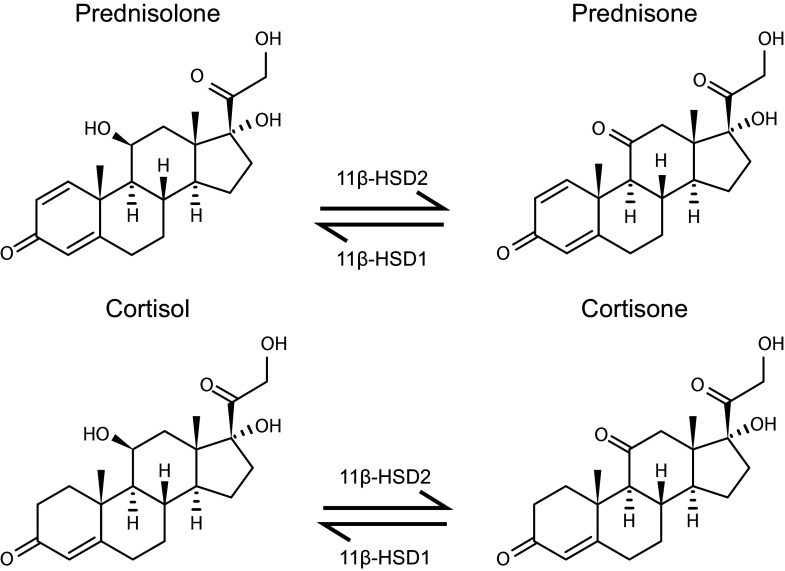
Conversion of glucocorticoids to their active/inactive forms. Glucocorticoids must be in their pharmacologically active form to exhibit effects on the glucocorticoid receptor. The reactions that activate/deactivate glucocorticoids are catalyzed by the enzyme 11-beta-hydroxysteroid dehydrogenase (11β-HSD) in its 2 isoforms 11β-HSD1 and 11β-HSD2. 11β-HSD1 catalyzes reduction of the glucocorticoid, whereas 11β-HSD2 catalyzes oxidation. This reaction is shown with both endogenous cortisol/inactive cortisone and synthetic glucocorticoids such as prednisolone/inactive prednisone.
FIGURE 5.
FIGURE 5.
Glucocorticoid receptor (GR) isoform interaction and signaling. A: the classical signaling mechanism of the glucocorticoid receptor. When the glucocorticoid receptor binds ligand, it releases heat shock protein (HSP)90 and translocates to the nucleus, where it dimerizes with another molecule of either GRα or GRβ. Once dimerized, GRα recruits histone acetyltransferases (HATs) and GRβ recruits histone deacetylases (HDACs). B: here we propose the idea that if GRβ has a ligand it binds to it can dimerize with another GRβ and recruit HATs and increase the transcription of its target genes. When it dimerizes with GRα it increases the production of anti-inflammatory genes. GRE, glucocorticoid response element.
FIGURE 6.
FIGURE 6.
Glucocorticoid receptor (GR) translocation into the nucleus. Before binding glucocorticoid, GRα exists in the cytoplasm bound to 2 molecules of heat shock protein (HSP)90, 1 molecule of p23 stabilizer, and 1 molecule of FK506-binding protein (FKBP)51. When GRα binds glucocorticoid, FKBP51 dissociates and FKBP52 comes in to facilitate the translocation of GRα into the nucleus. Once in the nucleus, the complex of HSP90, p23, and FKBP52 dissociates, and GRα dimerizes and binds to glucocorticoid response elements (GREs) in promoters of genes to regulate transcription.
FIGURE 7.
FIGURE 7.
Glucocorticoid receptor (GR) phosphorylation sites. GR is phosphorylated at 3 major sites at its NH2 terminus for human GR at serines S203, S211, S226. Phosphorylation of S203 is mostly observed in the cytoplasm. The glucocorticoid-induced sites are S211 and S226. Once activated by ligand, GR undergoes a conformational change that allows for kinases to phosphorylate opened amino acid residues. The p38 MAP kinase (MAPK) has been shown to phosphorylate S211, and c-Jun NH2-terminal kinase (JNK) phosphorylates S226. Then, GR moves into the nucleus to bind to glucocorticoid response elements (GREs), which are inverse palindromic sequences as indicated by the arrows. GR binding to GREs in the promoter of genes elicits a gene response.
Figure 8.
Figure 8.
Glucocorticoid receptor (GR) recruitment of chromatin remodeling complexes. The preinitiation complex forms when GR binds to glucocorticoid response elements (GREs). GR will recruit Switch/Sucrose Nonfermentable (SWI/SNF) protein complex as well as other coactivators that lead to chromatin remodeling and the formation of the preinitiation complex.
FIGURE 9.
FIGURE 9.
Coregulators primarily bind to the activation function 2 (AF-2) domain of glucocorticoid receptor (GR)α. The protein structure of GRα contains 4 primary domains. First is the NH2-terminal domain (NTD), also called activation function 1 (AF-1), which is followed by the DNA binding domain (DBD), the hinge (H) region, and the ligand binding domain (LBD). Within the LBD is the AF-2 region, which is the primary site for coregulator binding. NCOA, nuclear receptor coactivator; NRIP1, nuclear receptor-interacting protein 1; PGC-1α, peroxisome proliferator-activated receptor (PPAR)γ coactivator 1 alpha.
FIGURE 10.
FIGURE 10.
The dexamethasone-induced coregulator interactome of glucocorticoid receptor (GR)α. The binding of dexamethasone (DEX) to GRα induces a conformational change that allows the binding of coactivators [nuclear receptor coactivator (NCOA)1/2/3, peroxisome proliferator-activated receptor (PPAR)γ coactivator 1 alpha (PGC-1α), and nuclear receptor subfamily 0 group B member 1 (NR0B1)], which increases GRα’s transcriptional activity. The binding of dexamethasone to GRα also represses the recruitment of corepressors [nuclear receptor corepressor (NCOR)1/2, preferentially expressed antigen in melanoma (PRAME), nuclear receptor-interacting protein 1 (NRIP1), and double homeobox 4 (DUX4)]. GRE, glucocorticoid response element.
FIGURE 11.
FIGURE 11.
The selective gene inhibition or activation by glucocorticoid receptor (GR)α can be determined by the coregulator recruitment. The recruitment of nuclear receptor coactivator (NCOA)2 is required for GRα to suppress proinflammatory genes including IL1α, IL1β, and TNFα. Within the liver, during fasting the recruitment of peroxisome proliferator-activated receptor (PPAR)γ coactivator 1 alpha (PGC-1α) to GRα induces the activation of energy expenditure mechanisms and increases the expression of PEPCK and G6Pase. DEX, dexamethasone; GRE, glucocorticoid response element.
FIGURE 12.
FIGURE 12.
Glucocorticoid-responsive and -resistant conditions. Systemic and local inflammatory disorders discussed in sect. 4 are generally responsive to glucocorticoids (GCs), during which glucocorticoids improve clinical outcomes through both antagonizing proinflammatory and promoting anti-inflammatory mechanisms. However, the therapeutic effects of glucocorticoids are antagonized by glucocorticoid resistance, which involves multiple mechanisms involving glucocorticoid receptor (GR) antagonists (GRβ), phosphatases, histone modification, and P-glycoproteins (P-gp). COPD, chronic obstructive pulmonary disease; IBD, inflammatory bowel disease; RA, rheumatoid arthritis; SARS-CoV-2, severe acute respiratory syndrome coronavirus 2; SLE, systemic lupus erythematosus. GvHD, graft-versus-host disease.
FIGURE 13.
FIGURE 13.
Inhaled allergens are taken up by tissue dendritic cells that migrate into the draining lymph nodes via afferent lymphatic vessels, presenting the antigens to antigen-specific naive T cells. Activated antigen-specific T cells then egress the lymph nodes and traffic to the target lung tissues, where the antigens reactivate them to induce local inflammation triggering cytokine and chemokine production, further recruiting other inflammatory cells.
FIGURE 14.
FIGURE 14.
Acute and chronic glucocorticoid exposure have opposite effects. During an acute exposure (<30 days) glucocorticoids are metabolically healthy and induce weight loss, reduce inflammation, and reduce fat mass. On the other hand, chronic glucocorticoid exposure (>30 days) causes weight gain, adiposity, inflammation, fatty liver disease, and glucose intolerance. The paradoxical effects of glucocorticoids on metabolic disease may be due to the development of glucocorticoid resistance.
FIGURE 15.
FIGURE 15.
Rodent model of early life stress [maternal separation with early weaning (MSEW)]. MSEW litter pups are separated from the dam for 4 h/day from postnatal day (PND)2 to PND5 and for 8 h/day from PND6 to PND16. Pups are weaned early on PND17. Separation occurred at the same time of day, during which the mother was removed from the cage and pups were placed into a clean cage in an incubator (30 ± 1°C, 60% humidity). After weaning, mice are housed 3 per cage divided by sex and treatment or special diet (e.g., high-fat diet).

References

    1. Barnes PJ, Adcock IM. Glucocorticoid resistance in inflammatory diseases. Lancet 373: 1905–1917, 2009. doi:10.1016/S0140-6736(09)60326-3. - DOI - PubMed
    1. Cruz-Topete D, Cidlowski JA. One hormone, two actions: anti- and pro-inflammatory effects of glucocorticoids. Neuroimmunomodulation 22: 20–32, 2015. doi:10.1159/000362724. - DOI - PMC - PubMed
    1. Rhen T, Cidlowski JA. Antiinflammatory action of glucocorticoids—new mechanisms for old drugs. N Engl J Med 353: 1711–1723, 2005. doi:10.1056/NEJMra050541. - DOI - PubMed
    1. Quax RA, Peeters RP, Feelders RA. Selective glucocorticoid receptor modulators: future of glucocorticoid immunosuppressive therapy? Endocrinology 152: 2927–2929, 2011. doi:10.1210/en.2011-1258. - DOI - PubMed
    1. Van Raalte D, Ouwens D, Diamant M. Novel insights into glucocorticoid‐mediated diabetogenic effects: towards expansion of therapeutic options? Eur J Clin Invest 39: 81–93, 2009. doi:10.1111/j.1365-2362.2008.02067.x. - DOI - PubMed

LinkOut - more resources