. 2023 Oct 24;8(5):e0032123.
doi: 10.1128/msphere.00321-23. Epub 2023 Sep 21.

PERK-mediated antioxidant response is key for pathogen persistence in ticks

Affiliations

PERK-mediated antioxidant response is key for pathogen persistence in ticks

Kristin L Rosche et al. mSphere. .

Abstract

A crucial phase in the life cycle of tick-borne pathogens is the time spent colonizing and persisting within the arthropod. Tick immunity is emerging as a key force shaping how transmissible pathogens interact with the vector. How pathogens remain in the tick despite immunological pressure remains unknown. In persistently infected Ixodes scapularis, we found that Borrelia burgdorferi (causative agent of Lyme disease) and Anaplasma phagocytophilum (causative agent of granulocytic anaplasmosis) activate a cellular stress pathway mediated by the endoplasmic reticulum receptor PKR-like ER kinase (PERK) and the central regulatory molecule eIF2α. Disabling the PERK pathway through pharmacological inhibition and RNA interference (RNAi) significantly decreased microbial numbers. In vivo RNAi of the PERK pathway not only reduced the number of A. phagocytophilum and B. burgdorferi colonizing larvae after a bloodmeal but also significantly reduced the number of bacteria that survive the molt. An investigation into PERK pathway-regulated targets revealed that A. phagocytophilum and B. burgdorferi induce activity of the antioxidant response regulator, nuclear factor erythroid 2-related factor 2 (Nrf2). Tick cells deficient for nrf2 expression or PERK signaling showed accumulation of reactive oxygen and nitrogen species in addition to reduced microbial survival. Supplementation with antioxidants rescued the microbicidal phenotype caused by blocking the PERK pathway. Altogether, our study demonstrates that the Ixodes PERK pathway is activated by transmissible microbes and facilitates persistence in the arthropod by potentiating an Nrf2-regulated antioxidant environment. IMPORTANCE Recent advances demonstrate that the tick immune system recognizes and limits the pathogens they transmit. Innate immune mediators such as antimicrobial peptides and reactive oxygen/nitrogen species are produced and restrict microbial survival. It is currently unclear how pathogens remain in the tick, despite this immune assault. We found that an antioxidant response controlled by the PERK branch of the unfolded protein response is activated in ticks that are persistently infected with Borrelia burgdorferi (Lyme disease) or Anaplasma phagocytophilum (granulocytic anaplasmosis). The PERK pathway induces the antioxidant response transcription factor, Nrf2, which coordinates a gene network that ultimately neutralizes reactive oxygen and nitrogen species. Interfering with this signaling cascade in ticks causes a significant decline in pathogen numbers. Given that innate immune products can cause collateral damage to host tissues, we speculate that this is an arthropod-driven response aimed at minimizing damage to "self" that also inadvertently benefits the pathogen. Collectively, our findings shed light on the mechanistic push and pull between tick immunity and pathogen persistence within the arthropod vector.

Keywords: ATF4; Anaplasma phagocytophilum; Borrelia burgdorferi; Ixodes scapularis; Nrf2; PERK; antioxidant response; eIF2α; tick-borne disease; vector competence.


Conflict of interest statement

The authors declare no conflict of interest.

Figures
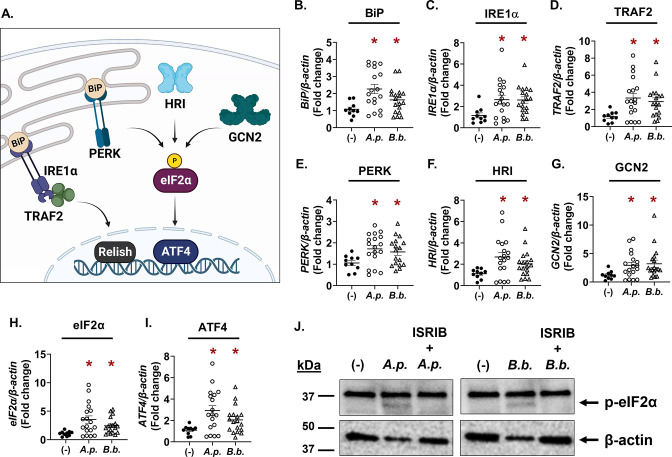
FIG 1
FIG 1
Tick-borne pathogens induce eIF2α-regulated stress responses in infected, unfed nymphs. (A) Graphic representation of IRE1α-TRAF2 signaling and the integrated stress response pathways in Ixodes ticks. (B–I) Gene expression in flat, unfed I. scapularis nymphs that are either uninfected (−), A. phagocytophilum-infected (A.p.), or B. burgdorferi-infected (B.b.). Each data point is representative of one nymph. Gene expression was quantified by qRT-PCR using primers listed in Table S1. Student’s t-test. *P < 0.05. (J) Phosphorylated eIF2α (36 kDa) immunoblot against ISE6 tick cells that were either uninfected (−), infected for 24 h (MOI 50), or treated with the eIF2α phosphorylation inhibitor ISRIB for 1 h prior to infection (24 h). β-Actin was probed as an internal loading control (45 kDa). Immunoblots are representative of two biological replicates. See also Fig. S1. A.p., A. phagocytophilum; B.b., B. burgdorferi; ISRIB, integrated stress response inhibitor.
FIG 2
FIG 2
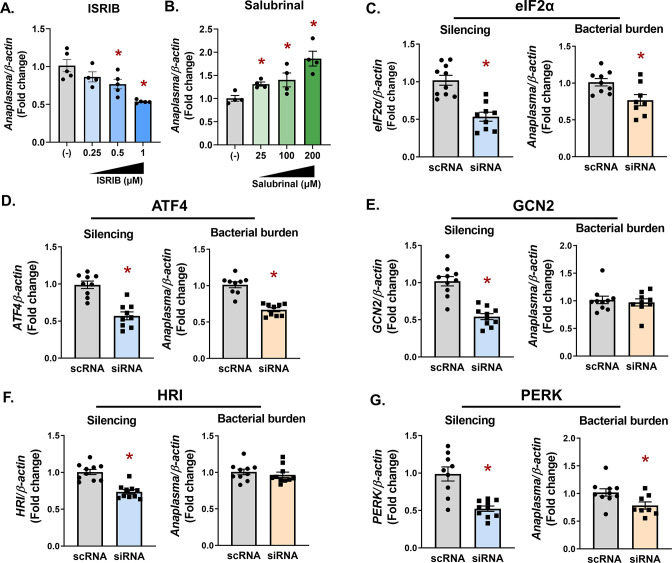
The PERK-eIF2α-ATF4 axis promotes A. phagocytophilum infection in tick cells. (A and B) ISE6 tick cells (1 × 10⁶) were pretreated with ISRIB (A) or salubrinal (B) at the indicated concentrations for 1 h prior to infection with A. phagocytophilum for 18 h (MOI 50). (C–G) IDE12 tick cells (1 × 10⁶) were treated with silencing RNAs (siRNAS) against indicated genes or scRNA controls for 24 h prior to infection with A. phagocytophilum (MOI 50) for 18 h. A. phagocytophilum burden and gene silencing for eIF2α (C), ATF4 (D), GCN2 (E), HRI (F), and PERK (G) were measured by qRT-PCR. Data are representative of at least five biological replicates with at least two technical replicates. Error bars show standard error of the mean. *P < 0.05 (Student’s t-test). scRNA, scrambled RNA; siRNA, small interfering RNA.
FIG 3
FIG 3
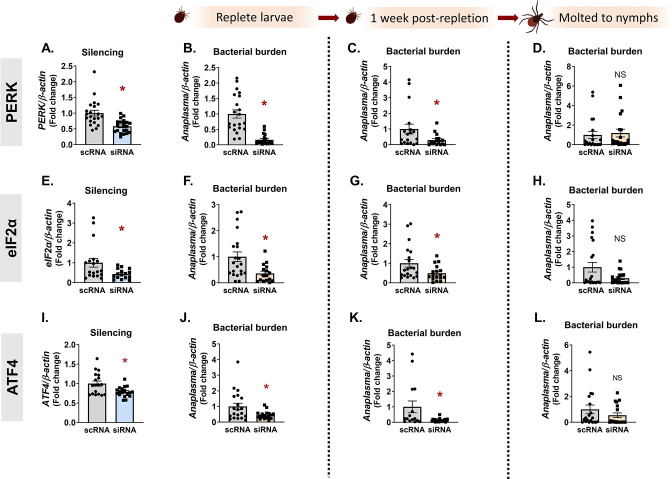
The PERK pathway supports A. phagocytophilum in vivo. I. scapularis larvae were immersed overnight in siRNA targeting PERK (A–D), eIF2α (E–H), or ATF4 (I–L) and fed on A. phagocytophilum-infected mice. Silencing efficiency (A, E, and I) and bacterial burden were assessed at three time intervals by qRT-PCR: immediately following repletion (B, F, and J), 1 week post-repletion (C, G, and K), and after ticks molted to nymphs (D, H, and L). Data are representative of 10–20 ticks and at least two experimental replicates. Each point represents one tick, with two technical replicates. Error bars show standard error of the mean. *P < 0.05 (Mann-Whitney test). NS, non-significant; scRNA, scrambled RNA, siRNA, small interfering RNA.
Fig 4
Fig 4
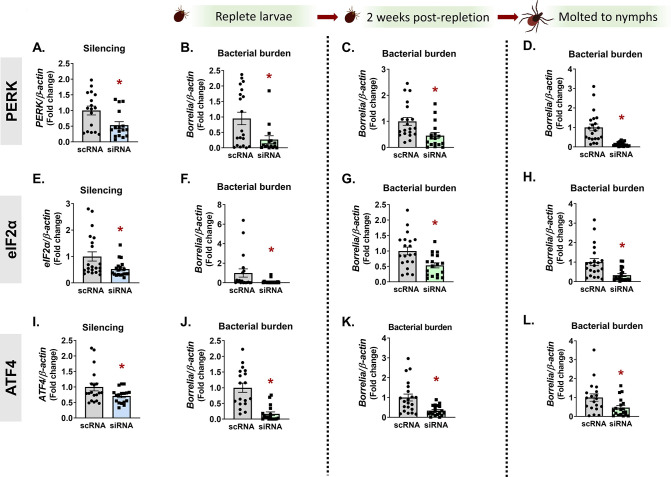
In vivo B. burgdorferi colonization and persistence through the molt is supported by the PERK pathway. PERK (A–D), eIF2α (E–H), or ATF4 (I–L) were silenced in I. scapularis larvae by immersing ticks in siRNA overnight. Recovered ticks were fed on B. burgdorferi-infected mice. Silencing efficiency (A, E, and I) and bacterial burden were assessed at three time intervals by qRT-PCR: immediately following repletion (B, F, and J), 2 weeks post-repletion (C, G, and K), and after ticks molted to nymphs (D, H, and L). Data are representative of 10–20 ticks and at least two experimental replicates. Each point represents one tick, with two technical replicates. Error bars show standard error of the mean. *P < 0.05 (Mann-Whitney test). scRNA, scrambled RNA, siRNA, small interfering RNA.
Fig 5
Fig 5
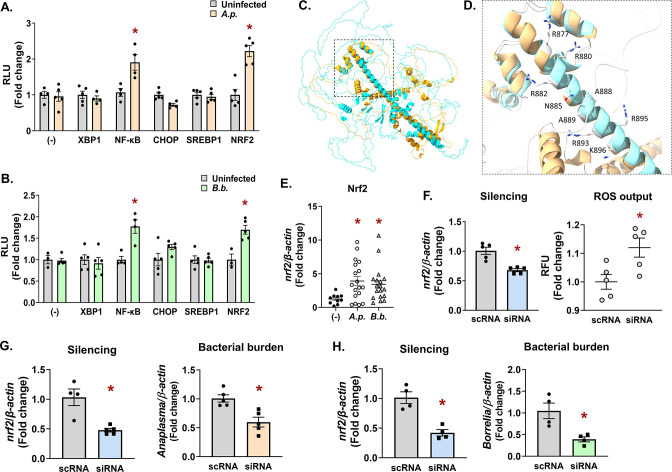
Infection triggers an Nrf2-regulated antioxidant response in ticks that promotes pathogen survival. (A and B) HEK293T cells (1 × 10⁴) were transfected with luciferase reporter vectors for assaying activity of ER stress transcription factors XBP1, NF-κB, CHOP, SREBP1, and NRF2 or were untransfected (−). Cells were then infected with A.p. (A) or B.b. (B). After 24 h, D-luciferin was added and luminescence was measured as RLU. Measurements were normalized to uninfected controls (gray bars). Luciferase assays are representative of three to five biological replicates with at least two experimental replicates ± SEM. Student’s t-test. *P < 0.05. (C and D) Predicted Ixodes Nrf2 structure modeled with AlphaFold (46, 47) (blue) and overlaid with human Nrf2 (orange) using UCSF ChimeraX.(48) The bZIP domain is indicated by a box with dashed lines. (D) Magnified region of the bZIP domain depicting residues that that are predicted to interact with antioxidant response element sequences in DNA promoter regions (R877, R880, R882, N885, A888, A889, R893, R895, and K896). See also Fig. S2. (E) Nrf2 expression levels in flat, unfed nymphs that are uninfected (−), A.p.-infected, or B.b.-infected. Each data point is representative of one nymph. Gene expression was quantified by qRT-PCR using Nrf2 primers listed in Table S1. Student’s t-test. *P < 0.05. (F–H) IDE12 tick cells were treated with silencing RNAs (siRNA) targeting nrf2 for 24 h prior to infection with A. phagocytophilum (18 h) (F and G) or B. burgdorferi (H). Gene silencing (F–H) and bacterial burden (G and H) were quantified by qRT-PCR. ROS was measured as relative fluorescent units after 24 h of infection (F). Data are representative of at least four to five biological replicates and two technical replicates. Error bars show SEM, *P < 0.05 (Student’s t-test). bZIP, basic leucine zipper; RLU, relative luminescence unit; scRNA, scrambled RNA; SEM, standard error of the mean; siRNA, small interfering RNA.
Fig 6
Fig 6
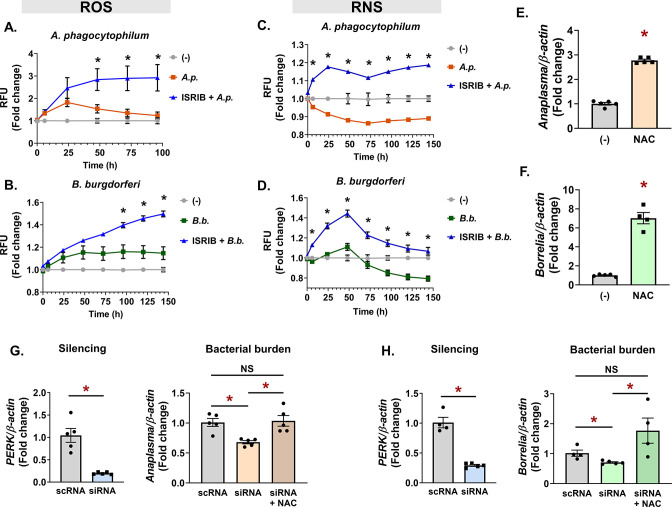
Antioxidant activity of the PERK-eIF2α pathway protects pathogens in ticks. (A–D) ROS (A and B) and RNS (C and D) measurements in ISE6 cells (1.68 × 10⁵) untreated (-), infected (A.p. or B.b.), or pretreated with 1-µM ISRIB prior to infection with A. phagocytophilum (ISRIB + A.p.) (A and C) or B. burgdorferi (ISRIB + B.b.) (B and D). Fluorescence was measured at the indicated time points and is presented as RFU, normalized to untreated, uninfected controls (−). See also Fig. S3A and B. (E and F) IDE12 cells were infected with A. phagocytophilum (E) or B. burgdorferi (F) alone or in the presence of NAC for 24 h. (G and H) perk was silenced in IDE12 cells (1 × 10⁶). Cells were infected with A. phagocytophilum (G) or B. burgdorferi (H) alone or in the presence of NAC. See also Fig. S4A and B. Silencing levels and bacterial burdens were quantified by qRT-PCR. Data are representative of at least four to five biological replicates and two technical replicates. Error bars show SEM. *P < 0.05 (Student’s t-test). NAC, N-acetyl cysteine; RFU, relative fluorescent unit; scRNA, scrambled RNA; siRNA, small interfering RNA.
Fig 7
Fig 7
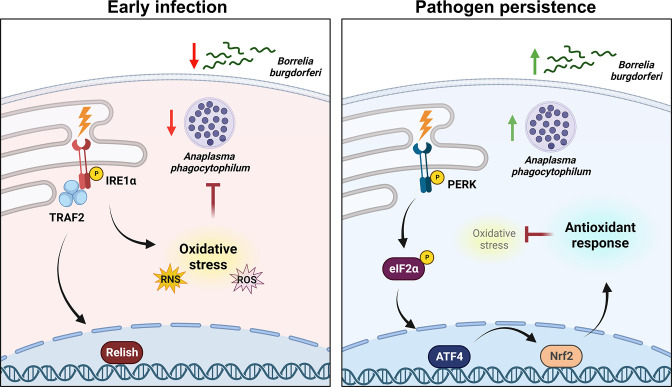
The PERK-eIF2α-ATF4 axis promotes pathogen survival in ticks through an Nrf2-mediated antioxidant response. When colonizing the tick, A. phagocytophilum and B. burgdorferi trigger the Ixodes IMD pathway and ROS/RNS through the IRE1α-TRAF2 axis of the UPR. Tick-borne microbes persist in the tick over time by stimulating the PERK branch of the UPR, which signals through eIF2α and the transcription factors ATF4 and Nrf2 to trigger an antioxidant response that promotes microbial survival.

Update of

References

    1. WHO . n.d. Vector-borne diseases. WHO. Available from: http://www.who.int/mediacentre/factsheets/fs387/en
    1. Paddock CD, Lane RS, Staples JE, Labruna MB. 2016. Changing paradigms for tick-borne diseases in the Americas. In Global health impacts of vector-borne diseases: workshop summary. National Academies Press (US), Washington (DC). - PubMed
    1. 2011. “The short-term and long-term outcomes: workshop report” Critical Needs and Gaps in Understanding Prevention, Amelioration, and Resolution of Lyme and Other Tick-Borne Diseases; National Academies Press, Washington, D.C. doi: 10.17226/13134 - DOI - PubMed
    1. Jongejan F, Uilenberg G. 2004. The global importance of ticks. Parasitology 129 Suppl:S3–S14. doi: 10.1017/s0031182004005967 - DOI - PubMed
    1. Park JM, Oliva Chávez AS, Shaw DK. 2021. Ticks: more than just a pathogen delivery service. Front Cell Infect Microbiol 11:739419. doi: 10.3389/fcimb.2021.739419 - DOI - PMC - PubMed

Publication types