Stannous Source in Toothpastes Leads to Differences in Their Antimicrobial Efficacy
- PMID: 37737308
- PMCID: PMC11619871
- DOI: 10.3290/j.ohpd.b4424911
Stannous Source in Toothpastes Leads to Differences in Their Antimicrobial Efficacy
Abstract
Purpose: The aim of this in-vitro study was to investigate the antimicrobial efficacy of identical experimental toothpastes with different stannous sources.
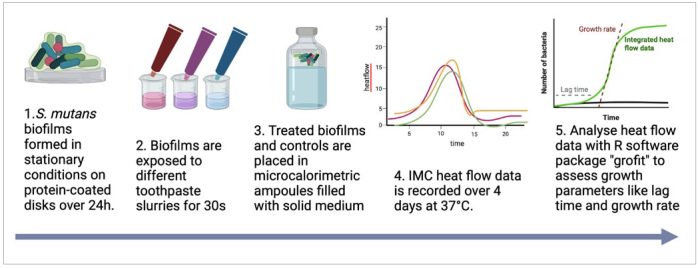
Materials and methods: Streptococcus mutans biofilms were grown on protein-coated glass disks in static conditions for 24 h and thereafter exposed to toothpaste slurries or physiological saline (negative control; n = 15) for 30 s. Four experimental toothpastes were applied in this study, containing either stannous chloride (SnCl2; B: 3500 ppm Sn2+, and D: 3600 ppm Sn2+) or stannous fluoride (SnF2; C: 3500 ppm Sn2+, and E: 3600 ppm Sn2+). Marketed toothpaste meridol® (A: 3300 ppm SnF2) served as control. All five toothpastes contained amine fluoride (AmF). The biofilms were placed on agar surface and their metabolic activity was assessed by isothermal microcalorimetry over 96 h. The heat flow data was analysed for growth rate and lag time using grofit package in software R. Additionally, reduction of active biofilm compared to untreated control was calculated.
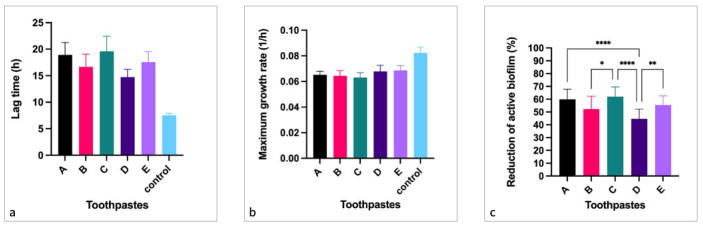
Results: All toothpastes significantly prolong the lag time of treated biofilms in comparison to negative control (p < 0.05). Toothpastes containing SnF2 (C and E) prolonged the lag time statistically significantly compared to toothpastes containing SnCl2 (B and D) (p < 0.05). The maximum growth rate was statistically significantly reduced by all tested toothpastes compared to the untreated control group (p < 0.05). Toothpastes containing SnF2 (A, C and E) reached 59.9 ± 7.8, 61.9 ± 7.7, and 55.6 ± 7.0% reduction of active biofilm, respectively. Thus, they exhibit statistically significantly better results than toothpastes B (52.9 ± 9.9%) and D (44.7 ± 7.6%). Toothpaste D, which contains a slightly higher concentration of Sn2+, was the least effective in reducing active biofilm.
Conclusion: The toothpastes containing SnF2 combined with AmF had the highest antimicrobial efficacy in this study.
Keywords: antimicrobial; biofilm; caries; stannous chloride; stannous fluoride; toothpaste.
Figures
Similar articles
-
Efficacy of Experimental Mouth Rinses on Caries-Related Biofilms in vitro.Front Oral Health. 2021 Jul 14;2:676028. doi: 10.3389/froh.2021.676028. eCollection 2021. Front Oral Health. 2021. PMID: 35048021 Free PMC article.
-
A comparative in vitro study investigating the occlusion and mineralization properties of commercial toothpastes in a four-day dentin disc model.J Clin Dent. 2011;22(3):74-81. J Clin Dent. 2011. PMID: 21905401
-
Combined use of stannous fluoride-containing mouth rinse and toothpaste prevents enamel erosion in vitro.Clin Oral Investig. 2023 Sep;27(9):5189-5201. doi: 10.1007/s00784-023-05138-4. Epub 2023 Jul 11. Clin Oral Investig. 2023. PMID: 37432505 Free PMC article.
-
[Study of the effectiveness of amine fluoride and stannous fluoride containing toothpaste and mouthwash].Fogorv Sz. 1991 Jun-Jul;84(6-7):181-4. Fogorv Sz. 1991. PMID: 1915968 Review. Hungarian.
-
Experiences with amine fluoride containing products in the management of dental hard tissue lesions focusing on Hungarian studies: a review.Acta Med Acad. 2013 Nov;42(2):189-97. doi: 10.5644/ama2006-124.86. Acta Med Acad. 2013. PMID: 24308398 Review.
Cited by
-
Stannous Fluoride in Toothpastes: A Review of Its Clinical Effects and Likely Mechanisms of Action.J Funct Biomater. 2025 Feb 20;16(3):73. doi: 10.3390/jfb16030073. J Funct Biomater. 2025. PMID: 40137352 Free PMC article. Review.
-
Interactions and effects of a stannous-containing sodium fluoride dentifrice on oral pathogens and the oral microbiome.Front Microbiol. 2024 Feb 15;15:1327913. doi: 10.3389/fmicb.2024.1327913. eCollection 2024. Front Microbiol. 2024. PMID: 38426054 Free PMC article.
-
Antiseptics Prescription for the Prevention and Treatment of Periodontal Diseases: A Comprehensive Review.Health Sci Rep. 2025 Jul 9;8(7):e71019. doi: 10.1002/hsr2.71019. eCollection 2025 Jul. Health Sci Rep. 2025. PMID: 40636542 Free PMC article.
-
Effect of Dentifrice Ingredients on Volume and Vitality of a Simulated Periodontal Multispecies Biofilm.Dent J (Basel). 2024 May 13;12(5):141. doi: 10.3390/dj12050141. Dent J (Basel). 2024. PMID: 38786539 Free PMC article.
References
-
- Arweiler NB, Auschill TM, Reich E, Netuschil L. Substantivity of toothpaste slurries and their effect on reestablishment of the dental biofilm. J Clin Periodontol. 2002;29:615–621. - PubMed
-
- Astasov-Frauenhoffer M, Braissant O, Hauser-Gerspach I, Weiger R, Walter C, Zitzmann NU, et al. Microcalorimetric determination of the effects of amoxicillin, metronidazole, and their combination on in vitro biofilm. J Periodontol. 2014;85:349–357. - PubMed
-
- Auschill TM, Deimling D, Hellwig E, Arweiler NB. Antibacterial effect of two toothpastes following a single brushing. Oral Health Prev Dent. 2007;5:25–32. - PubMed
-
- Baig A, He T, Buisson J, Sagel L, Suszcynsky-Meister E, White DJ. Extrinsic whitening effects of sodium hexametaphosphate – a review including a dentifrice with stabilized stannous fluoride. Compend Contin Educ Dent. 2005;26:47–53. - PubMed
MeSH terms
Substances
LinkOut - more resources
Full Text Sources
Molecular Biology Databases