


Combination of Fibrosis-4, liver-stiffness measurement, and Fibroscan-AST score to predict liver-related outcomes in nonalcoholic fatty liver disease
- PMID: 37738409
- PMCID: PMC10519529
- DOI: 10.1097/HC9.0000000000000244
Combination of Fibrosis-4, liver-stiffness measurement, and Fibroscan-AST score to predict liver-related outcomes in nonalcoholic fatty liver disease
Abstract
Introduction: Noninvasive tests, such as Fibrosis-4 (FIB-4), liver-stiffness measurement (LSM) by vibration-controlled transient elastography, and Fibroscan-AST (FAST), are frequently used for risk stratification in NAFLD. The comparative performance of FIB-4 and LSM and FAST to predict clinical outcomes of patients with NAFLD remained unclear. We aim to evaluate the performance of FIB-4, LSM, and FAST scores to predict clinical outcomes in patients with NAFLD.
Methods: We included consecutive adult patients with NAFLD with transient elastography performed between 2015 and 2022 from the United States and Singapore. Patients with NAFLD stratified based on baseline FIB-4, LSM, and FAST score were followed up until clinical outcomes notably liver-related events (LREs), LREs or death, death, and major adverse cardiac events.
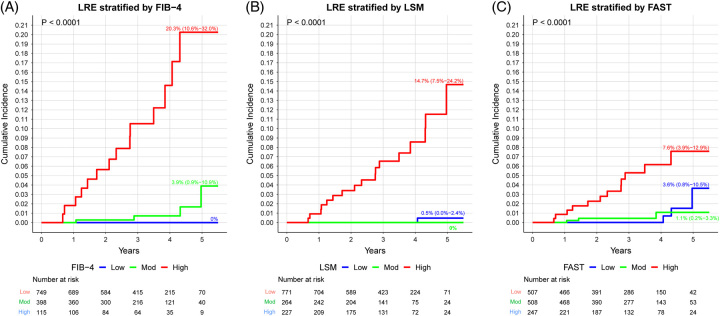
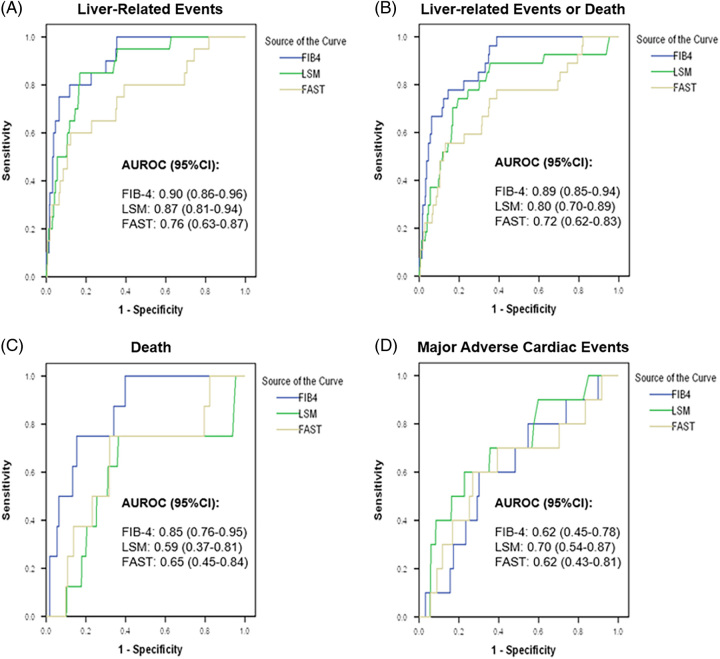
Results: A total of 1262 patients with NAFLD (63% with obesity and 37% with diabetes) with vibration-controlled transient elastography were followed up for median 3.5 years. FIB-4 stratified patients with NAFLD into low-risk (<1.3), intermediate-risk (1.3-2.67), and high-risk (>2.67) in 59.4%, 31.5%, and 9.1%, respectively. No LRE occurred with baseline FIB-4 <1.3, regardless of LSM and FAST score. Higher FIB-4 was associated with a higher risk of LREs within each LSM category. FIB-4 had a higher area under the received operating characteristic curve than LSM or FAST score to predict LRE.
Conclusions: In this multicenter international study, FIB-4 and LSM synergistically predicted the risk of LRE. In patients with FIB-4 <1.3, vibration-controlled transient elastography may incorrectly classify up to 10% of the patients as high risk. FIB-4 should be incorporated into risk stratification in NAFLD even among patients who underwent VCTE.
Copyright © 2023 The Author(s). Published by Wolters Kluwer Health, Inc. on behalf of the American Association for the Study of Liver Diseases.
Conflict of interest statement
Vincent L. Chen received grants from KOWA and AstraZeneca. The remaining authors have no conflicts to report.
Figures
References
-
- Le MH, Yeo YH, Li X, Li J, Zou B, Wu Y, et al. 2019 Global NAFLD Prevalence: a systematic review and meta-analysis. Clin Gastroenterol Hepatol. 2022;20:2809–17.e28. - PubMed
-
- Younossi ZM, Stepanova M, Ong J, Trimble G, AlQahtani S, Younossi I, et al. Nonalcoholic steatohepatitis is the most rapidly increasing indication for liver transplantation in the United States. Clin Gastroenterol Hepatol. 2021;19:580–9.e5. - PubMed
-
- Choo BP, Goh GBB, Chia SY, Oh HC, Tan NC, Tan JYL, et al. Non-alcoholic fatty liver disease screening in type 2 diabetes mellitus: A cost-effectiveness and price threshold analysis. Ann Acad Med Singap. 2022;51:686–94. - PubMed
Publication types
MeSH terms
Grants and funding
LinkOut - more resources
Full Text Sources
Medical
