Review
. 2023 Nov:146:106570.
doi: 10.1016/j.oraloncology.2023.106570. Epub 2023 Sep 20.

Egress of resident memory T cells from tissue with neoadjuvant immunotherapy: Implications for systemic anti-tumor immunity

Affiliations
Review

Egress of resident memory T cells from tissue with neoadjuvant immunotherapy: Implications for systemic anti-tumor immunity

Magdalena A Rainey et al. Oral Oncol. 2023 Nov.

Abstract

Introduction: Resident memory T (TRM) cells are embedded in peripheral tissue and capable of acting as sentinels that can respond quickly to repeat pathogen exposure as part of an endogenous anti-microbial immune response. Recent evidence suggests that chronic antigen exposure and other microenvironment cues may promote the development of TRM cells within solid tumors as well, and that this TRM phenotype can sequester tumor-specific T cells into tumors and out of circulation resulting in limited systemic antitumor immunity. Here, we perform a review of the published English literature and describe tissue-specific mediators of TRM cell differentiation in states of infection and malignancy with special focus on the role of TGF-β and how targeting TGF-β signaling could be used as a therapeutical approach to promote tumor systemic immunity.

Discussion: The presence of TRM cells with antigen specificity to neoepitopes in tumors associates with positive clinical prognosis and greater responsiveness to immunotherapy. Recent evidence indicates that solid tumors may act as reservoirs for tumor specific TRM cells and limit their circulation - possibly resulting in impaired systemic antitumor immunity. TRM cells utilize specific mechanisms to egress from peripheral tissues into circulation and other peripheral sites, and emerging evidence indicates that immunotherapeutic approaches may initiate these processes and increase systemic antitumor immunity.

Conclusions: Reversing tumor sequestration of tumor-specific T cells prior to surgical removal or radiation of tumor may increase systemic antitumor immunity. This finding may underlie the improved recurrence free survival observed with neoadjuvant immunotherapy in clinical trials.


Conflict of interest statement

Declaration of Competing Interest The authors declare that they have no known competing financial interests or personal relationships that could have appeared to influence the work reported in this paper.

Figures
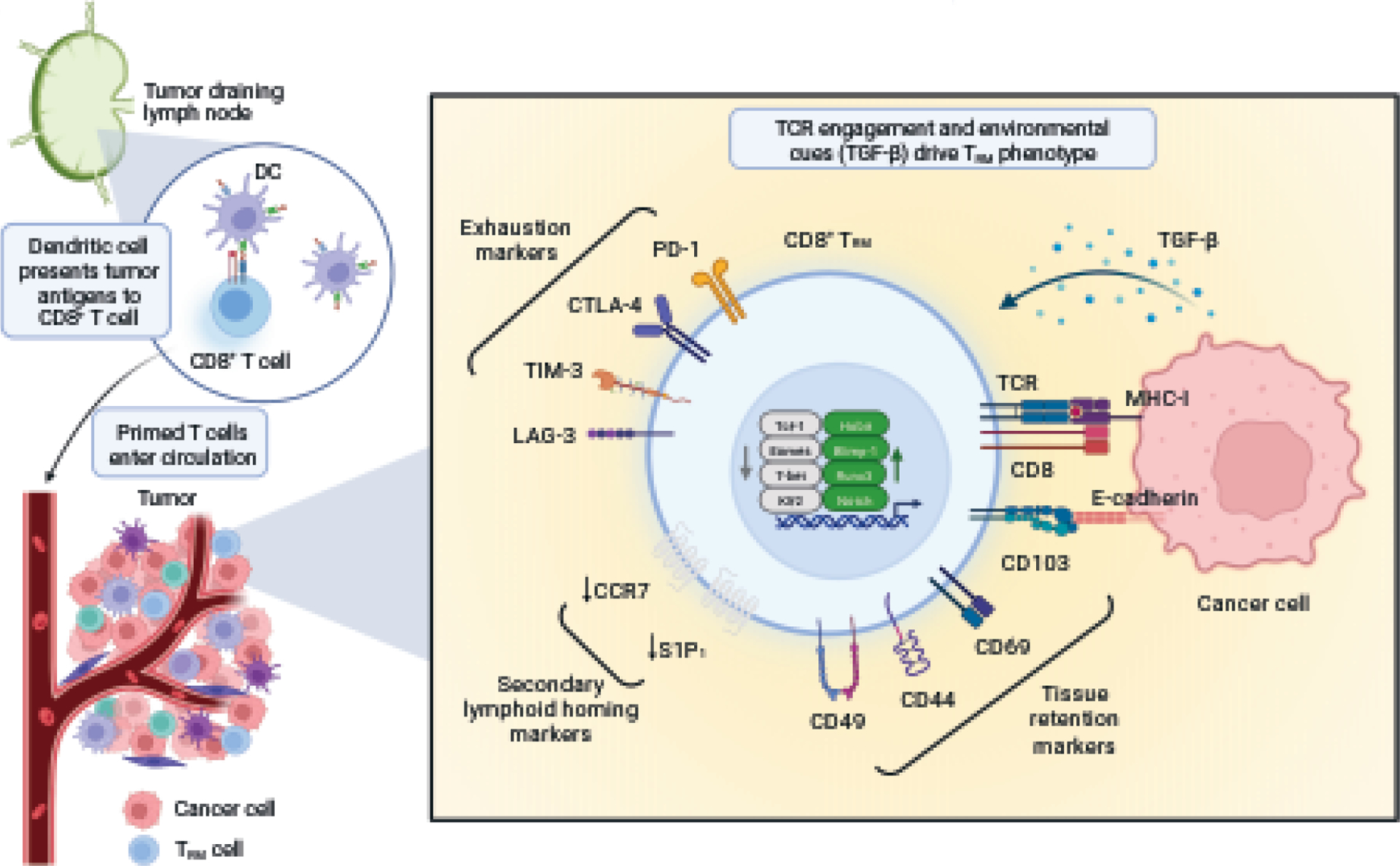
Figure 1:
Figure 1:. Mechanisms of development and maintenance of TRM cells.
Tissue-specific dendritic cells (DCs) migrate to the draining lymph nodes (dLN) where they present antigens to naïve T cells. Once primed, these T cells have the capacity to become CD8+ TRM precursors and migrate to the injured tissue, following a chemotactic gradient. In the tissue, exposure to transforming growth factor beta (TGF-β) initiates the resident memory program, namely by driving the expression of the integrin alpha E (ITGAE/CD103) that binds to E-cadherin expressed by the tissue, enforcing retention. TGF-β is also important in driving the general transcriptional profile of TRM cells, which requires the expression of Hobit, Blimp-1, Runx3 and Notch and downregulation of Tcf-1, Eomes, T-bet and Klf2. TRM cells are often characterized by the expression of immune checkpoint receptors associated with T cell exhaustion such as Lag-3, TIM-3, CTLA-4, and PD-1.
Figure 2:
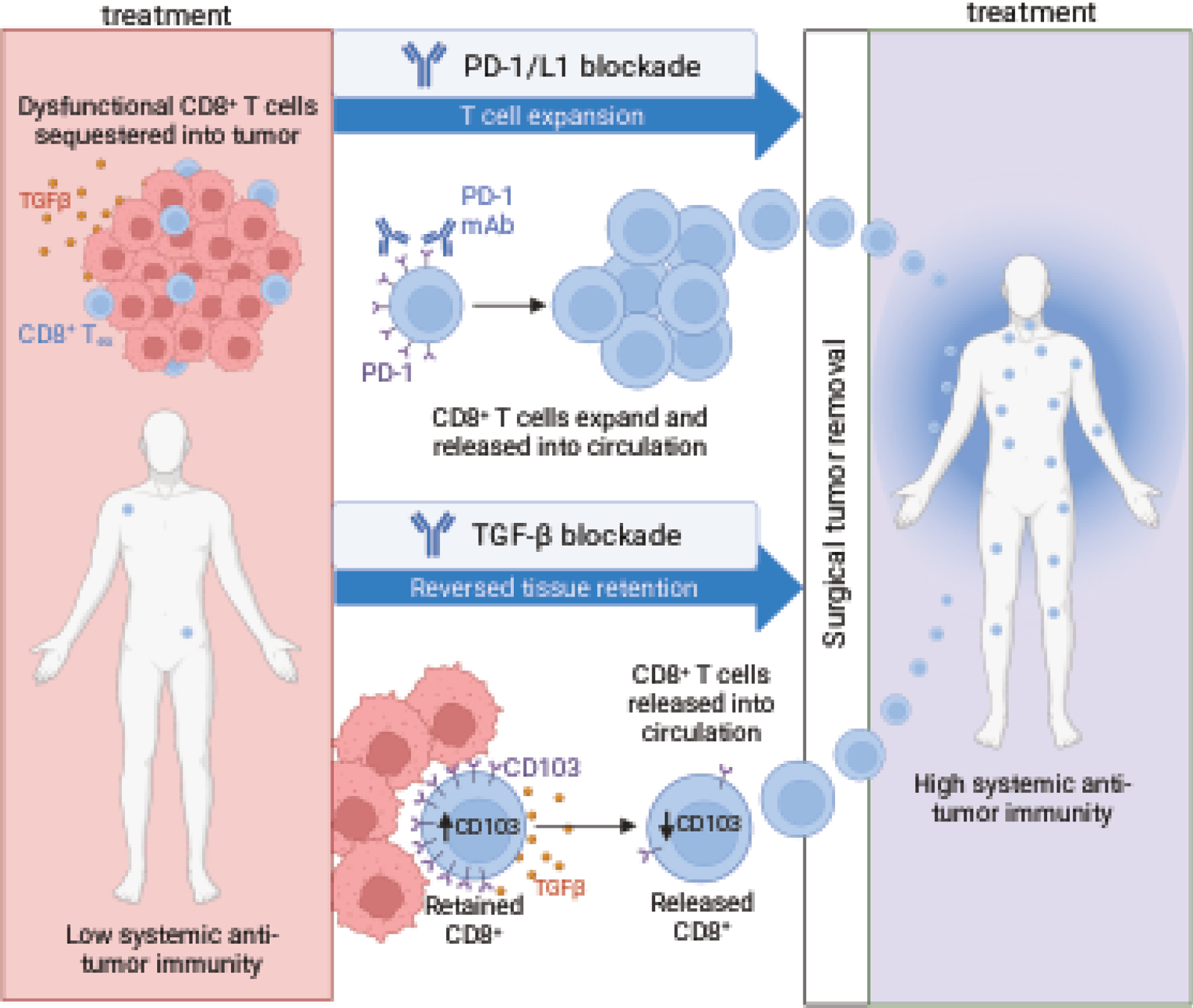
Figure 2:. Neoadjuvant therapy as a strategy to induce recirculation of TRM-like cells and systemic immunity against cancer.
Through expression of tissue resident markers such as CD103, exhausted, dysfunctional CD8+ T cells reside in tumor tissue. PD-1 targeting immune checkpoint blockade with or without TGF- β blockade enhance egress of CD8+ T cells out of the tumor and into circulation prior to surgical removal of the tumor. This treatment result may increase the systemic anti-tumor immunity of the patient and improve recurrence free survival.

References

    1. Bonilla FA, Oettgen HC. Adaptive immunity. J Allergy Clin Immunol. Feb 2010;125(2 Suppl 2):S33–40. doi:10.1016/j.jaci.2009.09.017 - DOI - PubMed
    1. Masopust D, Schenkel JM. The integration of T cell migration, differentiation and function. Nat Rev Immunol. May 2013;13(5):309–20. doi:10.1038/nri3442 - DOI - PubMed
    1. Jameson SC, Masopust D. Understanding Subset Diversity in T Cell Memory. Immunity. Feb 20 2018;48(2):214–226. doi:10.1016/j.immuni.2018.02.010 - DOI - PMC - PubMed
    1. Gebhardt T, Wakim LM, Eidsmo L, Reading PC, Heath WR, Carbone FR. Memory T cells in nonlymphoid tissue that provide enhanced local immunity during infection with herpes simplex virus. Nat Immunol. May 2009;10(5):524–30. doi:10.1038/ni.1718 - DOI - PubMed
    1. Masopust D, Vezys V, Usherwood EJ, et al. Activated primary and memory CD8 T cells migrate to nonlymphoid tissues regardless of site of activation or tissue of origin. J Immunol. Apr 15 2004;172(8):4875–82. doi:10.4049/jimmunol.172.8.4875 - DOI - PubMed

Publication types

Substances