


Evaluation of survival outcome and prognostic factors for oral cavity cancer treated with volumetric arc therapy
- PMID: 37740764
- PMCID: PMC11798281
- DOI: 10.1007/s00432-023-05397-4
Evaluation of survival outcome and prognostic factors for oral cavity cancer treated with volumetric arc therapy
Abstract
Purpose: This study aimed to evaluate the survival outcomes and identify prognostic factors for patients with oral cavity cancer (OCC) who underwent adjuvant treatment with volumetric arc therapy (VMAT) using simultaneous integrated boost (SIB).
Methods: Data was collected for post-operated patients of carcinoma of oral cavity who received adjuvant VMAT with SIB between June 2018 and December 2022. The data was entered and analyzed using SPSS software version 20.0. Survival rates were estimated using Kaplan Meier method. To determine survival difference between the groups, log rank test was used. Multivariate analyses were performed with Cox proportional hazard model and p value < 0.05 was considered as significant.
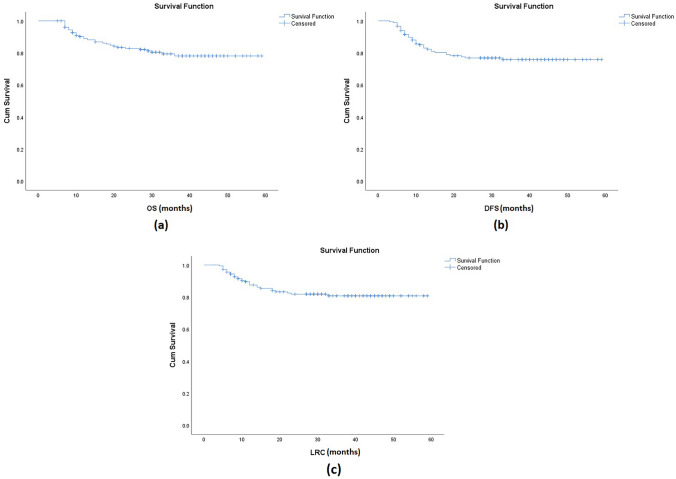
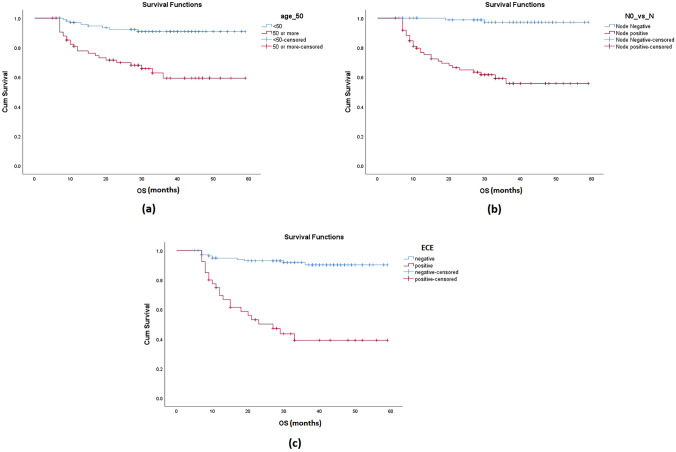
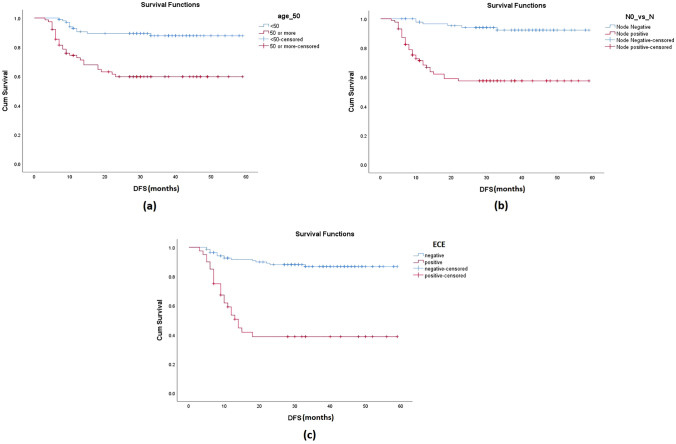
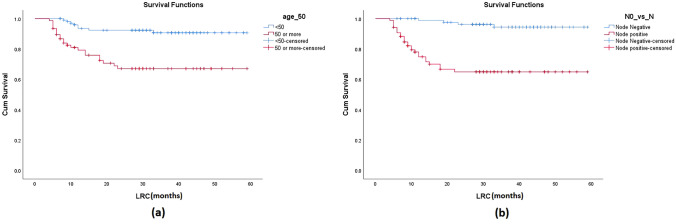
Results: A total of 178 patients were included in the study. The median follow-up period was 26 months (range 3-56 months). The 3-year OS, DFS, and LRC rates were 78% (95% CI 77-79%), 76% (95% CI 74-77%), and 81% (95% CI 80-82%), respectively. Univariate analysis identified age ≥ 50 years, lymph node involvement, extracapsular extension (ECE), and N2-N3 disease as significant adverse prognostic factors for OS, DFS, and LRC. Multivariate analysis confirmed age ≥ 50 years and nodal involvement as independent predictors of worse OS, DFS, and LRC. Additionally, ECE independently affected OS and DFS.
Conclusion: Adjuvant treatment with VMAT using SIBin patients with OCC is effective. Age and nodal involvement had significant impact on LRC, DFSand OS while ECE on DFSand OS.
Keywords: Oral cavity; Prognostic factors; Squamous cell carcinoma; Survival; Volumetric-modulated arc therapy.
© 2023. The Author(s), under exclusive licence to Springer-Verlag GmbH Germany, part of Springer Nature.
Conflict of interest statement
The author(s) declare no competing interests.
Figures
References
-
- Bernier J, Domenge C, Ozsahin M et al (2004) European Organization for Research and Treatment of Cancer Trial 22931. Postoperative irradiation with or without concomitant chemotherapy for locally advanced head and neck cancer. N Engl J Med 350(19):1945–1952. 10.1056/NEJMoa032641 - PubMed
-
- Boysen M, Lövdal O, Winther F et al (1992) The value of follow-up in patients treated for squamous cell carcinoma of the head and neck. Eur J Cancer 28:426–430. 10.1016/s0959-8049(05)80068-1 - PubMed
-
- Chao KSC, Ozyigit G, Tran BN et al (2003) Patterns of failure in patients receiving definitive and postoperative imrt for head-and-neck cancer. Int J Radiat Oncol Biol Phys 55(2):312–321. 10.1016/s0360-3016(02)03940-8 - PubMed
-
- Chen WC, Hwang TZ, Wang WH et al (2009) Comparison between conventional and intensity-modulated post-operative radiotherapy for stage III and IV oral cavity cancer in terms of treatment results and toxicity. Oral Oncol 45(6):505–510. 10.1016/j.oraloncology.2008.07.002 - PubMed
MeSH terms
LinkOut - more resources
Full Text Sources
Medical
