


Multiomics analysis reveals the molecular basis for increased body weight in silkworms (Bombyx mori) exposed to environmental concentrations of polystyrene micro- and nanoplastics
- PMID: 37741508
- PMCID: PMC10918344
- DOI: 10.1016/j.jare.2023.09.010
Multiomics analysis reveals the molecular basis for increased body weight in silkworms (Bombyx mori) exposed to environmental concentrations of polystyrene micro- and nanoplastics
Abstract
Introduction: Micro- and nanoplastics (MNPs) are emerging environmental pollutants that have raised serious concerns about their potential impact on ecosystem and organism health. Despite increasing efforts to investigate the impacts of micro- and nanoplastics (MNPs) on biota little is known about their potential impacts on terrestrial organisms, especially insects, at environmental concentrations.
Objectives: To address this gap, we used an insect model, silkworm Bombyx mori to examine the potential long-term impacts of different sizes of polystyrene (PS) MNPs at environmentally realistic concentrations (0.25 to 1.0 μg/mL).
Methods: After exposure to PS-MNPs over most of the larval lifetime (from second to last instar), the endpoints were examined by an integrated physiological (growth and survival) and multiomics approach (metabolomics, 16S rRNA, and transcriptomics).
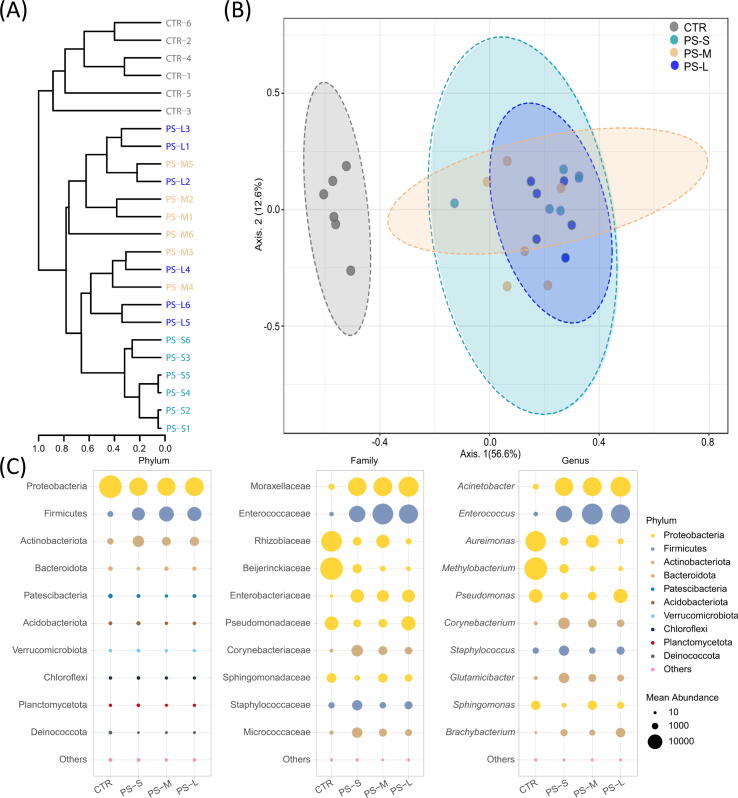
Results: Our results indicated that dietary exposures to PS-MNPs had no lethal effect on survivorship, but interestingly, increased host body weight. Multiomics analysis revealed that PS-MNPs exposure significantly altered multiple pathways, particularly lipid metabolism, leading to enriched energy reserves. Furthermore, the exposure changed the structure and composition of the gut microbiome and increased the abundance of gut bacteria Acinetobacter and Enterococcus. Notably, the predicted functional profiles and metabolite expressions were significantly correlated with bacterial abundance. Importantly, these observed effects were particle size-dependent and were ranked as PS-S (91.92 nm) > PS-M (5.69 µm) > PS-L (9.7 µm).
Conclusion: Overall, PS-MNPs at environmentally realistic concentrations exerted stimulatory effects on energy metabolism that subsequently enhanced body weight in silkworms, suggesting that chronic PS-MNPs exposure might trigger weight gain in animals and humans by influencing host energy and microbiota homeostasis.
Keywords: Gut microbiome; Metabolome; Model organism; Particle size-dependent effects; Silkworm; Transcriptome.
Copyright © 2024. Production and hosting by Elsevier B.V.
Conflict of interest statement
Declaration of Competing Interest The authors declare that they have no known competing financial interests or personal relationships that could have appeared to influence the work reported in this paper.
Figures




References
-
- Agathokleous E, Iavicoli I, Barceló D, Calabrese EJ. Micro/nanoplastics effects on organisms: A review focusing on ‘dose’. J Hazard Mater. 2021;417:126084. - PubMed
-
- Statista, Plastic production worldwide, https://www.statista.com, (2022).
-
- Agathokleous E, Iavicoli I, Barceló D, Calabrese EJ. Ecological risks in a ‘plastic’world: a threat to biological diversity? J Hazard Mater. 2021;417:126035. - PubMed
-
- Singh N., Hui D., Singh R., Ahuja I.P.S., FeoF L. Fraternali, Recycling of plastic solid waste: A state of art review and future applications. Compos Part B-Eng. 2017;115:409–422. doi: 10.1016/j.compositesb.2016.09.013. - DOI
Publication types
MeSH terms
Substances
LinkOut - more resources
Full Text Sources
Miscellaneous
