


A randomised pilot feasibility study of eye movement desensitisation and reprocessing recent traumatic episode protocol, to improve psychological recovery following intensive care admission for COVID-19
- PMID: 37744073
- PMCID: PMC9679313
- DOI: 10.1177/17511437221136828
A randomised pilot feasibility study of eye movement desensitisation and reprocessing recent traumatic episode protocol, to improve psychological recovery following intensive care admission for COVID-19
Abstract
Background: Approximately 50% of intensive care survivors experience persistent psychological symptoms. Eye-movement desensitisation and reprocessing (EMDR) is a widely recommended trauma-focussed psychological therapy, which has not been investigated systematically in a cohort of intensive care survivors: We therefore conducted a randomised pilot feasibility study of EMDR, using the Recent Traumatic Episode Protocol (R-TEP), to prevent psychological distress in intensive care survivors. Findings will determine whether it would be possible to conduct a fully-powered clinical effectiveness trial and inform trial design.
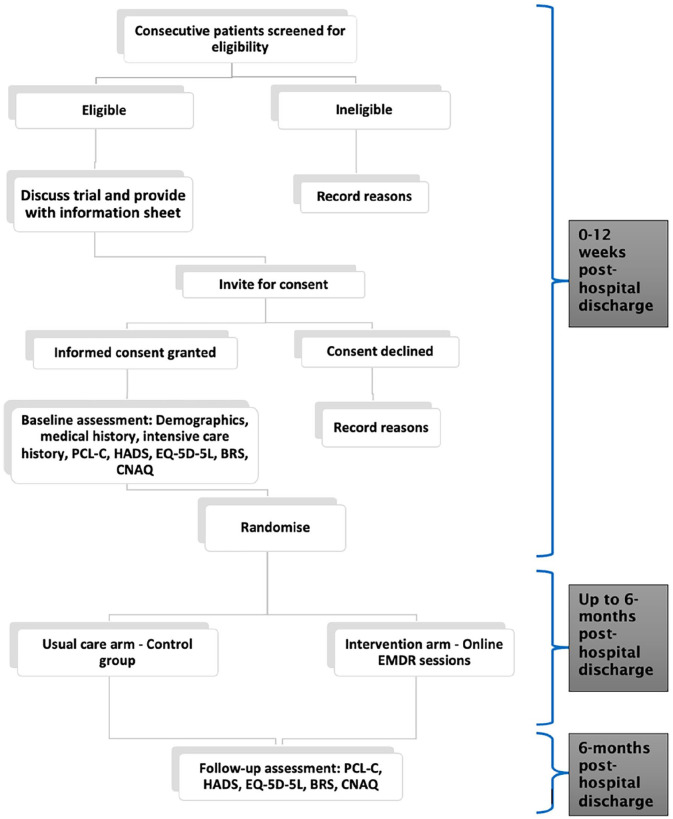
Method: We aimed to recruit 26 patients who had been admitted to intensive care for over 24 h with COVID-19 infection. Consenting participants were randomised (1:1) to receive either usual care plus remotely delivered EMDR R-TEP or usual care alone (controls). The primary outcome was feasibility. We also report factors related to safety and symptom changes in post-traumatic stress disorder, (PTSD) anxiety and depression.
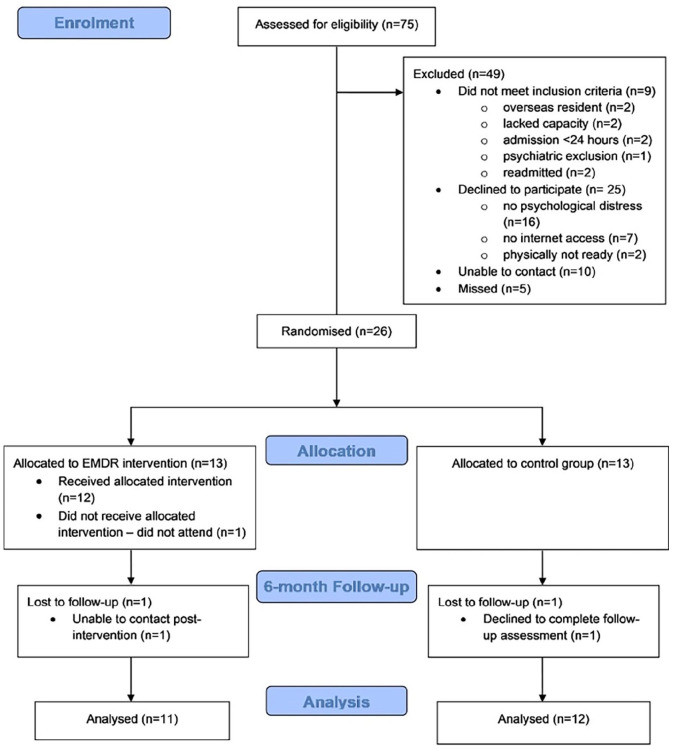
Results: We approached 51 eligible patients, with 26 (51%) providing consent. Intervention adherence (sessions offered/sessions completed) was 83%, and 23/26 participants completed all study procedures. There were no attributable adverse events. Between baseline and 6-month follow-up, mean change in PTSD score was -8 (SD = 10.5) in the intervention group versus +0.75 (SD = 15.2) in controls (p = 0.126). There were no significant changes to anxiety or depression.
Conclusion: Remotely delivered EMDR R-TEP met pre-determined feasibility and safety objectives. Whilst we achieved group separation in PTSD symptom change, we have identified a number of protocol refinements that would improve the design of a fully powered, multi-centre randomised controlled trial, consistent with currently recommended rehabilitation clinical pathways.
Trial registration: ClinicalTrials.gov: NCT04455360.
Keywords: COVID; Critical care; EMDR; PTSD; R-TEP; anxiety; depression; early EMDR intervention; feasibility; intensive care; psychology.
© The Author(s) 2022.
Conflict of interest statement
The author(s) declared no potential conflicts of interest with respect to the research, authorship, and/or publication of this article.
Figures
References
-
- Flaatten H, Waldmann C. The post-ICU syndrome, history and definition. In: Preiser J-C, Herridge M, Azoulay E. (eds) Post-intensive care syndrome. Cham, Switzerland: Springer, 2020, 3–12.
-
- Parker AM, Sricharoenchai T, Raparla S, et al. Posttraumatic stress disorder in critical illness survivors: a meta-analysis. Crit Care Med 2015; 43: 1121–1129. - PubMed
Associated data
LinkOut - more resources
Full Text Sources
Medical
Miscellaneous