


To vaccinate or to isolate? Establishing which intervention leads to measurable mortality reduction during the COVID-19 Delta wave in Poland
- PMID: 37744498
- PMCID: PMC10513426
- DOI: 10.3389/fpubh.2023.1221964
To vaccinate or to isolate? Establishing which intervention leads to measurable mortality reduction during the COVID-19 Delta wave in Poland
Abstract
Background: During the Delta variant COVID-19 wave in Poland there were serious regional differences in vaccination rates and discrepancies in the enforcement of pandemic preventive measures, which allowed us to assess the relative effectiveness of the policies implemented.
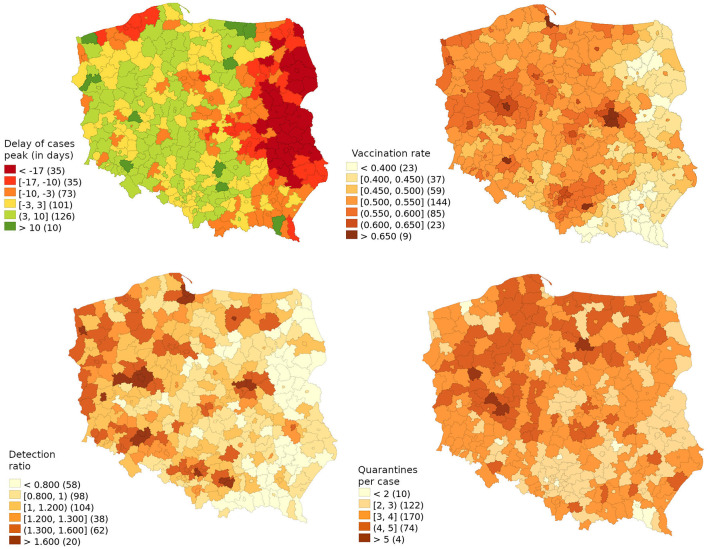
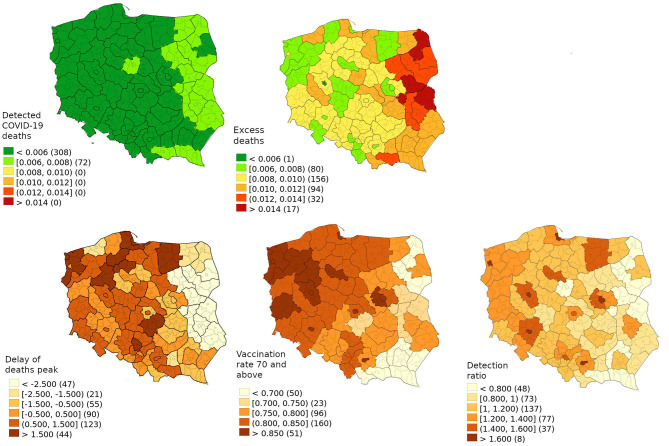
Methods: Creating a model that would predict mortality based on vaccination rates among the most vulnerable groups and the timing of the wave peak enabled us to calculate to what extent flattening the curve reduced mortality. Subsequently, a model was created to assess which preventive measures delayed the peak of infection waves. Combining those two models allowed us to estimate the relative effectiveness of those measures.
Results: Flattening the infection curve worked: according to our model, each week of postponing the peak of the wave reduced excess deaths by 1.79%. Saving a single life during the Delta wave required one of the following: either the vaccination of 57 high-risk people, or 1,258 low-risk people to build herd immunity, or the isolation of 334 infected individuals for a cumulative period of 10.1 years, or finally quarantining 782 contacts for a cumulative period of 19.3 years.
Conclusions: Except for the most disciplined societies, vaccination of high-risk individuals followed by vaccinating low-risk groups should have been the top priority instead of relying on isolation and quarantine measures which can incur disproportionately higher social costs. Our study demonstrates that even in a country with uniform policies, implementation outcomes varied, highlighting the importance of fine-tuning policies to regional specificity.
Keywords: COVID-19; SARS-CoV-2; evidence-based policy; flattening the curve; vaccination.
Copyright © 2023 Walkowiak, Walkowiak and Walkowiak.
Conflict of interest statement
The authors declare that the research was conducted in the absence of any commercial or financial relationships that could be construed as a potential conflict of interest.
Figures
References
-
- Non-pharmaceutical public health measures for mitigating the risk and impact of epidemic and pandemic influenza . Available online at: https://www.who.int/publications-detail-redirect/non-pharmaceutical-publ... (accessed June 25, 2023).
-
- Davies NG, Kucharski AJ, Eggo RM, Gimma A, Edmunds WJ, Centre for the Mathematical Modelling of Infectious Diseases COVID-19 working group . Effects of non-pharmaceutical interventions on COVID-19 cases, deaths, and demand for hospital services in the UK: a modelling study. Lancet Public Health. (2020) 5:e375–85. 10.1016/S2468-2667(20)30133-X - DOI - PMC - PubMed
MeSH terms
Supplementary concepts
LinkOut - more resources
Full Text Sources
Medical
Miscellaneous
