


Comparative study in vivo of the osseointegration of 3D-printed and plasma-coated titanium implants
- PMID: 37744721
- PMCID: PMC10514715
- DOI: 10.5312/wjo.v14.i9.682
Comparative study in vivo of the osseointegration of 3D-printed and plasma-coated titanium implants
Abstract
Background: Total hip arthroplasty is a common surgical treatment for elderly patients with osteoporosis, particularly in postmenopausal women. In such cases, highly porous acetabular components are a favorable option in achieving osseointegration. However, further discussion is needed if use of such acetabular components is justified under the condition of normal bone mass.
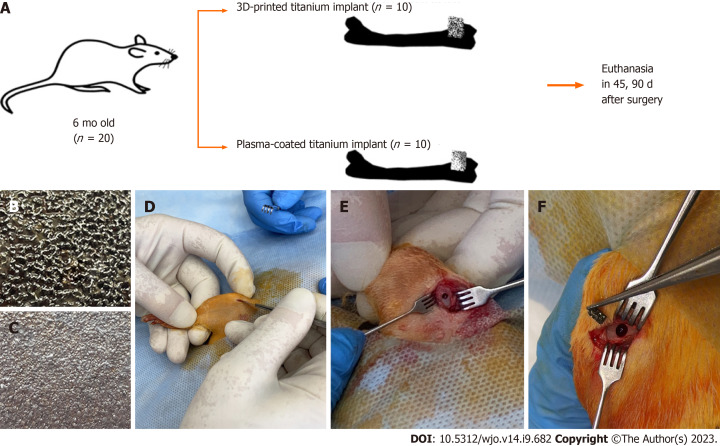
Aim: To determine the features of osseointegration of two different types of titanium implants [3-dimensional (3D)-printed and plasma-coated titanium implants] in bone tissue of a distal metaphysis in a rat femur model.
Methods: This study was performed on 20 white male laboratory rats weighing 300-350 g aged 6 mo. Rats were divided into two groups of 10 animals, which had two different types of implants were inserted into a hole defect (2 × 3 mm) in the distal metaphysis of the femur: Group I: 3D-printed titanium implant (highly porous); Group II: Plasma-coated titanium implant. After 45 and 90 d following surgery, the rats were sacrificed, and their implanted femurs were extracted for histological examination. The relative perimeter (%) of bone trabeculae [bone-implant contact (BIC%)] and bone marrow surrounding the titanium implants was measured.
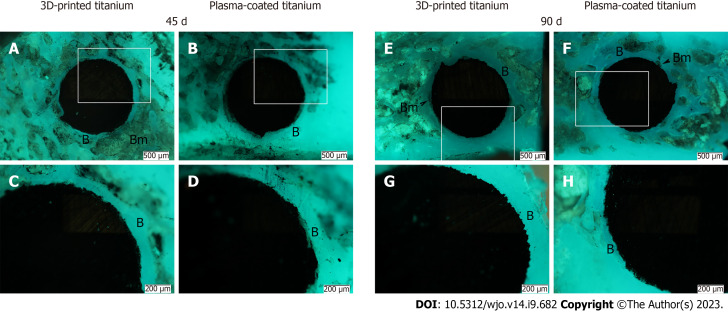
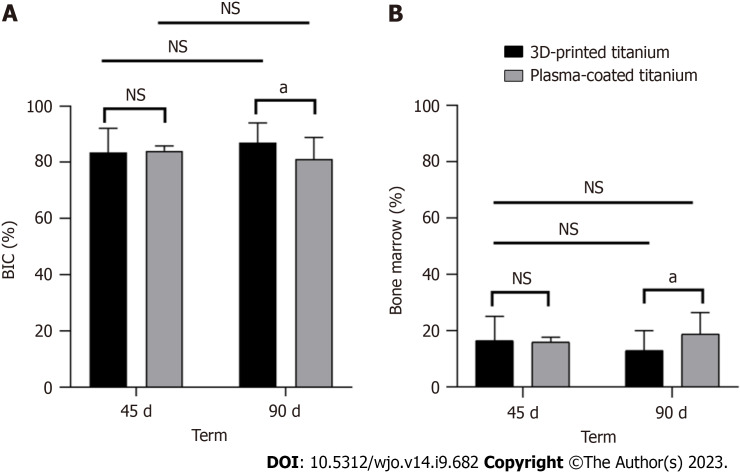
Results: Trabecular bone tissue was formed on the 45th day after implantation around the implants regardless of their type. 45 d after surgery, group I (3D-printed titanium implant) and group II (plasma-coated titanium implant) did not differ in BIC% (83.51 ± 8.5 vs 84.12 ± 1 .73; P = 0.838). After 90 d, the BIC% was higher in group I (87.04 ± 6.99 vs 81.24 ± 7.62; P = 0.049), compared to group II. The relative perimeter of the bone marrow after 45 d did not differ between groups and was 16.49% ± 8.58% for group I, and 15.88% ± 1.73% for group II. Futhermore, after 90 d, in group I the relative perimeter of bone marrow was 1.4 times smaller (12.96 ± 6.99 vs 18.76 ± 7.62; P = 0.049) compared to the relative perimeter of bone marrow in group II.
Conclusion: The use of a highly porous titanium implant, manufactured with 3D printing, for acetabular components provides increased osseointegration compared to a plasma-coated titanium implant.
Keywords: 3-dimensional printing; Femur; Hip arthroplasty; Microscopy; Porosity; Rats.
©The Author(s) 2023. Published by Baishideng Publishing Group Inc. All rights reserved.
Conflict of interest statement
Conflict-of-interest statement: The authors declare that they have no conflict of interest.
Figures
References
-
- Dall’Ava L, Hothi H, Di Laura A, Henckel J, Hart A. 3D printed acetabular cups for total hip arthroplasty: A review article. Metals (Basel) 2019;9:729.
-
- Malahias MA, Kostretzis L, Greenberg A, Nikolaou VS, Atrey A, Sculco PK. Highly Porous Titanium Acetabular Components in Primary and Revision Total Hip Arthroplasty: A Systematic Review. J Arthroplasty. 2020;35:1737–1749. - PubMed
-
- Small SR, Berend ME, Howard LA, Rogge RD, Buckley CA, Ritter MA. High initial stability in porous titanium acetabular cups: a biomechanical study. J Arthroplasty. 2013;28:510–516. - PubMed
LinkOut - more resources
Full Text Sources
