


Symbiotic diazotrophs in response to yak grazing and Tibetan sheep grazing in Qinghai-Tibetan plateau grassland soils
- PMID: 37744903
- PMCID: PMC10511875
- DOI: 10.3389/fmicb.2023.1257521
Symbiotic diazotrophs in response to yak grazing and Tibetan sheep grazing in Qinghai-Tibetan plateau grassland soils
Abstract
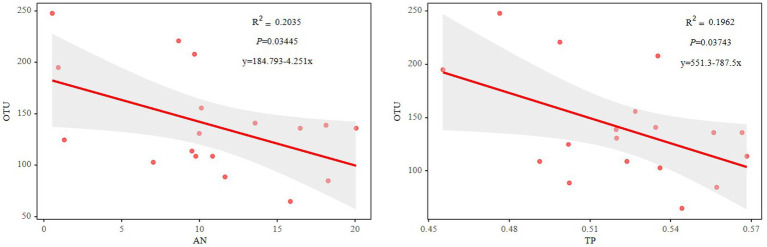
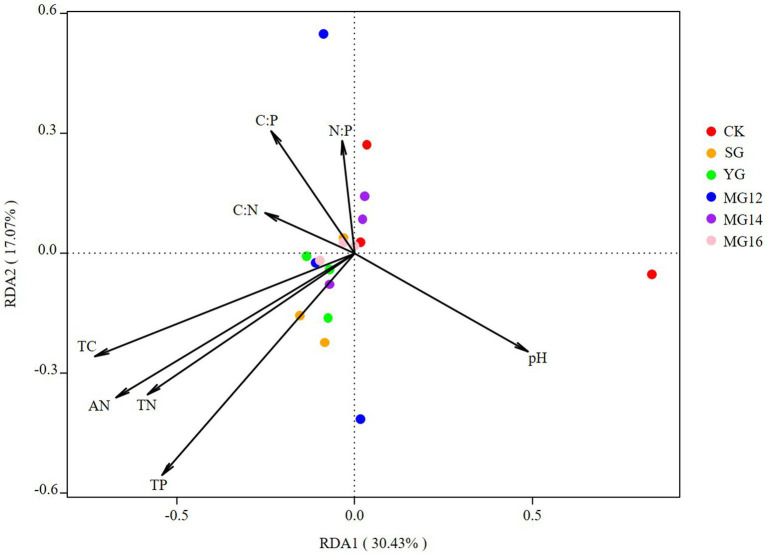
Grazing by local livestock is the traditional human practice in Qinghai-Tibetan Plateau grassland, and moderate intensity grazing can maintain high productivity and diversity of alpine grassland. Grazing ecosystems are often nitrogen-limited, but N2-fixing communities in response to yak grazing and Tibetan sheep grazing in Qinghai-Tibetan Plateau grassland have remained underexplored. In this study, we applied quantitative PCR quantitation and MiSeq sequencing of nifH under yak grazing and Tibetan grazing through a manipulated grazing experiment on an alpine grassland. The results showed that the grazing treatments significantly increased the soil ammonium nitrogen (AN) and total phosphorus (TP), but reduced the diazotrophs abundance. Compared with no grazing treatment, the composition of diazotrophs could be maximally maintained when the ratio of yak and Tibetan sheep were 1:2. The foraging strategies of grazing livestock reduced the legumes biomass, and thus reduced the diazotrophs abundance. Data analysis suggested that the direct key factors in regulating diazotrophs are AN and TP, and the changes of these two soil chemical properties were affected by the dung and urine of herbivore assemblages. Overall, these results indicated that the mixed grazing with a ratio of yak to Tibetan sheep as 1:2 can stabilize the soil diazotrophsic community, suggesting that MG12 are more reasonable grazing regimes in this region.
Keywords: Tibetan plateau; alpine grassland; grazing patterns; nifH gene; soil microbes.
Copyright © 2023 Sun, Zhao, Dong, Yang, Liu, Liu, Shi, Liu, Zhang and Yu.
Conflict of interest statement
The authors declare that the research was conducted in the absence of any commercial or financial relationships that could be construed as a potential conflict of interest.
Figures




References
-
- Abdalla M., Hastings A., Chadwick D. R., Jones D. L., Evans C. D., Jones M. B., et al. (2018). Critical review of the impacts of grazing intensity on soil organic carbon storage and other soil quality indicators in extensively managed grasslands. Agri. Ecosyst. Environ. 253, 62–81. doi: 10.1016/j.agee.2017.10.023, PMID: - DOI - PMC - PubMed
-
- Altesor A., Oesterheld M., Leoni E., Lezama F., Rodríguez C. (2005). Effect of grazing on community structure and productivity of a Uruguayan grassland. Plant Ecol. 179, 83–91. doi: 10.1007/s11258-004-5800-5 - DOI
-
- Barros F. M. d. R., Fracetto F. J. C., Lira Junior M. A., Bertini S. C. B., Fracetto G. G. M. (2021). Spatial and seasonal responses of diazotrophs and ammonium-oxidizing bacteria to legume-based silvopastoral systems. Appl. Soil Ecol. 158:103797. doi: 10.1016/j.apsoil.2020.103797 - DOI
-
- Batalla I., Knudsen M. T., Mogensen L., Hierro Ó., Pinto M., Hermansen J. E. (2015). Carbon footprint of milk from sheep farming systems in northern Spain including soil carbon sequestration in grasslands. J. Clean. Prod. 104, 121–129. doi: 10.1016/j.jclepro.2015.05.043 - DOI
LinkOut - more resources
Full Text Sources
