


Advancing Naturalistic Affective Science with Deep Learning
- PMID: 37744976
- PMCID: PMC10514024
- DOI: 10.1007/s42761-023-00215-z
Advancing Naturalistic Affective Science with Deep Learning
Abstract
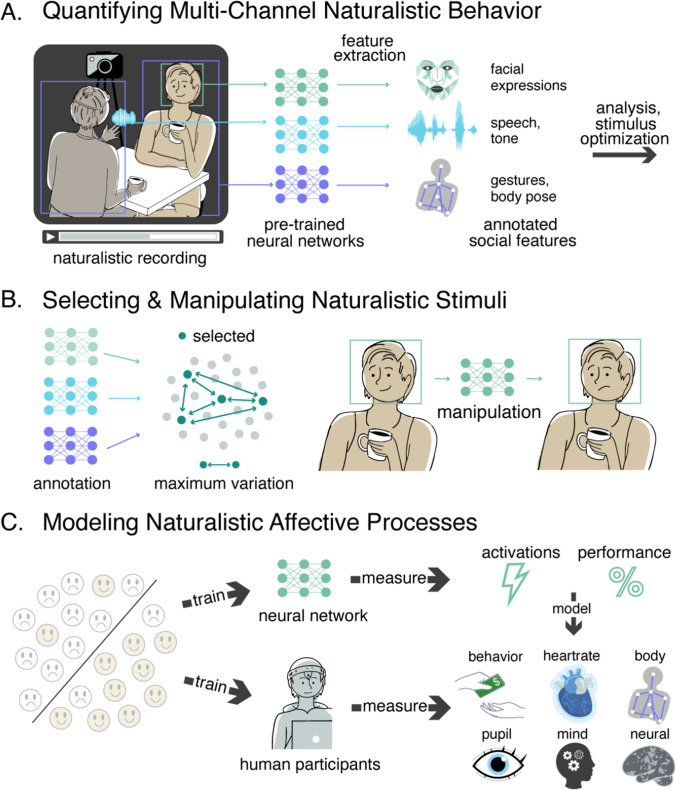
People express their own emotions and perceive others' emotions via a variety of channels, including facial movements, body gestures, vocal prosody, and language. Studying these channels of affective behavior offers insight into both the experience and perception of emotion. Prior research has predominantly focused on studying individual channels of affective behavior in isolation using tightly controlled, non-naturalistic experiments. This approach limits our understanding of emotion in more naturalistic contexts where different channels of information tend to interact. Traditional methods struggle to address this limitation: manually annotating behavior is time-consuming, making it infeasible to do at large scale; manually selecting and manipulating stimuli based on hypotheses may neglect unanticipated features, potentially generating biased conclusions; and common linear modeling approaches cannot fully capture the complex, nonlinear, and interactive nature of real-life affective processes. In this methodology review, we describe how deep learning can be applied to address these challenges to advance a more naturalistic affective science. First, we describe current practices in affective research and explain why existing methods face challenges in revealing a more naturalistic understanding of emotion. Second, we introduce deep learning approaches and explain how they can be applied to tackle three main challenges: quantifying naturalistic behaviors, selecting and manipulating naturalistic stimuli, and modeling naturalistic affective processes. Finally, we describe the limitations of these deep learning methods, and how these limitations might be avoided or mitigated. By detailing the promise and the peril of deep learning, this review aims to pave the way for a more naturalistic affective science.
Keywords: Affective science; Cognitive modeling; Deep learning; Generalizability; Person perception.
© The Society for Affective Science 2023. Springer Nature or its licensor (e.g. a society or other partner) holds exclusive rights to this article under a publishing agreement with the author(s) or other rightsholder(s); author self-archiving of the accepted manuscript version of this article is solely governed by the terms of such publishing agreement and applicable law.
Conflict of interest statement
Conflict of InterestOn behalf of all authors, the corresponding author states that there is no conflict of interest.
Figures
References
-
- Arias P, Rachman L, Liuni M, Aucouturier J-J. Beyond correlation: Acoustic transformation methods for the experimental study of emotional voice and speech. Emotion Review. 2021;13(1):12–24. doi: 10.1177/1754073920934544. - DOI
-
- Arulkumaran K, Deisenroth MP, Brundage M, Bharath AA. Deep reinforcement learning: A brief survey. IEEE Signal Processing Magazine. 2017;34(6):26–38. doi: 10.1109/MSP.2017.2743240. - DOI
Publication types
LinkOut - more resources
Full Text Sources