


Oculomotor analysis to assess brain health: preliminary findings from a longitudinal study of multiple sclerosis using novel tablet-based eye-tracking software
- PMID: 37745656
- PMCID: PMC10516298
- DOI: 10.3389/fneur.2023.1243594
Oculomotor analysis to assess brain health: preliminary findings from a longitudinal study of multiple sclerosis using novel tablet-based eye-tracking software
Abstract
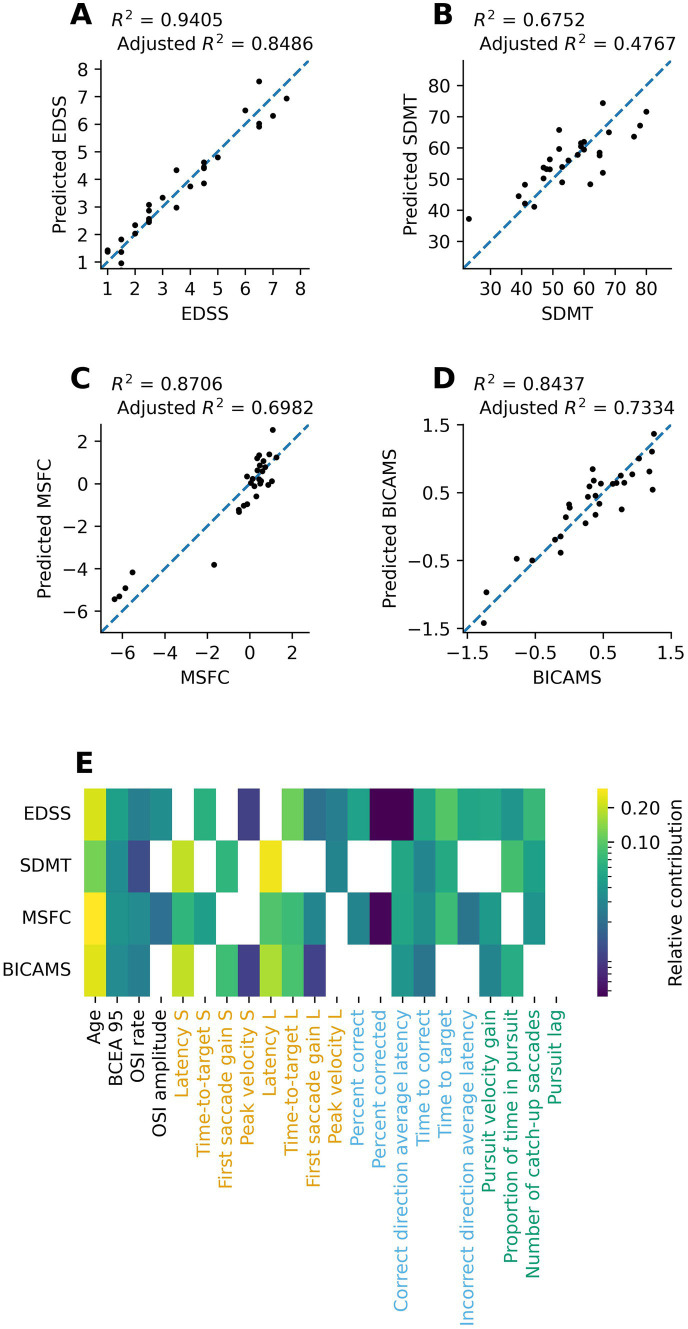
A growing body of evidence supports the link between eye movement anomalies and brain health. Indeed, the oculomotor system is composed of a diverse network of cortical and subcortical structures and circuits that are susceptible to a variety of degenerative processes. Here we show preliminary findings from the baseline measurements of an ongoing longitudinal cohort study in MS participants, designed to determine if disease and cognitive status can be estimated and tracked with high accuracy based on eye movement parameters alone. Using a novel gaze-tracking technology that can reliably and accurately track eye movements with good precision without the need for infrared cameras, using only an iPad Pro embedded camera, we show in this cross-sectional study that several eye movement parameters significantly correlated with clinical outcome measures of interest. Eye movement parameters were extracted from fixation, pro-saccade, anti-saccade, and smooth pursuit visual tasks, whereas the clinical outcome measures were the scores of several disease assessment tools and standard cognitive tests such as the Expanded Disability Status Scale (EDSS), Brief International Cognitive Assessment for MS (BICAMS), the Multiple Sclerosis Functional Composite (MSFC) and the Symbol Digit Modalities Test (SDMT). Furthermore, partial least squares regression analyses show that a small set of oculomotor parameters can explain up to 84% of the variance of the clinical outcome measures. Taken together, these findings not only replicate previously known associations between eye movement parameters and clinical scores, this time using a novel mobile-based technology, but also the notion that interrogating the oculomotor system with a novel eye-tracking technology can inform us of disease severity, as well as the cognitive status of MS participants.
Keywords: BICAMS; EDSS; MSFC; SDMT; digital biomarker; machine learning; mobile eye-tracker; multiple scleorsis.
Copyright © 2023 de Villers-Sidani, Voss, Bastien, Cisneros-Franco, Hussein, Mayo, Koch, Drouin-Picaro, Blanchette, Guitton and Giacomini.
Conflict of interest statement
ÉV-S was a co-founder of Innodem Neurosciences, which developed the Eye-Tracking Neurological Assessment (ETNA™) technology used in this study. PV and AD-P has ownership options in Innodem Neurosciences. JC-F was a part-time employee of Innodem Neurosciences and NK was a research intern at Innodem Neurosciences. DG was an unpaid consultant of Innodem Neurosciences. NB, SH, and FB were employees of Novartis Pharmaceuticals Canada Inc. PG was a paid medical and scientific advisor with Innodem Neurosciences and has stock options in Innodem Neurosciences. The remaining authors declare that the research was conducted in the absence of any commercial or financial relationships that could be construed as a potential conflict of interest.
Figures


References
-
- Kuhlmann T, Moccia M, Coetzee T, Cohen JA, Correale J, Graves J, et al. . International advisory committee on clinical trials in multiple sclerosis. Multiple sclerosis progression: time for a new mechanism-driven framework. Lancet Neurol. (2023) 22:78–88. doi: 10.1016/S1474-4422(22)00289-7 - DOI - PMC - PubMed
LinkOut - more resources
Full Text Sources
Other Literature Sources
