


Barriers and facilitators to recruitment of underrepresented research participants: Perspectives of clinical research coordinators
- PMID: 37745931
- PMCID: PMC10514687
- DOI: 10.1017/cts.2023.611
Barriers and facilitators to recruitment of underrepresented research participants: Perspectives of clinical research coordinators
Abstract
Background: Insufficient recruitment of groups underrepresented in medical research threatens the generalizability of research findings and compounds inequity in research and medicine. In the present study, we examined barriers and facilitators to recruitment of underrepresented research participants from the perspective of clinical research coordinators (CRCs).
Methods: CRCs from one adult and one pediatric academic medical centers completed an online survey in April-May 2022. Survey topics included: participant language and translations, cultural competency training, incentives for research participation, study location, and participant research literacy. CRCs also reported their success in recruiting individuals from various backgrounds and completed an implicit bias measure.
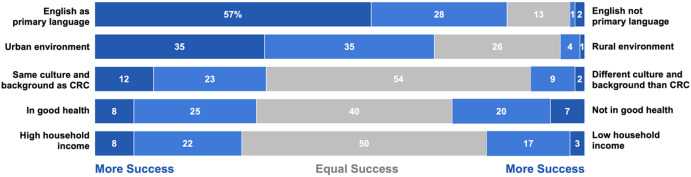
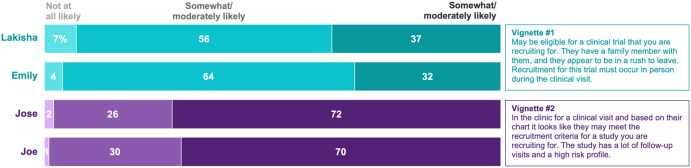
Results: Surveys were completed by 220 CRCs. CRCs indicated that recruitment is improved by having translated study materials, providing incentives to compensate participants, and reducing the number of in-person study visits. Most CRCs had completed some form of cultural competency training, but most also felt that the training either had no effect or made them feel less confident in approaching prospective participants from backgrounds different than their own. In general, CRCs reported having greater success in recruiting prospective participants from groups that are not underrepresented in research. Results of the implicit bias measure did not indicate that bias was associated with intentions to approach a prospective participant.
Conclusions: CRCs identified several strategies to improve recruitment of underrepresented research participants, and CRC insights aligned with insights from research participants in previous work. Further research is needed to understand the impact of cultural competency training on recruitment of underrepresented research participants.
Keywords: Research recruitment; clinical research coordinators; clinical trials; research equity; research participation; special populations; underrepresented groups.
© The Author(s) 2023.
Conflict of interest statement
The authors have no conflicts of interest to declare.
Figures
Similar articles
-
Barriers and Strategies for Recruitment of Racial and Ethnic Minorities: Perspectives from Neurological Clinical Research Coordinators.J Racial Ethn Health Disparities. 2017 Dec;4(6):1225-1236. doi: 10.1007/s40615-016-0332-y. Epub 2017 Feb 7. J Racial Ethn Health Disparities. 2017. PMID: 28176157 Free PMC article.
-
Recovery schools for improving behavioral and academic outcomes among students in recovery from substance use disorders: a systematic review.Campbell Syst Rev. 2018 Oct 4;14(1):1-86. doi: 10.4073/csr.2018.9. eCollection 2018. Campbell Syst Rev. 2018. PMID: 37131375 Free PMC article.
-
Diversity among research coordinators in a pediatric emergency medicine research collaborative network.J Clin Transl Sci. 2022 Aug 22;7(1):e46. doi: 10.1017/cts.2022.448. eCollection 2023. J Clin Transl Sci. 2022. PMID: 36845308 Free PMC article.
-
Recruitment and retention of underrepresented populations in Alzheimer's disease research: A systematic review.Alzheimers Dement (N Y). 2019 Nov 19;5:751-770. doi: 10.1016/j.trci.2019.09.018. eCollection 2019. Alzheimers Dement (N Y). 2019. PMID: 31921966 Free PMC article. Review.
-
Barriers and facilitators to participation of minorities in clinical trials.Ethn Dis. 2012 Spring;22(2):226-30. Ethn Dis. 2012. PMID: 22764647 Review.
Cited by
-
The Importance of Including Underserved Populations in Research.Pharmaceut Med. 2025 Mar;39(2):59-71. doi: 10.1007/s40290-025-00562-1. Epub 2025 Apr 1. Pharmaceut Med. 2025. PMID: 40169528 Review.
-
Scientia pro bono humani generis: Science for the benefit of humanity.J Clin Transl Sci. 2024 Feb 20;8(1):e29. doi: 10.1017/cts.2023.696. eCollection 2024. J Clin Transl Sci. 2024. PMID: 38384907 Free PMC article. No abstract available.
-
Mixed-Methods Approach: Impact of Clinical Consenter Diversity on Clinical Trials Enrollment.Cancers (Basel). 2025 Mar 20;17(6):1043. doi: 10.3390/cancers17061043. Cancers (Basel). 2025. PMID: 40149376 Free PMC article.
-
Building a Digital Health Research Platform to Enable Recruitment, Enrollment, Data Collection, and Follow-Up for a Highly Diverse Longitudinal US Cohort of 1 Million People in the All of Us Research Program: Design and Implementation Study.J Med Internet Res. 2025 Jan 15;27:e60189. doi: 10.2196/60189. J Med Internet Res. 2025. PMID: 39813673 Free PMC article.
-
PROGRESS: A patient-centered engagement infrastructure and multi-level approach to enrich diversity, equity, and inclusion in a national randomized online behavioral pain treatment study.J Pain. 2024 Oct 23:104718. doi: 10.1016/j.jpain.2024.104718. Online ahead of print. J Pain. 2024. PMID: 39454847
References
-
- Williams RJ, Tse T, DiPiazza K, Zarin DA. Terminated trials in the ClinicalTrials.gov results database: evaluation of availability of primary outcome data and reasons for termination. PLoS One. 2015;10(5):e0127242. doi: 10.1371/journal.pone.0127242. - DOI - PMC - PubMed
-
- Bernardez-Pereira S, Lopes RD, Carrion MJ, et al. Prevalence, characteristics, and predictors of early termination of cardiovascular clinical trials due to low recruitment: insights from the ClinicalTrials.gov registry. Am Heart J. 2014;168(2):213–9.e1. doi: 10.1016/j.ahj.2014.04.013. - DOI - PubMed
-
- Shieh C, Ofner S, Draucker CB. Reasons for and associated characteristics with early study termination: analysis of ClinicalTrials.gov data on pregnancy topics. Nurs Outlook. 2022;70(2):271–279. doi: 10.1016/j.outlook.2021.12.006. - DOI - PubMed
-
- Nazha B, Mishra M, Pentz R, Owonikoko TK. Enrollment of racial minorities in clinical trials: old problem assumes new urgency in the age of immunotherapy. Am Soc Clin Oncol Educ Book. 2019;39:3–10. - PubMed
Grants and funding
LinkOut - more resources
Full Text Sources
Miscellaneous