


Utility of Blood Cell Ratio Combinations for Diagnosis of Periprosthetic Joint Infection
- PMID: 37745972
- PMCID: PMC10517275
- DOI: 10.1016/j.artd.2023.101195
Utility of Blood Cell Ratio Combinations for Diagnosis of Periprosthetic Joint Infection
Abstract
Background: Periprosthetic joint infection (PJI) is a serious complication following joint replacement surgery, and its diagnosis can be challenging due to the similarity of symptoms to other conditions and the lack of confirmatory imaging tests. Platelet/mean platelet volume ratio (PVR), platelet/lymphocyte ratio, monocyte/lymphocyte ratio, and neutrophil/lymphocyte ratio have been proposed as potential markers to aid in the diagnosis of PJI. This study aimed to further assess the utility of these blood cell ratio combinations for the diagnosis of PJI.
Methods: A retrospective chart review was conducted on patients who presented to a university hospital for evaluation for PJI or underwent aseptic revision surgery. All patients were reviewed for inclusion in the study. Data were collected on several markers, including complete blood counts, synovial fluid white blood cell count, and polymorphonuclear percentage. Receiver operator characteristic curve analysis was used to evaluate the diagnostic capabilities of the markers and marker combinations.
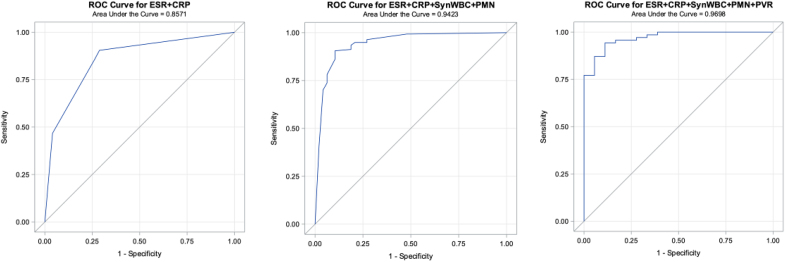
Results: The combination of erythrocyte sedimentation rate, C-reactive protein, synovial white blood cell count, and synovial polymorphonuclear percentage, with PVR, had the highest area under the curve of 0.97, with a sensitivity of 94.3% and a specificity of 88.9%, and a positive predictive value of 97.1% and a negative predictive value of 80.0%.
Conclusions: This study further supports the use of PVR calculated from complete blood count commonly ordered laboratory values obtained during routine complete blood counts when combined with established serum and synovial markers to increase the diagnostic accuracy for diagnosing PJI.
Keywords: Blood cell ratio; Diagnosis periprosthetic joint infection; Hip infection; Knee infection; Periprosthetic joint infection.
© 2023 The Authors.
Figures
References
-
- Peel T.N., Buising K.L., Choong P.F. Prosthetic joint infection: challenges of diagnosis and treatment. ANZ J Surg. 2011;81:32–39. - PubMed
-
- Pannu T.S., Villa J.M., Riesgo A.M., Patel P.D., Barsoum W.K., Higuera-Rueda C.A. Serum D-dimer in the diagnosis of periprosthetic knee infection: where are we today? J Knee Surg. 2020;33:106–110. - PubMed
-
- Shahi A., Kheir M.M., Tarabichi M., Hosseinzadeh H.R., Tan T.L., Parvizi J. Serum D-dimer test is promising for the diagnosis of periprosthetic joint infection and timing of reimplantation. J Bone Joint Surg Am. 2017;99:1419–1427. - PubMed
LinkOut - more resources
Full Text Sources
Research Materials
