


Current Models to Study the Sporothrix-Host Interaction
- PMID: 37746241
- PMCID: PMC10512367
- DOI: 10.3389/ffunb.2022.833111
Current Models to Study the Sporothrix-Host Interaction
Abstract
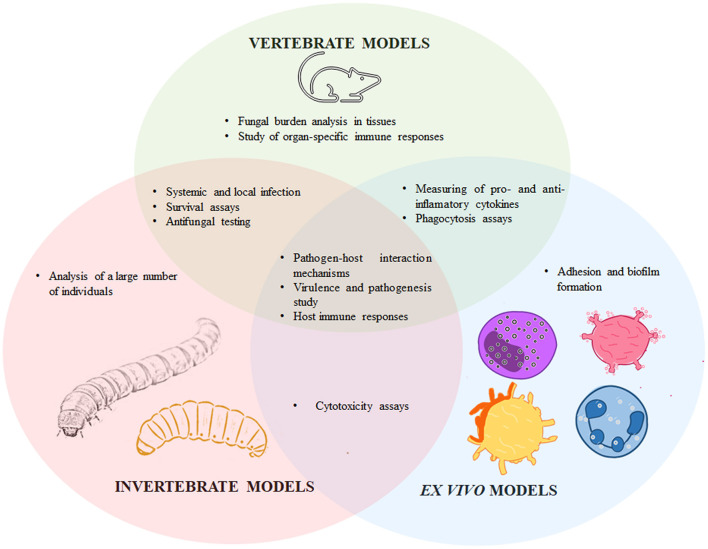
Sporotrichosis is a worldwide distributed subcutaneous mycosis that affects mammals, including human beings. The infection is caused by members of the Sporothrix pathogenic clade, which includes Sporothrix schenckii, Sporothrix brasiliensis, and Sporothrix globosa. The fungus can be acquired through traumatic inoculation of conidia growing in vegetal debris or by zoonotic transmission from sick animals. Although is not considered a life-threatening disease, it is an emergent health problem that affects mostly immunocompromised patients. The sporotrichosis causative agents differ in their virulence, host range, and sensitivity to antifungal drugs; therefore, it is relevant to understand the molecular bases of their pathogenesis, interaction with immune effectors, and mechanisms to acquired resistance to antifungal compounds. Murine models are considered the gold standard to address these questions; however, some alternative hosts offer numerous advantages over mammalian models, such as invertebrates like Galleria mellonella and Tenebrio molitor, or ex vivo models, which are useful tools to approach questions beyond virulence, without the ethical or budgetary features associated with the use of animal models. In this review, we analyze the different models currently used to study the host-Sporothrix interaction.
Keywords: animal model; antifungal drugs; ex vivo model; immune response; invertebrate model; pathogen-host interaction; virulence factors.
Copyright © 2022 Vargas-Macías, Gómez-Gaviria, García-Carnero and Mora-Montes.
Conflict of interest statement
The authors declare that the research was conducted in the absence of any commercial or financial relationships that could be construed as a potential conflict of interest.
Figures
References
-
- Alegranci P., de Abreu Ribeiro L. C., Ferreira L. S., Negrini Tde C., Maia D. C., Tansini A., et al. (2013). The predominance of alternatively activated macrophages following challenge with cell wall peptide-polysaccharide after prior infection with Sporothrix schenckii. Mycopathologia 176, 57–65. 10.1007/s11046-013-9663-y - DOI - PubMed
-
- Almeida-Paes R., de Oliveira L. C., Oliveira M. M. E., Gutierrez-Galhardo M. C., Nosanchuk J. D., Zancopé-Oliveira R. M. (2015). Phenotypic characteristics associated with virulence of clinical isolates from the Sporothrix complex. Biomed. Res. Int. 2015, 212308–212308. 10.1155/2015/212308 - DOI - PMC - PubMed
-
- Almeida-Paes R., Frases S., Araújo G. d. S., de Oliveira M. M. E., Gerfen G. J., Nosanchuk J.D., et al. (2012). Biosynthesis and functions of a melanoid pigment produced by species of the Sporothrix complex in the presence of L-tyrosine. Appl. Environ. Microbiol. 78, 8623–8630. 10.1128/AEM.02414-12 - DOI - PMC - PubMed
Publication types
LinkOut - more resources
Full Text Sources
