


Evaluating the Sensitivity, Specificity, and Accuracy of ChatGPT-3.5, ChatGPT-4, Bing AI, and Bard Against Conventional Drug-Drug Interactions Clinical Tools
- PMID: 37750052
- PMCID: PMC10518176
- DOI: 10.2147/DHPS.S425858
Evaluating the Sensitivity, Specificity, and Accuracy of ChatGPT-3.5, ChatGPT-4, Bing AI, and Bard Against Conventional Drug-Drug Interactions Clinical Tools
Abstract
Background: AI platforms are equipped with advanced algorithms that have the potential to offer a wide range of applications in healthcare services. However, information about the accuracy of AI chatbots against conventional drug-drug interaction tools is limited. This study aimed to assess the sensitivity, specificity, and accuracy of ChatGPT-3.5, ChatGPT-4, Bing AI, and Bard in predicting drug-drug interactions.
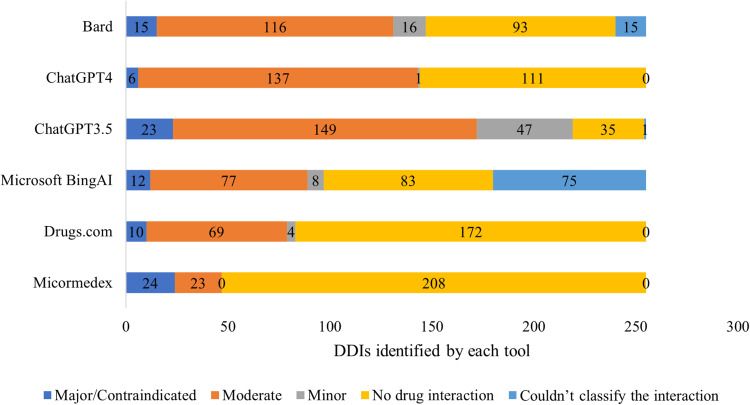
Methods: AI-based chatbots (ie, ChatGPT-3.5, ChatGPT-4, Microsoft Bing AI, and Google Bard) were compared for their abilities to detect clinically relevant DDIs for 255 drug pairs. Descriptive statistics, such as specificity, sensitivity, accuracy, negative predictive value (NPV), and positive predictive value (PPV), were calculated for each tool.
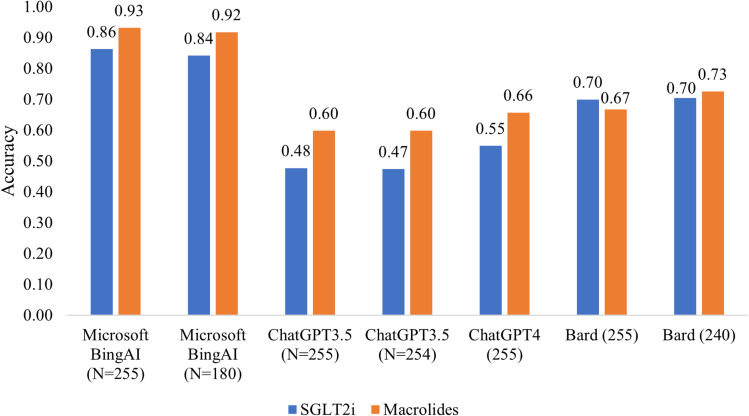
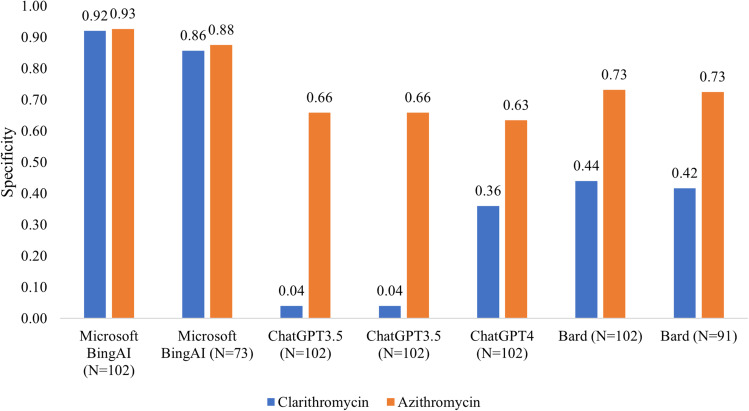
Results: When a subscription tool was used as a reference, the specificity ranged from a low of 0.372 (ChatGPT-3.5) to a high of 0.769 (Microsoft Bing AI). Also, Microsoft Bing AI had the highest performance with an accuracy score of 0.788, with ChatGPT-3.5 having the lowest accuracy rate of 0.469. There was an overall improvement in performance for all the programs when the reference tool switched to a free DDI source, but still, ChatGPT-3.5 had the lowest specificity (0.392) and accuracy (0.525), and Microsoft Bing AI demonstrated the highest specificity (0.892) and accuracy (0.890). When assessing the consistency of accuracy across two different drug classes, ChatGPT-3.5 and ChatGPT-4 showed the highest variability in accuracy. In addition, ChatGPT-3.5, ChatGPT-4, and Bard exhibited the highest fluctuations in specificity when analyzing two medications belonging to the same drug class.
Conclusion: Bing AI had the highest accuracy and specificity, outperforming Google's Bard, ChatGPT-3.5, and ChatGPT-4. The findings highlight the significant potential these AI tools hold in transforming patient care. While the current AI platforms evaluated are not without limitations, their ability to quickly analyze potentially significant interactions with good sensitivity suggests a promising step towards improved patient safety.
Keywords: Bard; Bing AI; ChatGPT; accuracy; drug-drug interaction; patient safety; sensitivity; specificity.
© 2023 Al-Ashwal et al.
Conflict of interest statement
The authors report no conflicts of interest in this work.
Figures
References
-
- Mhlanga D. Open AI in education, the responsible and ethical use of ChatGPT towards lifelong learning. Education, the Responsible and Ethical Use of ChatGPT Towards Lifelong Learning (February 11, 2023); 2023.
-
- Haluza D, Jungwirth D. Artificial intelligence and ten societal megatrends: an exploratory study using GPT-3. Systems. 2023;11(3):120. doi: 10.3390/systems11030120 - DOI
LinkOut - more resources
Full Text Sources
