Review
. 2023 Sep 27;8(1):367.
doi: 10.1038/s41392-023-01576-4.

Lymph node metastasis in cancer progression: molecular mechanisms, clinical significance and therapeutic interventions

Affiliations
Review

Lymph node metastasis in cancer progression: molecular mechanisms, clinical significance and therapeutic interventions

Haoran Ji et al. Signal Transduct Target Ther. .

Abstract

Lymph nodes (LNs) are important hubs for metastatic cell arrest and growth, immune modulation, and secondary dissemination to distant sites through a series of mechanisms, and it has been proved that lymph node metastasis (LNM) is an essential prognostic indicator in many different types of cancer. Therefore, it is important for oncologists to understand the mechanisms of tumor cells to metastasize to LNs, as well as how LNM affects the prognosis and therapy of patients with cancer in order to provide patients with accurate disease assessment and effective treatment strategies. In recent years, with the updates in both basic and clinical studies on LNM and the application of advanced medical technologies, much progress has been made in the understanding of the mechanisms of LNM and the strategies for diagnosis and treatment of LNM. In this review, current knowledge of the anatomical and physiological characteristics of LNs, as well as the molecular mechanisms of LNM, are described. The clinical significance of LNM in different anatomical sites is summarized, including the roles of LNM playing in staging, prognostic prediction, and treatment selection for patients with various types of cancers. And the novel exploration and academic disputes of strategies for recognition, diagnosis, and therapeutic interventions of metastatic LNs are also discussed.


Conflict of interest statement

The authors declare no competing interests.

Figures

Fig. 1
Fig. 1
An anatomical overview of the structural characteristics of lymph nodes. LEC lymphatic endothelial cell, FRC fibroblastic reticular cell
Fig. 2
Fig. 2
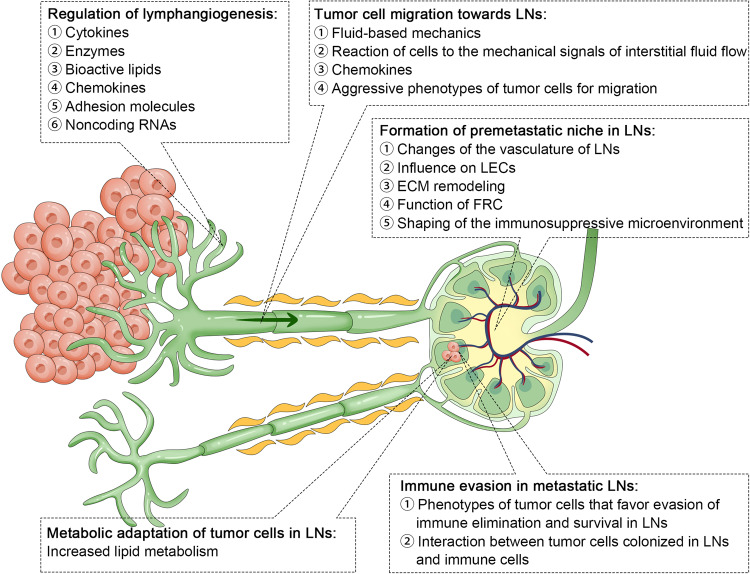
Molecular mechanisms of lymph node metastasis. LN lymph node, LEC lymphatic endothelial cell, ECM extracellular matrix, FRC fibroblastic reticular cell
Fig. 3
Fig. 3
Representative tumors types involving lymph node metastasis in different anatomical regions
Fig. 4
Fig. 4
Schematic diagram of the neck showing the AJCC classification of the cervical nodes
Fig. 5
Fig. 5
The IASLC LN map for lung cancer
Fig. 6
Fig. 6
Location of LN stations for nodal status evaluation of gastric cancer
Fig. 7
Fig. 7
A schematic overview of lymphadenectomy for standard gastric cancer surgery. a The extent of lymphadenectomy after total gastrectomy. b The extent of lymphadenectomy after distal gastrectomy. c The extent of lymphadenectomy after pylorus-preserving gastrectomy. d The extent of lymphadenectomy after proximal gastrectomy
Fig. 8
Fig. 8
a Application of USPIO nanoparticles in the detection of metastases in normal-sized pelvic LNs of patients with bladder and prostate cancer. USPIO nanoparticles taken up by macrophages lead to a signal decrease on T2- or T2*- weighted MRI, which is lacking in the malignant LN (arrow) due to few macrophages and little USPIO nanoparticle uptake compared to the benign LN (arrowhead). Copyright 2013, European Association of Urology. b Application of a NIR probe in the detection of LNM in mice. The pictures present NIR imaging-guided SLN surgery in an orthotopic 4T1 breast cancer model. Copyright 2020, Wiley-VCH. USPIO, ultrasmall superparamagnetic iron oxide; LN lymph node, MRI magnetic resonance imaging, NIR near-infrared, LNM lymph node metastasis, SLN sentinel lymph node
Fig. 9
Fig. 9
Overview diagram of the advantages and disadvantages of LND. LND lymph node dissection
Fig. 10
Fig. 10
a cDC1s take up and transport tumor antigens to TDLNs for presentation to naïve CD8+ T cells, priming cytotoxic effector CD8+ T cells. Copyright 2018, Francis Crick Institute. b TDLNs are enriched for tumor-specific PD-1+ T cells and blocking PD-L1 in TDLNs generates progenitor-exhausted T cells that seed the tumor, which enhances antitumor immunity. Copyright 2020, Elsevier Inc. cDC1 conventional type 1 dendritic cells, TDLN tumor-draining lymph node
Fig. 11
Fig. 11
Exploration of medical treatment strategies for lymph node metastasis. Created with BioRender.com
Fig. 12
Fig. 12
A visualized precision medicine nanoplatform of metastatic LNs for US/PA dual-modal imaging-guided in situ targeted hyperthermia-combined chemotherapy. Copyright 2021, Springer Nature. NP nanoparticle, PFH perfluorohexane, PLGA poly (lactatco-glycolic acid), LN lymph node, US ultrasonic, PA photoacoustic

References

    1. Gasteiger G, Ataide M, Kastenmüller W. Lymph node - an organ for T-cell activation and pathogen defense. Immunol. Rev. 2016;271:200–220. - PubMed
    1. Rezzola S, Sigmund EC, Halin C, Ronca R. The lymphatic vasculature: an active and dynamic player in cancer progression. Med. Res. Rev. 2022;42:576–614. - PMC - PubMed
    1. Zhou, H., Lei, P. J. & Padera, T. P. Progression of metastasis through lymphatic system. Cells10, 627 (2021). - PMC - PubMed
    1. Obinu A, et al. Lymph node metastases: importance of detection and treatment strategies. Expert Opin. Drug Deliv. 2018;15:459–467. - PubMed
    1. Takeda A, Salmi M, Jalkanen S. Lymph node lymphatic endothelial cells as multifaceted gatekeepers in the immune system. Trends Immunol. 2023;44:72–86. - PubMed

Publication types