. 2024 Feb;32(2):209-214.
doi: 10.1038/s41431-023-01463-0. Epub 2023 Sep 26.

A linear weighted combination of polygenic scores for a broad range of traits improves prediction of coronary heart disease

Affiliations

A linear weighted combination of polygenic scores for a broad range of traits improves prediction of coronary heart disease

Kristjan Norland et al. Eur J Hum Genet. 2024 Feb.

Abstract

Polygenic scores (PGS) for coronary heart disease (CHD) are constructed using GWAS summary statistics for CHD. However, pleiotropy is pervasive in biology and disease-associated variants often share etiologic pathways with multiple traits. Therefore, incorporating GWAS summary statistics of additional traits could improve the performance of PGS for CHD. Using lasso regression models, we developed two multi-PGS for CHD: 1) multiPGSCHD, utilizing GWAS summary statistics for CHD, its risk factors, and other ASCVD as training data and the UK Biobank for tuning, and 2) extendedPGSCHD, using existing PGS for a broader range of traits in the PGS Catalog as training data and the Atherosclerosis Risk in Communities Study (ARIC) cohort for tuning. We evaluated the performance of multiPGSCHD and extendedPGSCHD in the Mayo Clinic Biobank, an independent cohort of 43,578 adults of European ancestry which included 4,479 CHD cases and 39,099 controls. In the Mayo Clinic Biobank, a 1 SD increase in multiPGSCHD and extendedPGSCHD was associated with a 1.66-fold (95% CI: 1.60-1.71) and 1.70-fold (95% CI: 1.64-1.76) increased odds of CHD, respectively, in models that included age, sex, and 10 PCs, whereas an already published PGS for CHD (CHD_PRSCS) increased the odds by 1.50 (95% CI: 1.45-1.56). In the highest deciles of extendedPGSCHD, multiPGSCHD, and CHD_PRSCS, 18.4%, 17.5%, and 16.3% of patients had CHD, respectively.


Conflict of interest statement

The authors declare no competing interests.

Figures
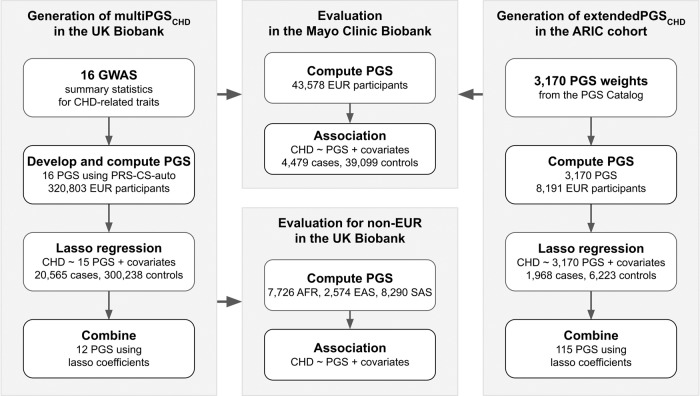
Fig. 1
Fig. 1
Study flowchart describing the development and evaluation of multiPGSCHD and extendedPGSCHD.
Fig. 2
Fig. 2. Associations between PGS and CHD in UK Biobank participants of European ancestry.
A Odds ratios per 1 SD increase in PGS from logistic regression models with CHD as the dependent variable. ASCVD atherosclerotic cardiovascular diseases, CHD coronary heart disease, PAD peripheral artery disease, AAA abdominal aortic aneurysm, CAVS calcific aortic valve stenosis. B Non-zero coefficients from the lasso regression model.
Fig. 3
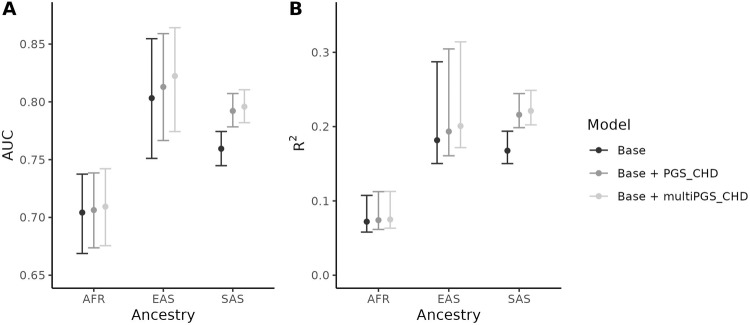
Fig. 3. Performance of PGSCHD and multiPGSCHD in UK Biobank participants of non-European ancestry.
95% confidence intervals were generated with 1000 bootstrap replicates. A Area under the curve (AUC). B Nagelkerke R2.
Fig. 4
Fig. 4. Evaluation of PGSCHD, multiPGSCHD, and extendedPGSCHD in the Mayo Clinic Biobank.
A Odds ratios per 1 SD increase in PGS from logistic regression models with CHD as the dependent variable. B CHD prevalence binned for each decile in PGS.

References

    1. Khera AV, Chaffin M, Aragam KG, Haas ME, Roselli C, Choi SH, et al. Genome-wide polygenic scores for common diseases identify individuals with risk equivalent to monogenic mutations. Nat Genet. 2018;50:1219–24. doi: 10.1038/s41588-018-0183-z. - DOI - PMC - PubMed
    1. Tamlander M, Mars N, Pirinen M, Widén E, Ripatti S. Integration of questionnaire-based risk factors improves polygenic risk scores for human coronary heart disease and type 2 diabetes. Commun Biol. 2022;5:1–13. doi: 10.1038/s42003-021-02996-0. - DOI - PMC - PubMed
    1. Dikilitas O, Schaid DJ, Kosel ML, Carroll RJ, Chute CG, Denny JA, et al. Predictive utility of polygenic risk scores for coronary heart disease in three major racial and ethnic groups. Am J Hum Genet. 2020;106:707–16. doi: 10.1016/j.ajhg.2020.04.002. - DOI - PMC - PubMed
    1. O’Sullivan JW, Raghavan S, Marquez-Luna C, Luzum JA, Damrauer SM, Ashley EA, et al. Polygenic risk scores for cardiovascular disease: A scientific statement from the American Heart Association. Circulation. 0(0):10.1161/CIR.0000000000001077. - PMC - PubMed
    1. Kullo IJ, Lewis CM, Inouye M, Martin AR, Ripatti S, Chatterjee N. Polygenic scores in biomedical research. Nat Rev Genet. 2022;23:524–32. doi: 10.1038/s41576-022-00470-z. - DOI - PMC - PubMed