


Exploring Factors Associated with Implant Removal Satisfaction in Breast Implant Illness Patients: A PRO BREAST-Q Study
- PMID: 37753329
- PMCID: PMC10519512
- DOI: 10.1097/GOX.0000000000005273
Exploring Factors Associated with Implant Removal Satisfaction in Breast Implant Illness Patients: A PRO BREAST-Q Study
Abstract
Background: Breast implant illness (BII) is a poorly understood heterogeneous disorder treated with implant removal; however, patient-reported symptoms and outcomes after treatment remain unclear.
Methods: A retrospective review of patients undergoing bilateral breast implant removal related to BII by two surgeons at an academic medical center between 2018 and 2022 was conducted. Patients were surveyed using the BREAST-Q Reconstruction model with the American Society for Aesthetic Plastic Surgery BII survey extension. Outcomes were analyzed using multivariable logistic regression, adjusted for patient-associated factors.
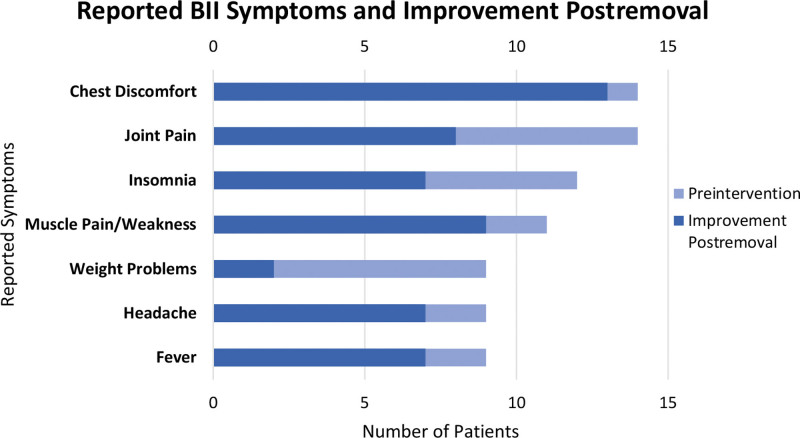
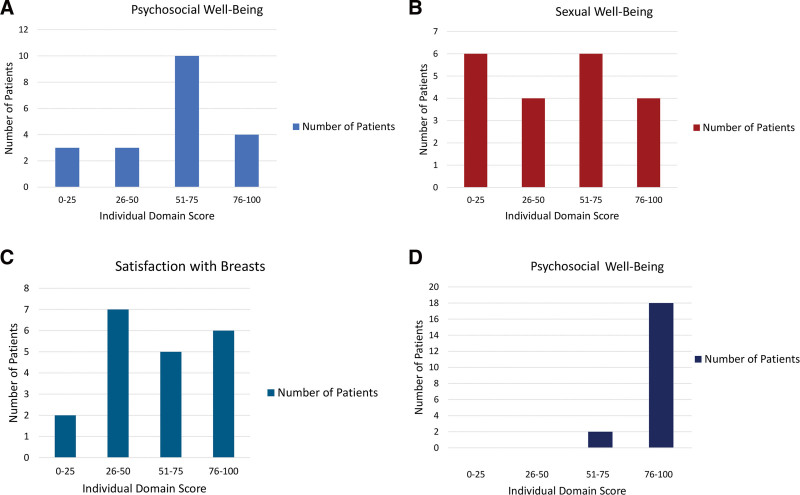
Results: Forty-seven patients were surveyed with a response rate of 51% (n = 24). Of the 20 patients who completed the survey, the majority were White (85%), with 45% (n = 9) having a documented history of psychiatric illness. Six (30%) patients had capsular contracture and four (20%) had documented implant rupture. Most implant removal procedures (n = 12, 60%) were not covered by insurance. Fourteen (70%) patients reported a net improvement in their symptoms after implant removal, most commonly chest discomfort, muscle pain, fever, and headaches. Capsular contracture was predictive of reduced psychosocial, sexual, and breast satisfaction scores (P = 0.015). Self-pay was predictive of increased breast satisfaction scores (P = 0.009), but had no impact on symptomatic improvement. A reduced time to implant removal was predictive of fewer residual symptoms (P = 0.032). Psychiatric illness had no significant impact on the outcomes.
Conclusions: In the setting of suspected or diagnosed BII, a reduced time to implant removal may decrease the risk of residual symptoms and improve overall patient satisfaction. In patients with capsular contracture, preoperative counseling should emphasize that implant removal may only improve physical symptoms.
Copyright © 2023 The Authors. Published by Wolters Kluwer Health, Inc. on behalf of The American Society of Plastic Surgeons.
Conflict of interest statement
The authors have no financial interest to declare in relation to the content of this article.
Figures
References
-
- Watad A, Rosenberg V, Tiosano S, et al. . Silicone breast implants and the risk of autoimmune/rheumatic disorders: a real-world analysis. Int J Epidemiol. 2018;47:1846–1854. - PubMed
-
- Caravantes-Cortes M-I, Roldan-Valadez E, Zwojewski-Martinez R-D, et al. . Breast prosthesis syndrome: pathophysiology and management algorithm. Aesthetic Plast Surg. 2020;44:1423–1437. - PubMed
-
- Breiting VB, Hölmich LR, Brandt B, et al. . Long-term health status of Danish women with silicone breast implants. Plast Reconstr Surg. 2004;114:217–26; discussion 227–228. - PubMed
-
- Lipworth L, Holmich LR, McLaughlin JK. Silicone breast implants and connective tissue disease: No association. Semin Immunopathol. 2011;33:287–294. - PubMed
Grants and funding
LinkOut - more resources
Full Text Sources