. 2024 Feb;18(2):291-304.
doi: 10.1002/1878-0261.13530. Epub 2023 Oct 5.

Urinary comprehensive genomic profiling predicts urothelial carcinoma recurrence and identifies responders to intravesical therapy

Affiliations

Urinary comprehensive genomic profiling predicts urothelial carcinoma recurrence and identifies responders to intravesical therapy

Goran Rac et al. Mol Oncol. 2024 Feb.

Abstract

Intravesical therapy (IVT) is the standard of care to decrease risk of recurrence and progression for high-grade nonmuscle-invasive bladder cancer. However, post-IVT recurrence remains common and the ability to risk-stratify patients before or after IVT is limited. In this prospectively designed and accrued cohort study, we examine the utility of urinary comprehensive genomic profiling (uCGP) for predicting recurrence risk following transurethral resection of bladder tumor (TURBT) and evaluating longitudinal IVT response. Urine was collected before and after IVT instillation and uCGP testing was done using the UroAmp™ platform. Baseline uCGP following TURBT identified patients with high (61%) and low (39%) recurrence risk. At 24 months, recurrence-free survival (RFS) was 100% for low-risk and 45% for high-risk patients with a hazard ratio (HR) of 9.3. Longitudinal uCGP classified patients as minimal residual disease (MRD) Negative, IVT Responder, or IVT Refractory with 24-month RFS of 100%, 50%, and 32%, respectively. Compared with MRD Negative patients, IVT Refractory patients had a HR of 10.5. Collectively, uCGP enables noninvasive risk assessment of patients following TURBT and induction IVT. uCGP could inform surveillance cystoscopy schedules and identify high-risk patients in need of additional therapy.

Keywords: Bacillus Calmette-Guérin; bladder cancer; genomics; intravesical instillation; personalized medicine; risk assessment.


Conflict of interest statement

VMC, DSF, PSL, CTW, BCM, KGP, VTB, and TGL report being employees and shareholders of Convergent Genomics. AJW discloses membership on the advisory boards of Urobiome Therapeutics and Pathnostics and funding from Pathnostics, VB Tech, the Craig H. Neilsen Foundation, and NIH. All other authors have no disclosures.

Figures
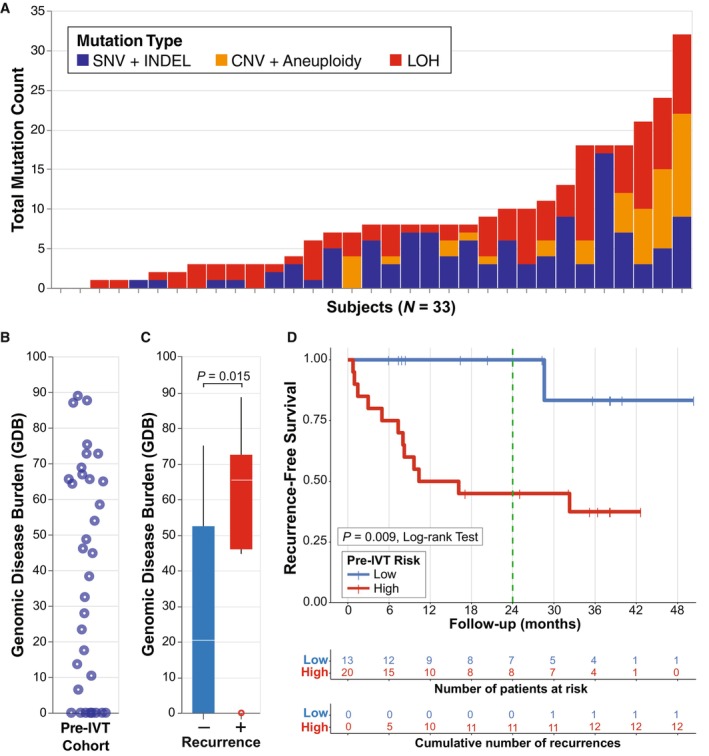
Fig. 1
Fig. 1
Urinary comprehensive genomic profiling detects MRD to predict recurrence risk following TURBT. Prior to beginning IVT, uCGP was performed on NMIBC patients following curative‐intent TURBT. (A) Cumulative mutation counts for all pre‐IVT subjects (N = 33) are shown. Single nucleotide variant (SNV) and insertion/deletion (INDEL) mutations are grouped together. Copy‐number variation (CNV) and aneuploidy events are grouped together. (B) A strip plot demonstrates the variability of GDB following TURBT. (C) Box plot of mean GDB in patients that did and did not recur. Statistical significance was determined by the Mann–Whitney U‐test. (D) RFS by UroAmp pre‐IVT low and high recurrence risk groups. The vertical green line indicates the primary study endpoint of 24 months.
Fig. 2
Fig. 2
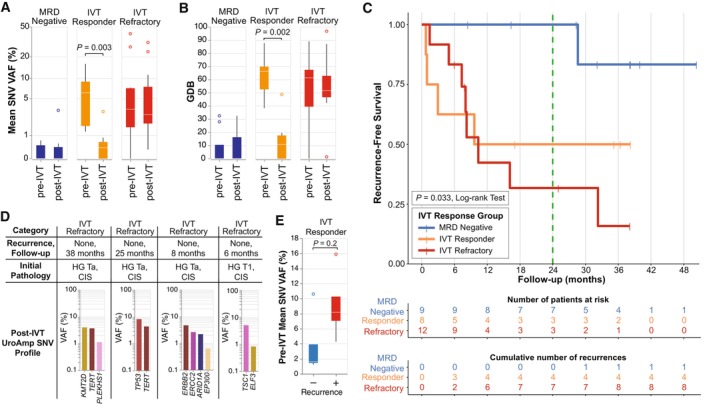
Longitudinal MRD detection stratifies patients by IVT response and predicts recurrence risk. (A) Box plots demonstrate mean SNV VAF and (B) mean GBD quantified for each response group (MRD Negative, Responder, and Refractory) prior to and following IVT. Statistical significance was determined by the Mann–Whitney U‐test. (C) RFS by IVT response group. The vertical green line indicates the primary study endpoint of 24 months. (D) Patients in the ‘IVT Refractory’ response group who do not have diagnosed recurrences are shown with follow‐up time, initial pathology, and post‐IVT uCGP tumor mutation profile. (E) Box plot of pre‐IVT mean SNV VAF for patients in the responder group are shown by recurrence status.
Fig. 3
Fig. 3
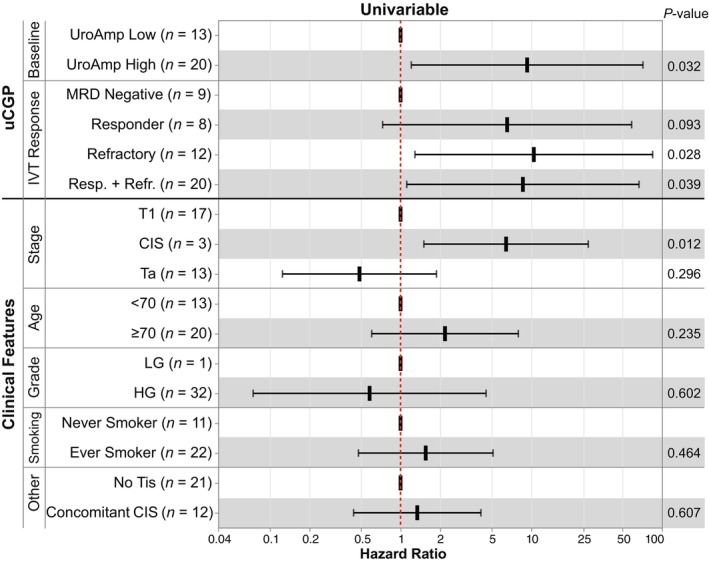
Urinary comprehensive genomic profiling predicted recurrence risk. Baseline (n = 33) and longitudinal (n = 29) NMIBC cohorts were analyzed for recurrence risk. Univariable Cox proportional‐hazard regression analyses of UroAmp recurrence risk and IVT response groups as well as clinical risk factors are shown with confidence intervals. P‐values were determined by the Wald test.
Fig. 4
Fig. 4
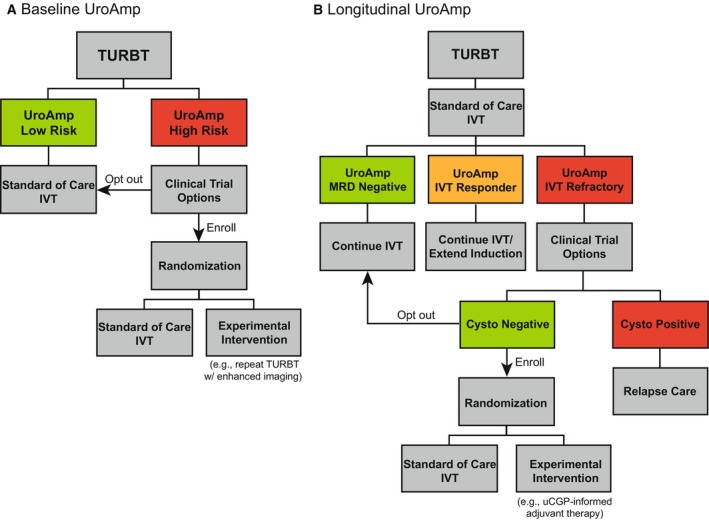
Proposed urinary comprehensive genomic profiling‐informed clinical trial design. (A). Baseline UroAmp can inform early intervention trial design following curative‐intent TURBT of NMIBC. Here, UroAmp identifies high‐recurrence risk patients who are most likely to benefit from further surgical intervention. An appropriate trial may randomize these patients to receive standard‐of‐care therapy (control) or an experimental intervention such as repeat TURBT using an enhanced imaging technology followed by standard‐of‐care therapy. (B). Longitudinal UroAmp can inform ethical trial design following standard‐of‐care IVT induction. Here, IVT Responders can be identified for trials aiming to potentiate the efficacy of induction or maintenance regimens (e.g., extended induction). IVT Refractory patients can be identified for trials of second‐line therapies. Gene targets identified by uCGP can inform appropriate targeted therapy trials. Critically, the proposed trial designs offer ethical control arms and do not delay opportunities for radical cystectomy for patients who fail either control or experimental arms.

References

    1. Chang SS, Boorjian SA, Chou R, Clark PE, Daneshmand S, Konety BR, et al. Diagnosis and treatment of non‐muscle invasive bladder cancer: AUA/SUO Guideline. J Urol. 2016;196:1021–1029. 10.1016/j.juro.2016.06.049 - DOI - PubMed
    1. Tobert CM, Nepple KG, McDowell BD, Charlton ME, Mott SL, Gruca TS, et al. Compliance with American Urological Association Guidelines for nonmuscle invasive bladder cancer remains poor: assessing factors associated with noncompliance and survival in a rural state. Urology. 2019;132:150–155. 10.1016/J.UROLOGY.2019.06.021 - DOI - PMC - PubMed
    1. Cumberbatch MGK, Foerster B, Catto JWF, Kamat AM, Kassouf W, Jubber I, et al. Repeat transurethral resection in non‐muscle‐invasive bladder cancer: a systematic review. Eur Urol. 2018;73:925–933. 10.1016/J.EURURO.2018.02.014 - DOI - PubMed
    1. Kamat AM, Georgieva MV, Song J, Bocharova I, Qian K, Guo A, et al. Disease progression among patients who receive available bladder preservation therapies after failure of BCG therapy in the SEER‐Medicare data. J Clin Oncol. 2020;38:453. 10.1200/JCO.2020.38.6_SUPPL.453 - DOI
    1. Herr HW. Restaging transurethral resection of high risk superficial bladder cancer improves the initial response to bacillus Calmette‐Guerin therapy. J Urol. 2005;174:2134–2137. 10.1097/01.ju.0000181799.81119.fc - DOI - PubMed

MeSH terms