Multicenter Study
. 2024 Jan 1;42(1):26-37.
doi: 10.1200/JCO.23.01696. Epub 2023 Sep 27.

Isatuximab, Carfilzomib, Lenalidomide, and Dexamethasone for the Treatment of High-Risk Newly Diagnosed Multiple Myeloma

Affiliations
Multicenter Study

Isatuximab, Carfilzomib, Lenalidomide, and Dexamethasone for the Treatment of High-Risk Newly Diagnosed Multiple Myeloma

Lisa B Leypoldt et al. J Clin Oncol. .

Abstract

Purpose: The GMMG-CONCEPT trial investigated isatuximab, carfilzomib, lenalidomide, and dexamethasone (Isa-KRd) in transplant-eligible (TE) and transplant-noneligible (TNE) patients with newly diagnosed multiple myeloma (NDMM) with exclusively high-risk disease for whom prospective trials are limited, aiming to induce minimal residual disease (MRD) negativity.

Methods: This academic, investigator-initiated, multicenter, phase II trial enrolled patients with high-risk NDMM (HRNDMM) defined by mandatory International Staging System stage II/III combined with del17p, t(4;14), t(14;16), or more than three 1q21 copies as high-risk cytogenetic aberrations (HRCAs). Patients received Isa-KRd induction/consolidation and Isa-KR maintenance. TE patients received high-dose melphalan. TNE patients received two additional Isa-KRd cycles postinduction. This prespecified interim analysis (IA) reports the primary end point, MRD negativity (<10-5, next-generation flow), at the end of consolidation. The secondary end point was progression-free survival (PFS).

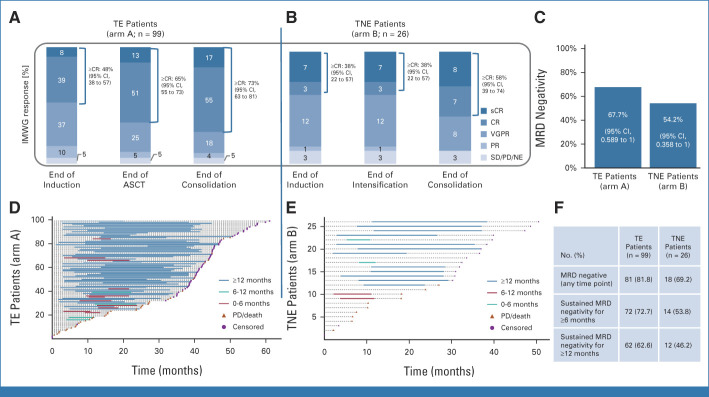
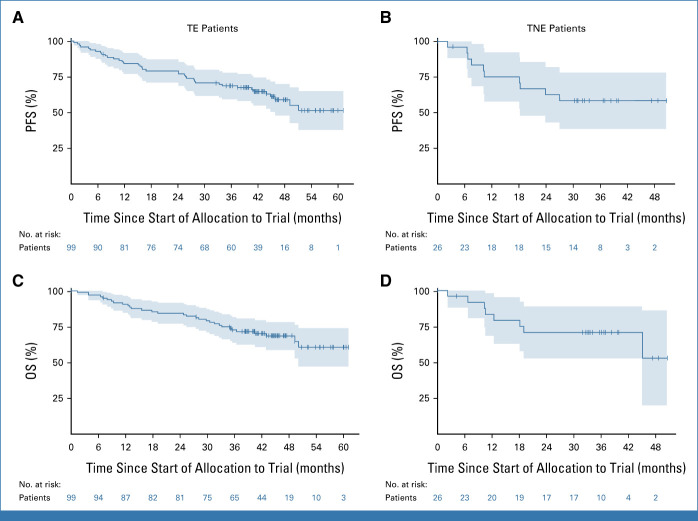
Results: Among 125 patients with HRNDMM (TE-intention-to-treat [ITT]-IA, 99; TNE-ITT, 26) of the IA population for the primary end point, the median age was 58 (TE-ITT-IA) and 74 (TNE-ITT) years. Del17p was the most common HRCA (TE, 44.4%; TNE, 42.3%); about one third of evaluable TE/TNE patients presented two or more HRCAs, respectively. The trial met its primary end point with MRD negativity rates after consolidation of 67.7% (TE) and 54.2% (TNE) of patients. Eighty-one of 99 TE-ITT-IA patients reached MRD negativity at any time point (81.8%). MRD negativity was sustained for ≥1 year in 62.6% of patients. With a median follow-up of 44 (TE) and 33 (TNE) months, median PFS was not reached in either arm.

Conclusion: Isa-KRd effectively induces high rates of sustainable MRD negativity in the difficult-to-treat HRNDMM population, regardless of transplant status, translating into a median PFS that was not yet reached after 44/33 months.

Trial registration: ClinicalTrials.gov NCT03104842.


Conflict of interest statement

The following represents disclosure information provided by authors of this manuscript. All relationships are considered compensated unless otherwise noted. Relationships are self-held unless noted. I = Immediate Family Member, Inst = My Institution. Relationships may not relate to the subject matter of this manuscript. For more information about ASCO's conflict of interest policy, please refer to www.asco.org/rwc or ascopubs.org/jco/authors/author-center.

Open Payments is a public database containing information reported by companies about payments made to US-licensed physicians (Open Payments).

Katja C. Weisel

Honoraria: Amgen, Bristol Myers Squibb, Janssen-Cilag, GlaxoSmithKline, Adaptive Biotechnologies, Karyopharm Therapeutics, Takeda, Sanofi, AbbVie, Novartis, Pfizer, Celgene, Janssen (Inst), Oncopeptides, Roche, Menarini

Consulting or Advisory Role: Amgen, Adaptive Biotechnologies, Bristol Myers Squibb, Celgene, GlaxoSmithKline, Janssen-Cilag, Karyopharm Therapeutics, Sanofi, Takeda, Oncopeptides, Roche, Menarini

Research Funding: Amgen (Inst), Celgene (Inst), Sanofi (Inst), Janssen-Cilag (Inst), Bristol Myers Squibb/Celgene (Inst), GlaxoSmithKline (Inst), AbbVie (Inst)

Travel, Accommodations, Expenses: Amgen, Celgene, Bristol Myers Squibb, Janssen-Cilag, GlaxoSmithKline, Takeda, Menarini

No other potential conflicts of interest were reported.

Figures
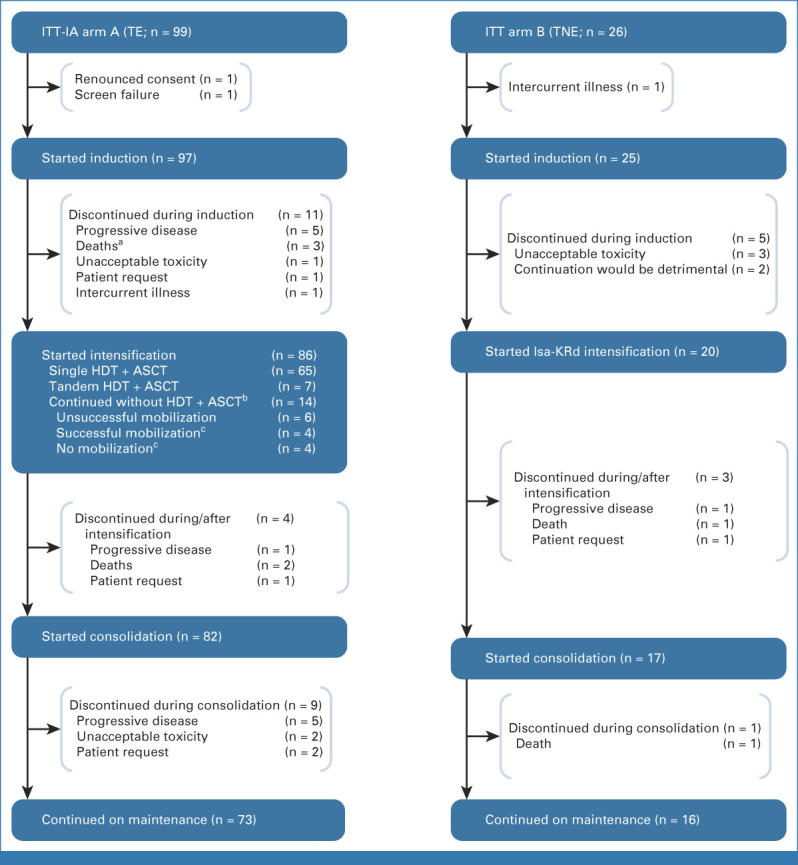
FIG 1.
FIG 1.
Patient disposition until the end of consolidation. aOne of the three deaths occurred during mobilization. bAll patients not undergoing HDT + ASCT received two additional cycles of Isa-KRd (analogous to arm B). cNo HDT-ASCT because of investigator decision or patient wish. ASCT, autologous stem-cell transplantation; HDT, high-dose therapy; IA, interim analysis; Isa-KRd, isatuximab, carfilzomib, lenalidomide, and dexamethasone; ITT, intention-to-treat; TE, transplant-eligible; TNE, transplant-noneligible.
FIG 2.
FIG 2.
Best response according to the IMWG (A and B) according to treatment phase in (A) TE and (B) TNE patients, rates of greater than or equal to CR and 95% CIs are added. (C) MRD negativity status at the end of consolidation (primary end point). 95% CIs refer to the one-sided binomial test result of the primary end point, testing the observed MRD negativity rate against 50% and 30%, respectively. (D and E) Swimmer plots showing achievement and sustainment of MRD negativity (next-generation flow; MRD <10−5) for (D) TE and (E) TNE patients. (F) Sustained MRD negativity for ≥6 months or ≥12 months in both study arms. ASCT, autologous stem-cell transplantation; CR, complete response; IMWG, International Myeloma Working Group; MRD, minimum residual disease; NE, not evaluable; PD, progressive disease; PR, partial response; sCR, stringent complete response; SD, stable disease; TE, transplant-eligible; TNE, transplant-noneligible; VGPR, very good partial response.
FIG 3.
FIG 3.
Kaplan-Meier plots for PFS in (A) TE and (B) TNE patients. OS in (C) TE and (D) TNE patients. OS, overall survival; PFS, progression-free survival; TE, transplant-eligible; TNE, transplant-noneligible.
FIG 4.
FIG 4.
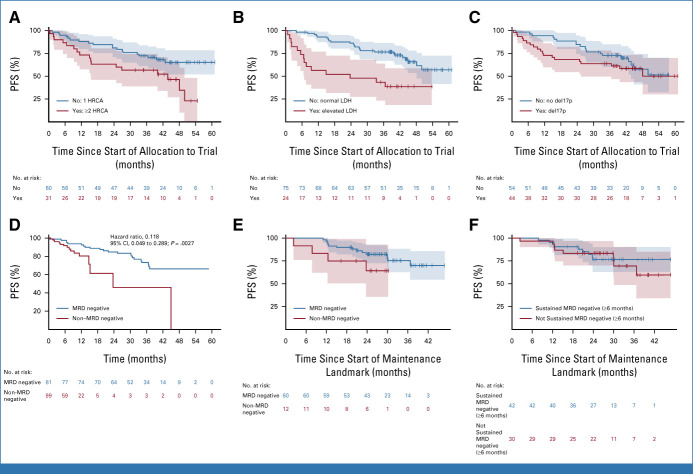
KM plots for PFS in TE patients according to the presence (red) or absence (blue) of (A) two or more HRCAs, (B) elevated LDH, or (C) del17p. (D) Adjusted Simon-Makuch (Bernasconi-SM) plot for TE patients: estimation of expected PFS under the state of first achievement of MRD negativity on study (blue) compared with the state waiting for MRD negativity (red). Blue curve can be interpreted as the expected PFS of a patient to be known achieving MRD negativity on study (alternatively to be interpreted as the hazard of PD/death under the state of MRD negativity). Red curve can be interpreted as the expected PFS of a patient who is assumed to fail achievement of MRD negativity (alternatively to be interpreted as the hazard of PD/death while waiting for MRD negativity). (E and F) KM plots for PFS from the landmark start of maintenance therapy according to (E) MRD outcome assessed at the end of the consolidation or (F) the achievement of sustained MRD negativity for ≥6 months until the end of consolidation. HRCAs, high-risk cytogenic aberrations; KM, Kaplan-Meier; LDH, lactate dehydrogenase; MRD, minimum residual disease; PD, progressive disease; PFS, progression-free survival; TE, transplant-eligible.
FIG A1.
FIG A1.
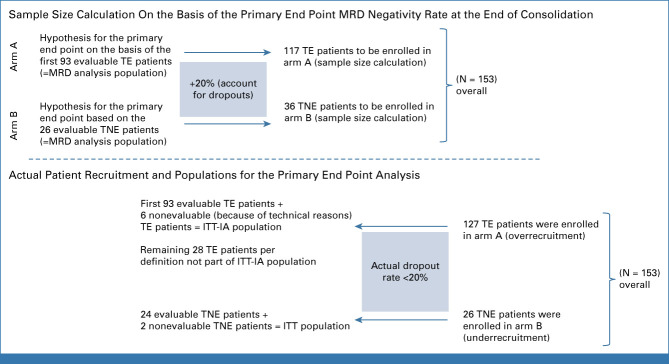
Depiction of analysis populations. IA, interim analysis; ITT, intention-to-treat; MRD, minimum residual disease; TE, transplant-eligible; TNE, transplant-noneligible.
FIG A2.
FIG A2.
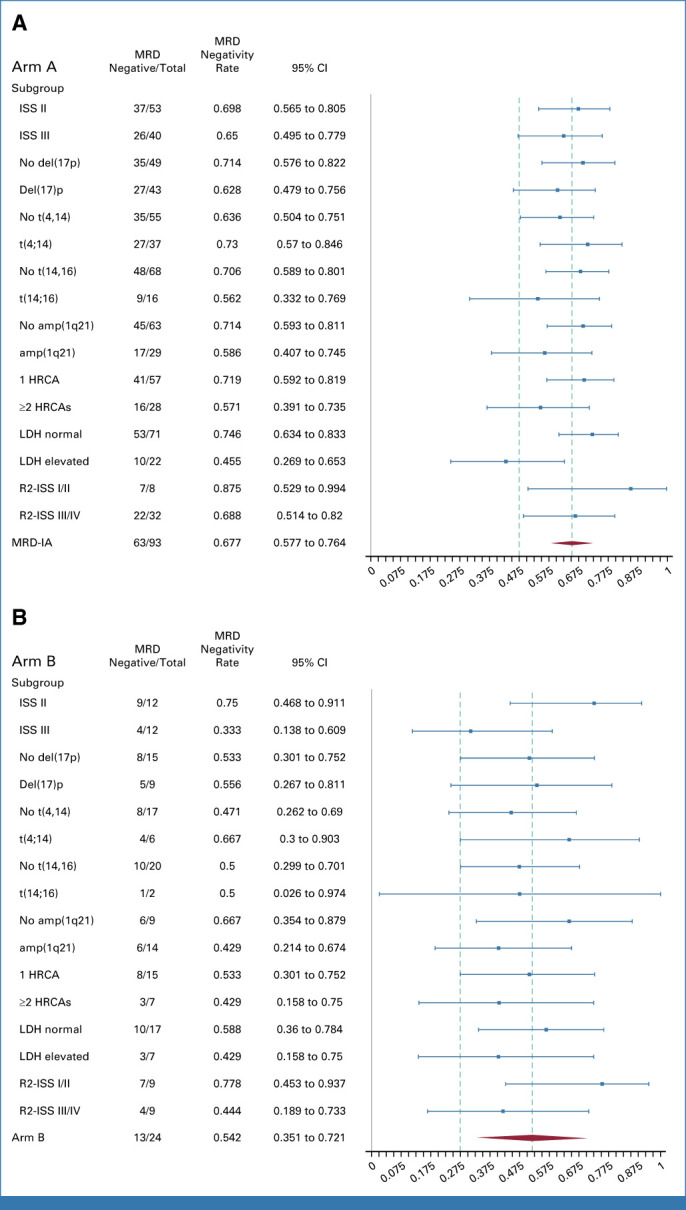
Forest plots displaying achievement of MRD negativity end point according to specific subsets of transplant-eligible (A) and transplant-noneligible (B) patients. HRCA, high-risk cytogenic aberration; ISS, International Staging System; LDH, lactate dehydrogenase; MRD, minimal residual disease; R2-ISS, Second Revision of the International Staging System.
FIG A3.
FIG A3.
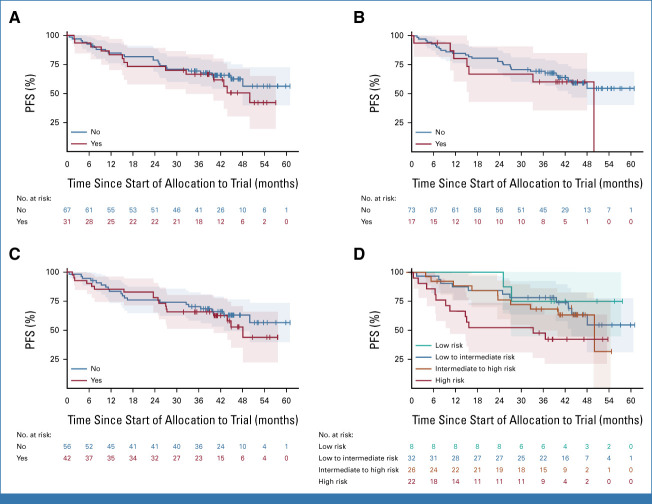
PFS in transplant-eligible patients according to the presence (red) or absence (blue) of (A) amplification of 1q21, (B) t(14;16), (C) t(4;14), or (D) according to R2-ISS. PFS, progression-free survival; R2-ISS, Second Revision of the International Staging System.

References

    1. Attal M, Lauwers-Cances V, Hulin C, et al. : Lenalidomide, bortezomib, and dexamethasone with transplantation for myeloma. N Engl J Med 376:1311-1320, 2017 - PMC - PubMed
    1. Mateos MV, Dimopoulos MA, Cavo M, et al. : Daratumumab plus bortezomib, melphalan, and prednisone for untreated myeloma. N Engl J Med 378:518-528, 2018 - PubMed
    1. Moreau P, Attal M, Hulin C, et al. : Bortezomib, thalidomide, and dexamethasone with or without daratumumab before and after autologous stem-cell transplantation for newly diagnosed multiple myeloma (CASSIOPEIA): A randomised, open-label, phase 3 study. Lancet 394:29-38, 2019 - PubMed
    1. Facon T, Kumar S, Plesner T, et al. : Daratumumab plus lenalidomide and dexamethasone for untreated myeloma. N Engl J Med 380:2104-2115, 2019 - PMC - PubMed
    1. McCarthy PL, Holstein SA, Petrucci MT, et al. : Lenalidomide maintenance after autologous stem-cell transplantation in newly diagnosed multiple myeloma: A meta-analysis. J Clin Oncol 35:3279-3289, 2017 - PMC - PubMed

Publication types

MeSH terms

Associated data