


Introducing the participant-generated experience and satisfaction (PaGES) index: a novel, longitudinal mixed-methods evaluation tool
- PMID: 37759174
- PMCID: PMC10537543
- DOI: 10.1186/s12874-023-02016-1
Introducing the participant-generated experience and satisfaction (PaGES) index: a novel, longitudinal mixed-methods evaluation tool
Abstract
Background: Patient-Reported Outcomes or Experience Measures (PROMS / PREMS) are routinely used in clinical studies to assess participants' views and experiences of trial interventions and related quality of life. Purely quantitative approaches lack the necessary detail and flexibility to understand the real-world impact of study interventions on participants, according to their own priorities. Conversely, purely qualitative assessments are time consuming and usually restricted to a small, possibly unrepresentative, sub-sample. This paper, which reports a pilot study within a randomised controlled trial of induction of labour, reports the feasibility, and acceptability of the Participant-Generated Experience and Satisfaction (PaGES) Index, a new mixed qualitative / quantitative PREM tool.
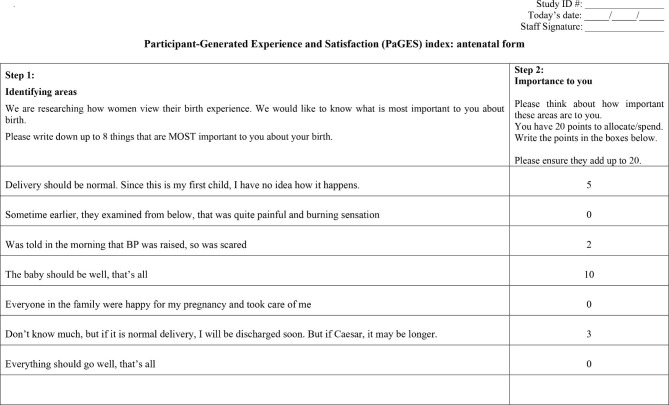
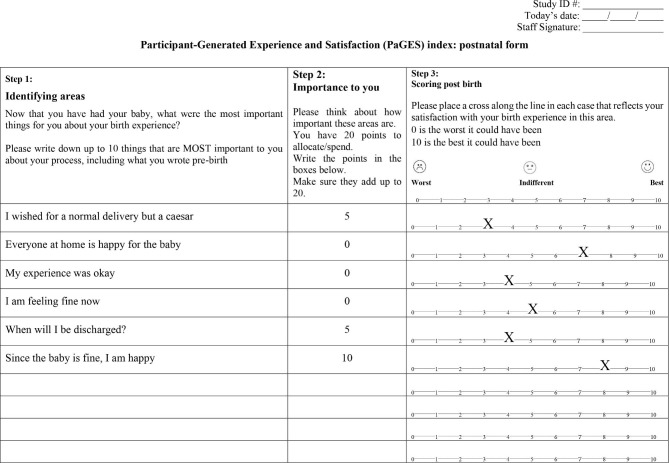
Methods: The single-sheet PaGES Index was completed by hypertensive pregnant women in two hospitals in Nagpur, India before and after taking part in the 'Misoprostol or Oxytocin for Labour Induction' (MOLI) randomised controlled trial. Participants recorded aspects of the impending birth they considered most important, and then ranked them. After the birth, participants completed the PaGES Index again, this time also scoring their satisfaction with each item. Forms were completed on paper in the local language or in English, supported by Research Assistants. Following translation (when needed), responses were uploaded to a REDCap database, coded in Excel and analysed thematically. A formal qualitative evaluation (qMOLI) was also conducted to obtain stakeholder perspectives of the PaGES Index and the wider trial. Semi-structured interviews were conducted with participants, and focus groups with researchers and clinicians. Data were managed using NVivo 12 software and analysed using the framework approach.
Results: Participants and researchers found the PaGES Index easy to complete and administer; mothers valued the opportunity to speak about their experience. Qualitative analysis of the initial 68 PaGES Index responses identified areas of commonality and difference among participants and also when comparing antenatal and postnatal responses. Theme citations and associated comments scores were fairly stable before and after the birth. The qMOLI phase, comprising 53 one-to-one interviews with participants and eight focus groups involving 83 researchers and clinicians, provided support that the PaGES Index was an acceptable and even helpful means of capturing participant perspectives.
Conclusions: Subjective participant experiences are an important aspect of clinical trials. The PaGES Index was found to be a feasible and acceptable measure that unites qualitative research's explanatory power with the comparative power of quantitative designs. It also offers the opportunity to conduct a before-and-after evaluation, allowing researchers to examine the expectations and actual experiences of all clinical trial participants, not just a small sub-sample. This study also shows that, with appropriate research assistant input, the PaGES Index can be used in different languages by participants with varying literacy levels.
Trial registration: Clinical Trials.gov (21/11/2018) (NCT03749902).
Keywords: Birth; Experience; Instrument; Participant; Patient-generated; Qualitative research; Quantitative research; Satisfaction.
© 2023. The Author(s).
Conflict of interest statement
The authors declare no competing interests.
Figures
References
-
- Cella DF, Hahn EA, Jensen SE, Butt Z, Nowinski CJ, Rothrock N, Lohr KN. Patient-reported outcomes in performance measurement. Research Triangle Park (NC): RTI Press; 2015. - PubMed
-
- Devlin N, Appleby J. Getting the most out of PROMs: putting health outcomes at the heart of NHS decision making. In. King’s Fund, London; 2010.
-
- Desomer A, van den Heede K, Triemstra M, Paget J, de Boer D, Kohn L, Cleemput I. KCE Health Services Research. Edited by (KCE): BHCKC; 2018. Use of patient-reported outcome and experience measures in patient care and policy - short report; p. 52.
Publication types
MeSH terms
Associated data
Grants and funding
LinkOut - more resources
Full Text Sources
Medical
