Review
. 2023 Sep 19;13(9):1409.
doi: 10.3390/biom13091409.

Mitochondrial Calcium Overload Plays a Causal Role in Oxidative Stress in the Failing Heart

Affiliations
Review

Mitochondrial Calcium Overload Plays a Causal Role in Oxidative Stress in the Failing Heart

Haikel Dridi et al. Biomolecules. .

Abstract

Heart failure is a serious global health challenge, affecting more than 6.2 million people in the United States and is projected to reach over 8 million by 2030. Independent of etiology, failing hearts share common features, including defective calcium (Ca2+) handling, mitochondrial Ca2+ overload, and oxidative stress. In cardiomyocytes, Ca2+ not only regulates excitation-contraction coupling, but also mitochondrial metabolism and oxidative stress signaling, thereby controlling the function and actual destiny of the cell. Understanding the mechanisms of mitochondrial Ca2+ uptake and the molecular pathways involved in the regulation of increased mitochondrial Ca2+ influx is an ongoing challenge in order to identify novel therapeutic targets to alleviate the burden of heart failure. In this review, we discuss the mechanisms underlying altered mitochondrial Ca2+ handling in heart failure and the potential therapeutic strategies.

Keywords: calcium; heart failure; mitochondria.


Conflict of interest statement

Andrew R. Marks and Columbia University own shares in ARMGO Pharma, Inc., a biotechnology company developing RyR targeted drugs. All the remaining authors declare no conflict of interest.

Figures
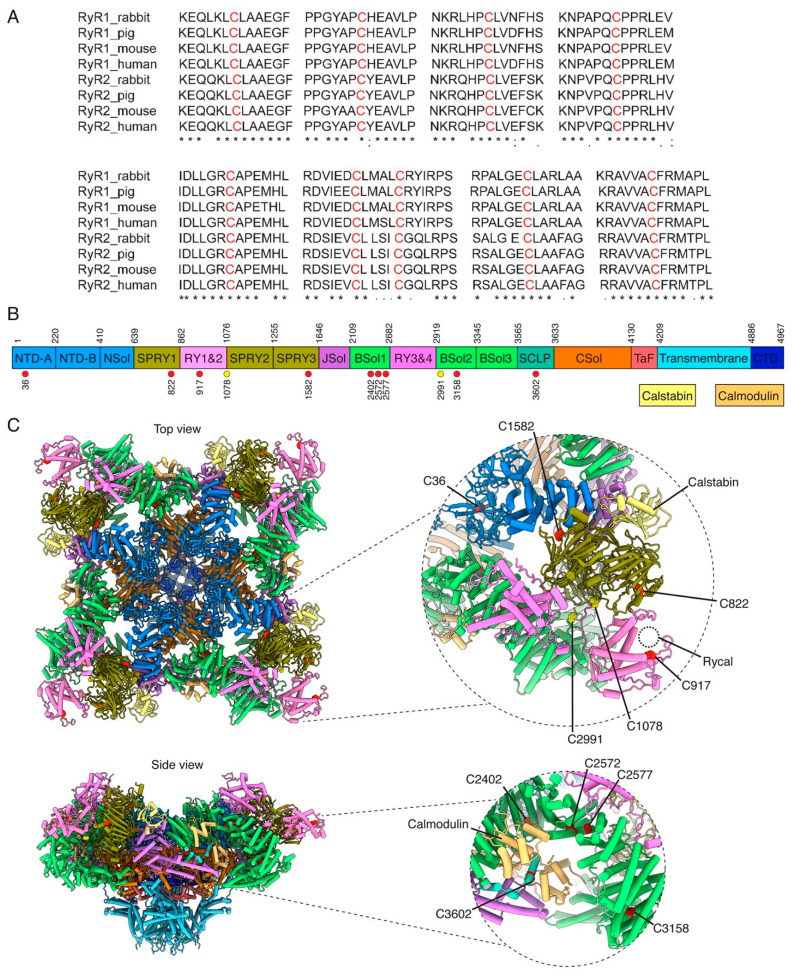
Figure 2
Figure 2
Cysteine residues of ryanodine receptors prone to oxidation by ROS. (A) Evolutionary conservation of the hyper-active cysteines (red) across the RyR isoforms 1 and 2 in a rabbit, pig, mouse, and human. (B) Schematic diagram of the domain architecture of RyR2. Red circle in the diagram indicates the cysteines prone to oxidation for each RyR2 domain according to [243]. The same applies for the yellow circles, but according to [253] (C) Human RyR2 structure (PDB: 7UA3) showing the top and side views (left). The discussed oxidized cysteines are indicated in the close-up views (right). * means conserved residue among species.
Figure 1
Figure 1
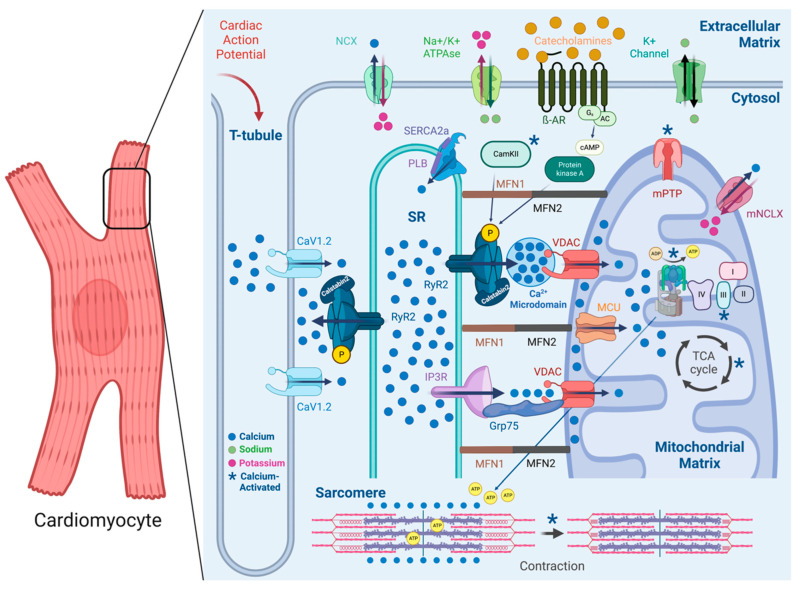
Physical interaction and Ca2+ transfer from the SR to the mitochondria in cardiomyocytes: during the depolarization phase of the cardiac action potential, Ca2+ enters the cardiomyocyte through voltage-activated L-type Ca2+ channels (CaV1.2) and triggers RyR2 to open and release Ca2+ from SR Ca2+ stores through calcium-induced calcium release (CICR). RyR2 activity can be increased by CaMKII or PKA phosphorylation, in response to stress. Ca2+ release from the SR by RyR2 creates high [Ca2+]cyt microdomains for mitochondrial Ca2+ uptake. Close contact points between the SR and mitochondria are controlled by SR mitofusin 2 (MFN2) tethering to MFN2 and MFN1 on the outer mitochondrial membrane (OMM), further creating microdomains of a high Ca2+ concentration in the vicinity of mitochondria. Ca2+ release from the SR by IP3R transits through the protein complex formed by IP3R/GRP75/VDAC and enters the mitochondria through the MCU, later being removed by mNCLX. Ca2+ activates complex III of the electron transport chain, ATP Synthase, several dehydrogenases in the TCA cycle, mPTP, CaMKII, and contraction of the sarcomeres. To induce repolarization, SERCA2a and NCX cycle Ca2+ out of the cytosol.

References

    1. Black H.R. The burden of cardiovascular disease: Following the link from hypertension to myocardial infarction and heart failure. Pt 2Am. J. Hypertens. 2003;16:4S–6S. doi: 10.1016/S0895-7061(03)00969-5. - DOI - PubMed
    1. Benjamin E.J., Muntner P., Alonso A., Bittencourt M.S., Callaway C.W., Carson A.P., Chamberlain A.M., Chang A.R., Cheng S., Das S.R., et al. Heart Disease and Stroke Statistics-2019 Update: A Report from the American Heart Association. Circulation. 2019;139:e56–e528. doi: 10.1161/CIR.0000000000000659. - DOI - PubMed
    1. Grossman W., Jones D., McLaurin L.P. Wall stress and patterns of hypertrophy in the human left ventricle. J. Clin. Investig. 1975;56:56–64. doi: 10.1172/JCI108079. - DOI - PMC - PubMed
    1. Santulli G. Pathophysiology and Pharmacotherapy of Cardiovascular Disease. Adis; Cham, Switzerland: 2015. Sympathetic nervous system signaling in heart failure and cardiac aging; pp. 83–105. - DOI
    1. Burkart F., Kiowski W. Circulatory abnormalities and compensatory mechanisms in heart failure. Am. J. Med. 1991;90:19S–22S. doi: 10.1016/0002-9343(91)90268-3. - DOI - PubMed

Publication types