


Exploring the Relationship between Mood Disorders and Coexisting Health Conditions: The Focus on Nutraceuticals
- PMID: 37759862
- PMCID: PMC10526332
- DOI: 10.3390/brainsci13091262
Exploring the Relationship between Mood Disorders and Coexisting Health Conditions: The Focus on Nutraceuticals
Abstract
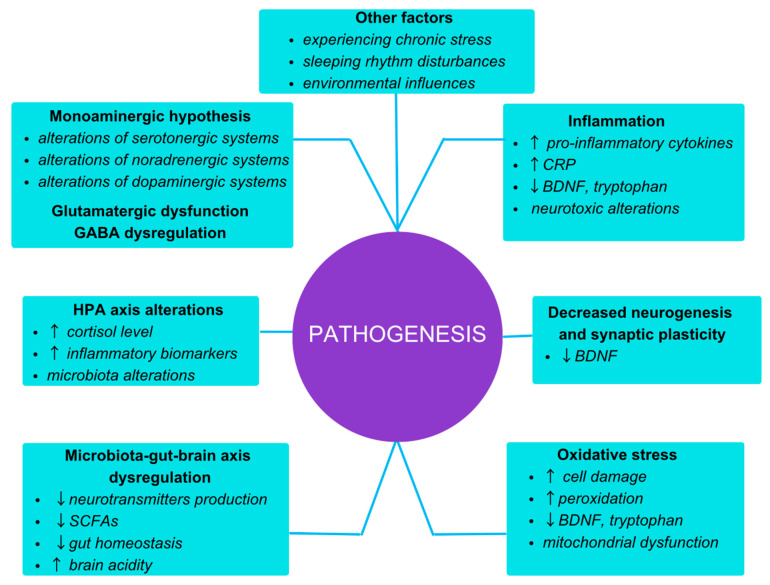
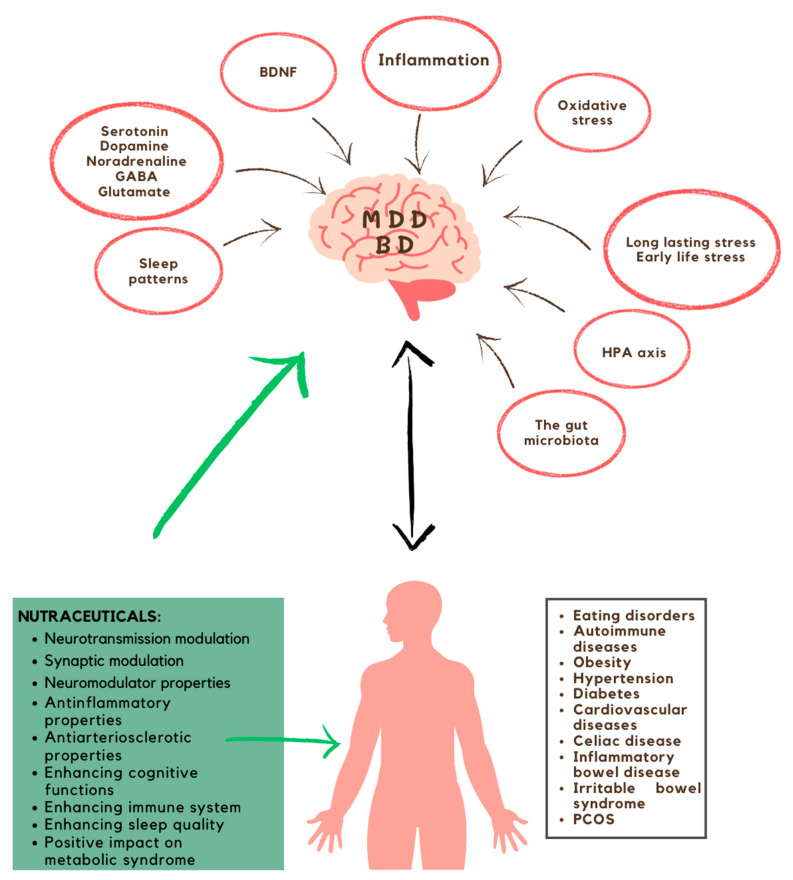
Major depressive disorder and bipolar disorder are the leading causes of global disability. Approximately 50% of patients fail to attain remission, prompting a pronounced focus on the significance of dietary patterns and specific nutrients within the pathophysiology of mood disorders. The connection between chronic diseases and mood disorders follows a bidirectional pattern: physical ailments are interrelated with affective disorders, and, concurrently, mood symptoms often precede chronic diseases and have the potential to worsen their prognosis. Nutraceuticals affect factors that could potentially impact the onset of mood disorders: monoamines and brain-derived neurotrophic factor (BDNF) concentrations, neuroinflammation, oxidative stress, and sleep quality. Furthermore, mood disorders rarely manifest in isolation. Typically, such patients concurrently experience other mental disorders or somatic comorbidities: obesity, hypertension, diabetes, polycystic ovary syndrome (PCOS), etc., where providing nutritional support is also pertinent. To optimize the therapeutic approach for individuals with mood disorders, incorporating nutritional support may not solely ameliorate symptoms stemming directly from the mental condition, but also indirectly through interventions targeting comorbidities.
Keywords: bipolar disorder; comorbidity; major depressive disorder; nutraceuticals; nutritional support.
Conflict of interest statement
Agnieszka Mechlińska has no conflict of interest. Mariusz S. Wiglusz has received research support from Alkermes, Biogen, Janssen, KCR, Otsuka, and Servier. Jakub Słupski has received research support from Actavis, Eli Lilly, Minerva, Sunovion, Celon, Janssen, Biogen, and Novartis. Adam Włodarczyk has received research support from Actavis, Eli Lilly, Minerva Neurosciences, Sunovion Pharmaceuticals, KCR, Janssen, Otsuka, Apodemus, Cortexyme, and Acadia. Wiesław J. Cubała has received research support from Acadia, Alkermes, Allergan, Angelini, Auspex Pharmaceuticals, BMS, Celon, Cephalon, Cortexyme, Ferrier, Forest Laboratories, GedeonRichter, GWPharmaceuticals, HMNC Brain Health, IntraCellular Therapies, Janssen, KCR, Lilly, Lundbeck, Minerva, MSD, NIH, Novartis, Orion, Otsuka, Sanofi, and Servier; Honoraria from Adamed, Angelini, AstraZeneca, BMS, Celon, GSK, Janssen, KRKA, Lekam, Lundbeck, Minerva, NeuroCog, Novartis, Orion, Pfizer, Polfa Tarchomin, Sanofi, Servier, and Zentiva; Advisory board position with Angelini, Celon (terminated), Douglas Pharmaceuticals, Janssen, MSD, Novartis, and Sanofi.
Figures
References
-
- World Health Organization. [(accessed on 25 March 2023)]. Available online: https://www.who.int/news-room/fact-sheets/detail/mental-disorders.
-
- Nestsiarovich A., Reps Jenna M., Matheny Michael E., DuVall S., Lynch K., Beaton M., Jiang X., Spotnitz M., Pfohl S.R., Shah N.H., et al. Predictors of diagnostic transition from major depressive disorder to bipolar disorder: A retrospective observational network study. Transl. Psychiatr. 2021;11:642. doi: 10.1038/s41398-021-01760-6. - DOI - PMC - PubMed
Publication types
LinkOut - more resources
Full Text Sources
