


With or without Feedback?-How the Presence of Feedback Affects Processing in Children with Developmental Language Disorder
- PMID: 37759863
- PMCID: PMC10526478
- DOI: 10.3390/brainsci13091263
With or without Feedback?-How the Presence of Feedback Affects Processing in Children with Developmental Language Disorder
Abstract
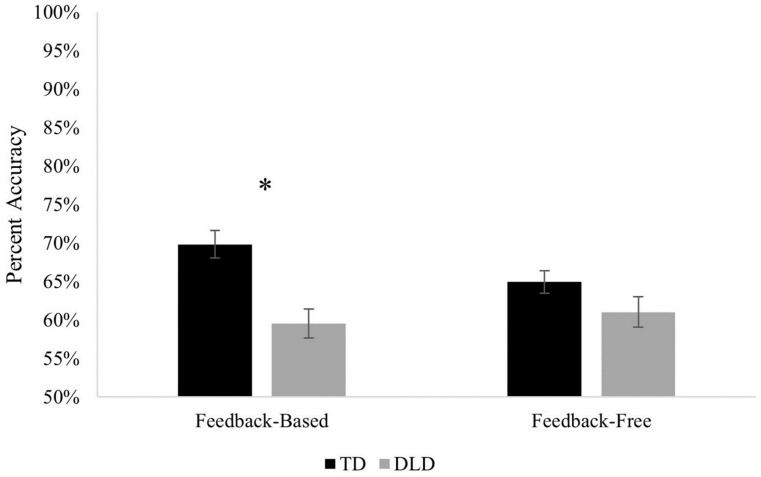
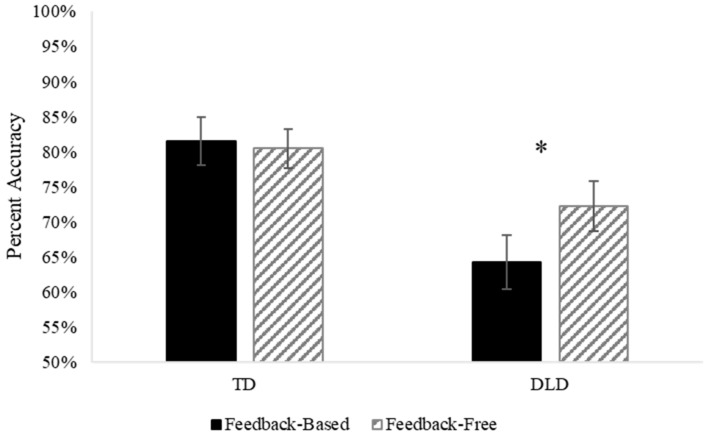
Language acquisition depends on the ability to process and learn probabilistic information, often through the integration of performance feedback. Children with developmental language disorder (DLD) have demonstrated weaknesses in both probabilistic learning and feedback processing, but the individual effects of each skill are poorly understood in this population. This study examined school-aged children with DLD (n = 29) and age- and gender-matched children with typical development (TD; n = 44) on a visual probabilistic classification learning task presented with and without feedback. In the feedback-based version of the task, children received performance feedback on a trial-by-trial basis during the training phase of the task. In the feedback-free version, children responded after seeing the correct choice marked with a green border and were not presented with feedback. Children with TD achieved higher accuracy than children with DLD following feedback-based training, while the two groups achieved similar levels of accuracy following feedback-free training. Analyses of event-related potentials (ERPs) provided insight into stimulus encoding processes. The feedback-free task was dominated by a frontal slow wave (FSW) and a late parietal component (LPC) which were not different between the two groups. The feedback-based task was dominated by a parietal slow wave (PSW) and an LPC, both of which were found to be larger in the TD than in the DLD group. In combination, results suggest that engagement with feedback boosts learning in children with TD, but not in children with DLD. When the need to process feedback is eliminated, children with DLD demonstrate behavioral and neurophysiological responses similar to their peers with TD.
Keywords: developmental language disorder; encoding; event-related potential; feedback processing; probabilistic classification learning.
Conflict of interest statement
The authors declare no conflict of interest. The funders had no role in the design of the study; in the collection, analyses, or interpretation of data; in the writing of the manuscript; or in the decision to publish the results.
Figures



References
-
- Norbury C.F., Gooch D., Wray C., Baird G., Charman T., Simonoff E., Vamvakas G., Pickles A. The impact of nonverbal ability on prevalence and clinical presentation of language disorder: Evidence from a population study. J. Child Psychol. Psychiatry. 2016;57:1247–1257. doi: 10.1111/jcpp.12573. - DOI - PMC - PubMed
-
- Bishop D.V., Snowling M.J., Thompson P.A., Greenhalgh T., CATALISE-2 Consortium Phase 2 of CATALISE: A multinational and multidisciplinary Delphi consensus study of problems with language development: Terminology. J. Child Psychol. Psychiatry. 2017;58:1068–1080. doi: 10.1111/jcpp.12721. - DOI - PMC - PubMed
Grants and funding
LinkOut - more resources
Full Text Sources
Miscellaneous
