


The Synergy Zone: Connecting the Mind, Brain, and Heart for the Ideal Classroom Learning Environment
- PMID: 37759915
- PMCID: PMC10526388
- DOI: 10.3390/brainsci13091314
The Synergy Zone: Connecting the Mind, Brain, and Heart for the Ideal Classroom Learning Environment
Abstract
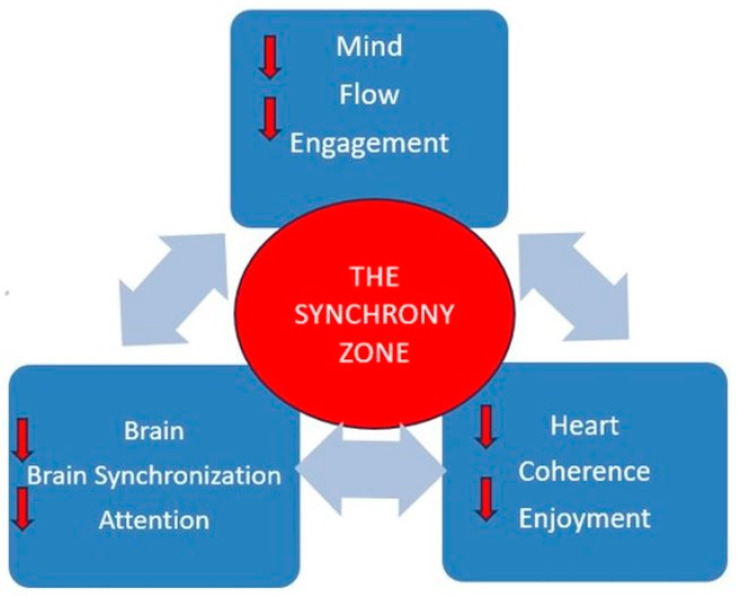
This paper proposes a new perspective on implementing neuroeducation in the classroom. The pandemic exacerbated the mental health issues of faculty and students, creating a mental health crisis that impairs learning. It is important to get our students back in "the zone", both cognitively and emotionally, by creating an ideal learning environment for capturing our students and keeping them-the Synergy Zone. Research that examines the classroom environment often focuses on the foreground-instructors' organizational and instructional aspects and content. However, the emotional climate of the classroom affects student well-being. This emotional climate would ideally exhibit the brain states of engagement, attention, connection, and enjoyment by addressing the mind, brain, and heart. This ideal learning environment would be achieved by combining proposed practices derived from three areas of research: flow theory, brain synchronization, and positive emotion with heart engagement. Each of these enhances the desired brain states in a way that the whole is greater than the sum of the individual parts. I call this the Synergy Zone. A limitation of this proposed model is that implementation of some aspects may be challenging, and professional development resources might be needed. This essay presenting this perspective provides the relevant scientific research and the educational implications of implementation.
Keywords: attention; brain synchronization; classroom environment; education; emotion; engagement; flow; heart coherence; learning.
Conflict of interest statement
The authors declare no conflict of interest.
References
-
- Reyes M.R., Brackett M.A., Rivers S.E., White M., Salovey P. Classroom emotional climate, student engagement, and academic achievement. J. Educ. Psychol. 2012;104:700. doi: 10.1037/a0027268. - DOI
-
- Gashi S., Di Lascio E., Santini S. Using students’ physiological synchrony to quantify the classroom emotional climate; Proceedings of the 2018 ACM International Joint Conference and 2018 International Symposium on Pervasive and Ubiquitous Computing and Wearable Computers; Singapore. 8–12 October 2018; pp. 698–701.
LinkOut - more resources
Full Text Sources
Miscellaneous
