


Machine Learning for Medical Image Translation: A Systematic Review
- PMID: 37760180
- PMCID: PMC10525905
- DOI: 10.3390/bioengineering10091078
Machine Learning for Medical Image Translation: A Systematic Review
Abstract
Background: CT scans are often the first and only form of brain imaging that is performed to inform treatment plans for neurological patients due to its time- and cost-effective nature. However, MR images give a more detailed picture of tissue structure and characteristics and are more likely to pick up abnormalities and lesions. The purpose of this paper is to review studies which use deep learning methods to generate synthetic medical images of modalities such as MRI and CT.
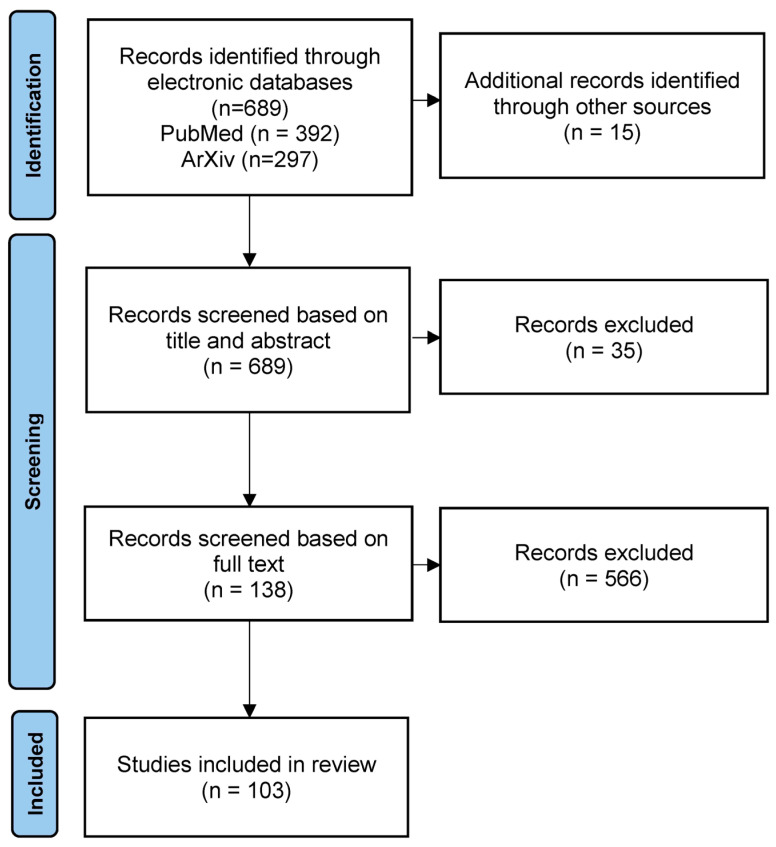
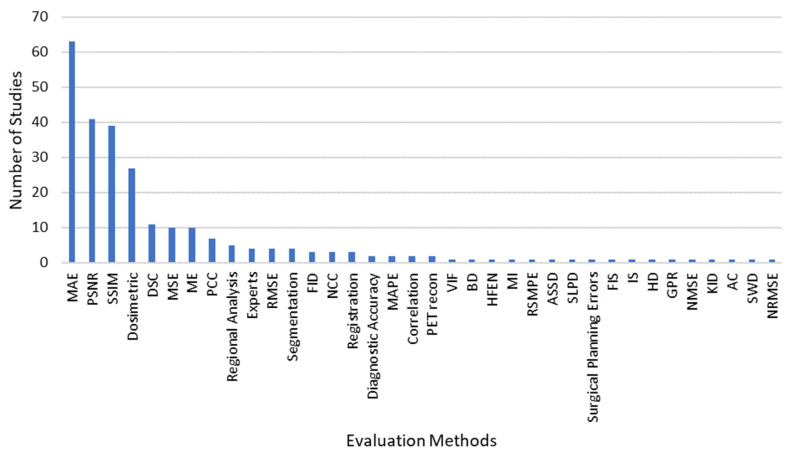
Methods: A literature search was performed in March 2023, and relevant articles were selected and analyzed. The year of publication, dataset size, input modality, synthesized modality, deep learning architecture, motivations, and evaluation methods were analyzed.
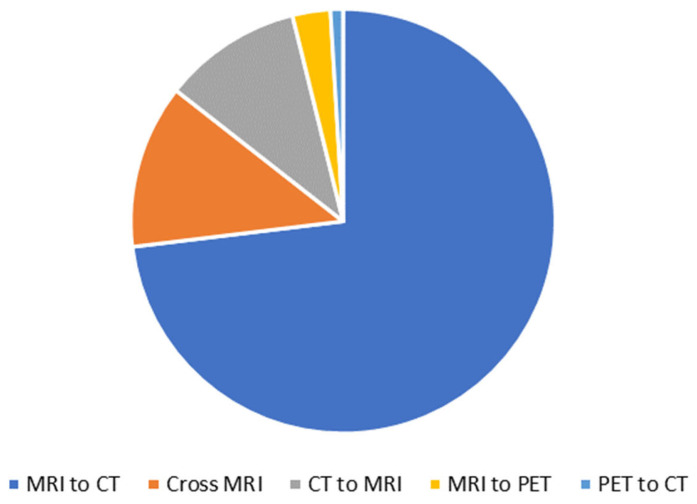
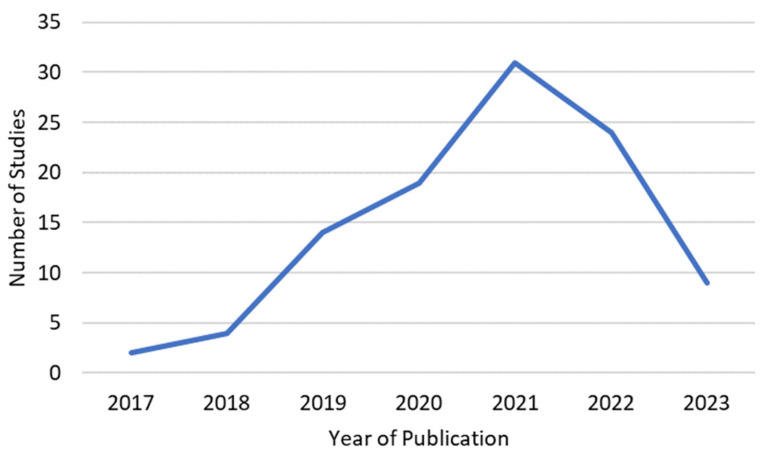
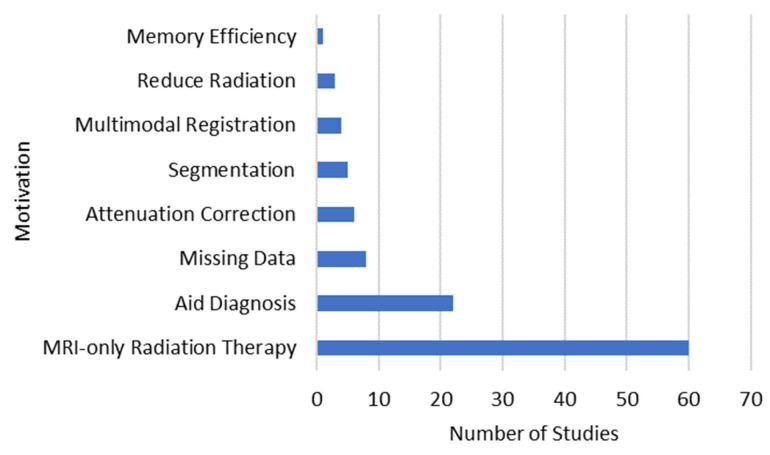
Results: A total of 103 studies were included in this review, all of which were published since 2017. Of these, 74% of studies investigated MRI to CT synthesis, and the remaining studies investigated CT to MRI, Cross MRI, PET to CT, and MRI to PET. Additionally, 58% of studies were motivated by synthesizing CT scans from MRI to perform MRI-only radiation therapy. Other motivations included synthesizing scans to aid diagnosis and completing datasets by synthesizing missing scans.
Conclusions: Considerably more research has been carried out on MRI to CT synthesis, despite CT to MRI synthesis yielding specific benefits. A limitation on medical image synthesis is that medical datasets, especially paired datasets of different modalities, are lacking in size and availability; it is therefore recommended that a global consortium be developed to obtain and make available more datasets for use. Finally, it is recommended that work be carried out to establish all uses of the synthesis of medical scans in clinical practice and discover which evaluation methods are suitable for assessing the synthesized images for these needs.
Keywords: CT to MRI; cross-modality synthesis; deep learning; medical image generation; medical imaging; modality translation.
Conflict of interest statement
The authors declare no conflict of interest.
Figures
References
-
- Goodfellow I.J., Pouget-Abadie J., Mirza M., Xu B., Warde-Farley D., Ozair S., Courville A., Bengio Y. Generative adversarial nets; Proceedings of the 27th International Conference on Neural Information Processing Systems; Montreal, QC, Canada. 8–13 December 2014; Cambridge, MA, USA: MIT Press; 2014. pp. 2672–2680.
-
- Ronneberger O., Fischer P., Brox T. U-Net: Convolutional Networks for Biomedical Image Segmentation; Proceedings of the Medical Image Computing and Computer-Assisted Intervention—MICCAI 2015; Munich, Germany. 5–9 October 2015; Cham, Switzerland: Springer; 2015.
-
- Yu B., Wang Y., Wang L., Shen D., Zhou L. Medical Image Synthesis via Deep Learning. In: Lee G., Fujita H., editors. Deep Learning in Medical Image Analysis: Challenges and Applications. Springer; Cham, Switzerland: 2020. pp. 23–44. - PubMed
Publication types
Grants and funding
LinkOut - more resources
Full Text Sources
