


Area Dose-Response and Radiation Origin of Childhood Thyroid Cancer in Fukushima Based on Thyroid Dose in UNSCEAR 2020/2021: High 131I Exposure Comparable to Chernobyl
- PMID: 37760552
- PMCID: PMC10526940
- DOI: 10.3390/cancers15184583
Area Dose-Response and Radiation Origin of Childhood Thyroid Cancer in Fukushima Based on Thyroid Dose in UNSCEAR 2020/2021: High 131I Exposure Comparable to Chernobyl
Erratum in
-
Correction: Kato et al. Area Dose-Response and Radiation Origin of Childhood Thyroid Cancer in Fukushima Based on Thyroid Dose in UNSCEAR 2020/2021: High 131I Exposure Comparable to Chernobyl. Cancers 2023, 15, 4583.Cancers (Basel). 2023 Dec 11;15(24):5802. doi: 10.3390/cancers15245802. Cancers (Basel). 2023. PMID: 38136444 Free PMC article.
Abstract
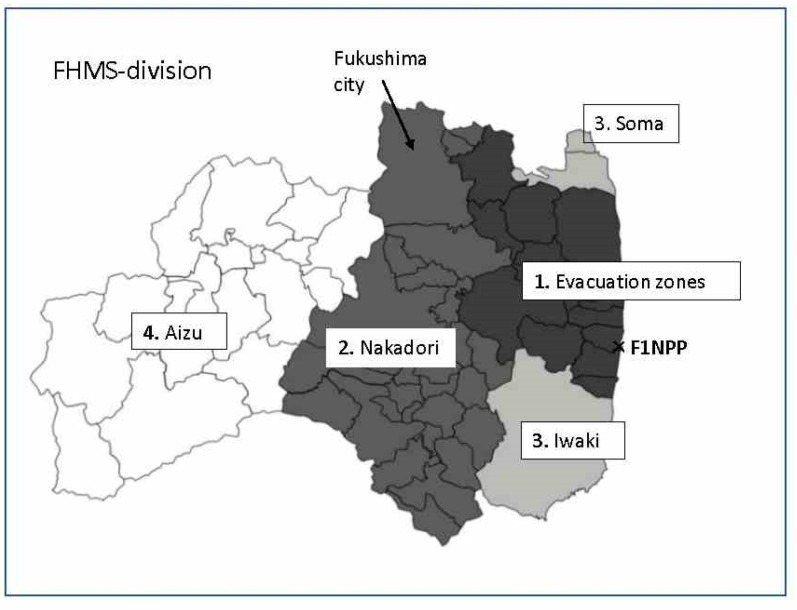
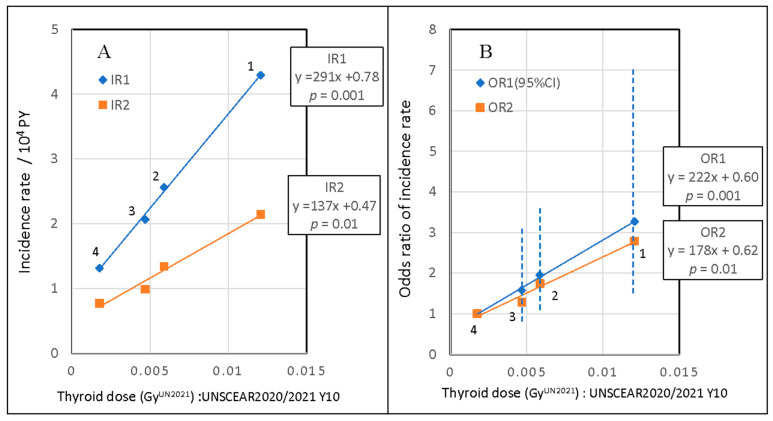
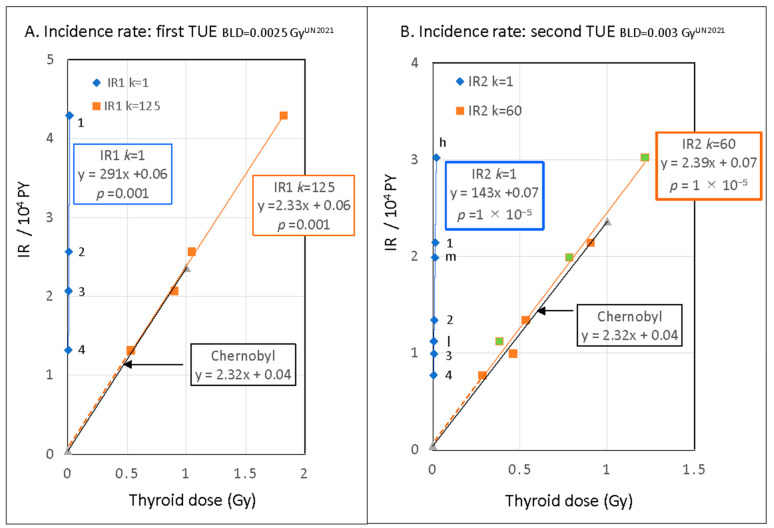
The FMU and the United Nations Scientific Committee on the Effects of Atomic Radiation (UNSCEAR) concluded that the high incidence of thyroid cancer after the Fukushima nuclear accident was not the result of radiation exposure, but rather might have been overdiagnosis based on the low thyroid dose estimated in the UNSCEAR 2020/2021 report. In this study, the origin of increased PTC in Fukushima was examined based on the thyroid dose estimated by UNSCEAR. The dose-response relationship of the incidence rate per person-years (PY) was analyzed for four areas in Fukushima prefecture via regression analysis. The linear response of the annual incidence rates to thyroid dose in the first six years showed that the dominant origin of childhood thyroid cancer was radiation exposure. Excess absolute risk (EAR) proportionally increased with thyroid dose, with an EAR/104 PY Gy of 143 (95%CI: 122, 165) in the second TUE (p < 0.001), which is approximately 50-100 times higher than the EAR/104 PY Gy ≒ 2.3 observed after the Chernobyl accident. This suggests an underestimation of the thyroid dose by UNSCEAR of approximately 1/50~1/100 compared with the thyroid dose for Chernobyl. The increased childhood thyroid cancer in Fukushima was found to arise from radioactive iodine exposure, which was comparable to that in Chernobyl.
Keywords: 131I exposure; Chernobyl; Fukushima; UNSCEAR 2020/2021; area dose–response; childhood thyroid cancer; excess absolute risk; overdiagnosis; radiation-induced PTC.
Conflict of interest statement
The authors declare no conflict of interest.
Figures
References
-
- Radiation Medical Science Center for the Fukushima Health Management Survey Materials and Minutes of Prefectural Oversight Committee Meetings. [(accessed on 1 August 2023)]. Available online: https://fhms.jp/en/fhms/outline/materials/
-
- Radiation Medical Science Center for the Fukushima Health Management Survey Report of the Fukushima Health Management Survey 2019. [(accessed on 1 August 2023)]. Available online: https://fukushima-mimamori.jp/outline/uploads/report_r1.pdf.
-
- Fukushima Prefectural Oversight Committee Meeting for FHMS Interim Summary of the results of FHMS. 2016. [(accessed on 1 August 2023)]. Available online: https://www.pref.fukushima.lg.jp/uploaded/attachment/158522.pdf. (In Japanese)
-
- Tsugane S. Estimation of the number of prevalent thyroid cancer patients in Fukushima Prefecture, Thyroid Examination Evaluation Subcommittee. 2014. [(accessed on 1 August 2023)]. Available online: https://www.pref.fukushima.lg.jp/uploaded/attachment/91000.pdf. (In Japanese)
-
- Fukushima Prefectural Oversight Committee Meeting for FHMS Summary of the Results of Full-Scale Screening (Second Examination) 2019. [(accessed on 1 August 2023)]. Available online: https://www.pref.fukushima.lg.jp/uploaded/attachment/336455.pdf. (In Japanese)
LinkOut - more resources
Full Text Sources
