


Using Single-Case Experimental Design and Patient-Reported Outcome Measures to Evaluate the Treatment of Cancer-Related Cognitive Impairment in Clinical Practice
- PMID: 37760621
- PMCID: PMC10526413
- DOI: 10.3390/cancers15184643
Using Single-Case Experimental Design and Patient-Reported Outcome Measures to Evaluate the Treatment of Cancer-Related Cognitive Impairment in Clinical Practice
Abstract
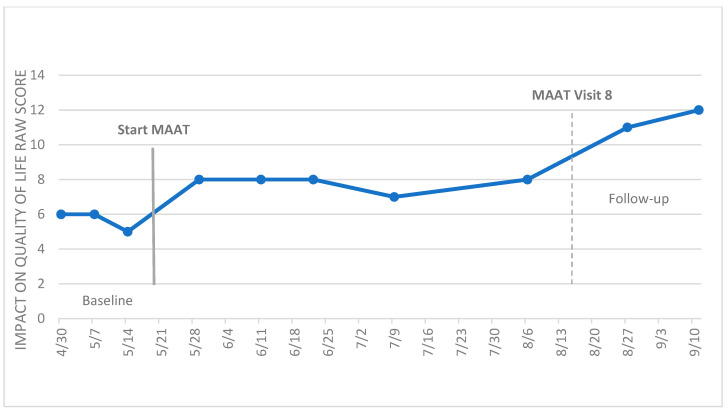
Cancer-related cognitive impairment (CRCI) affects a large proportion of cancer survivors and has significant negative effects on survivor function and quality of life (QOL). Treatments for CRCI are being developed and evaluated. Memory and attention adaptation training (MAAT) is a cognitive-behavioral therapy (CBT) demonstrated to improve CRCI symptoms and QOL in previous research. The aim of this article is to describe a single-case experimental design (SCED) approach to evaluate interventions for CRCI in clinical practice with patient-reported outcome measures (PROs). We illustrate the use of contemporary SCED methods as a means of evaluating MAAT, or any CRCI treatment, once clinically deployed. With the anticipated growth of cancer survivorship and concurrent growth in the number of survivors with CRCI, the treatment implementation and evaluation methods described here can be one way to assess and continually improve CRCI rehabilitative services.
Keywords: cancer survivorship; cognition; cognitive-behavioral therapy; single-case experimental design.
Conflict of interest statement
Ferguson is the lead author of
Figures
References
-
- Mandelblatt J.S., Small B.J., Luta G., Hurria A., Jim H., McDonald B.C., Graham D., Zhou X., Clapp J., Zhai W. Cancer-Related Cognitive Outcomes Among Older Breast Cancer Survivors in the Thinking and Living with Cancer Study. J. Clin. Oncol. 2018;36:3211–3222. doi: 10.1200/JCO.18.00140. - DOI - PMC - PubMed
Grants and funding
LinkOut - more resources
Full Text Sources
Miscellaneous
