


Chronic Kidney Disease Has No Impact on Tear Film Substance P Concentration in Type 2 Diabetes
- PMID: 37760810
- PMCID: PMC10525867
- DOI: 10.3390/biomedicines11092368
Chronic Kidney Disease Has No Impact on Tear Film Substance P Concentration in Type 2 Diabetes
Abstract
Purpose: The study aimed to ascertain the potential effects of chronic kidney disease (CKD) on substance P concentration in the tear film of people with type 2 diabetes.
Methods: Participants were classified into two groups: type 2 diabetes with concurrent chronic kidney disease (T2DM-CKD (n = 25)) and type 2 diabetes without chronic kidney disease (T2DM-no CKD (n = 25)). Ocular surface discomfort assessment, flush tear collection, in-vivo corneal confocal microscopy, and peripheral neuropathy assessment were conducted. Enzyme-linked immunosorbent assays were utilized to ascertain the levels of tear film substance P in collected flush tears. Correlation analysis, hierarchical multiple linear regression analysis, and t-tests or Mann-Whitney U tests were used in the analysis of data for two-group comparisons.
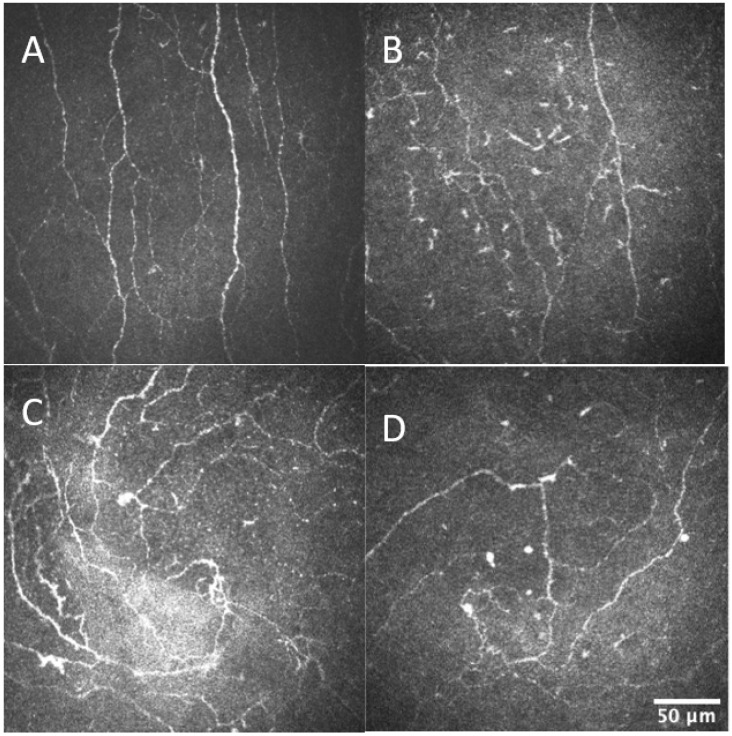
Results: There was no substantial difference between the T2DM-CKD and T2DM-no CKD groups for tear film substance P concentration (4.4 (0.2-50.4) and 5.9 (0.2-47.2) ng/mL, respectively; p = 0.54). No difference was observed in tear film substance P concentration between the low-severity peripheral neuropathy and high-severity peripheral neuropathy groups (4.4 (0.2-50.4) and 3.3 (0.3-40.7) ng/mL, respectively; p = 0.80). Corneal nerve fiber length (9.8 ± 4.6 and 12.4 ± 3.8 mm/mm2, respectively; p = 0.04) and corneal nerve fiber density (14.7 ± 8.5 and 21.1 ± 7.0 no/mm2, respectively; p < 0.01) were reduced significantly in the T2DM-CKD group compared to the T2DM-no CKD group. There were significant differences in corneal nerve fiber density (21.0 ± 8.1 and 15.8 ± 7.7 no/mm2, respectively; p = 0.04) and corneal nerve fiber length (12.9 ± 4.2 and 9.7 ± 3.8 mm/mm2, respectively; p = 0.03) between the low- and high-severity peripheral neuropathy groups.
Conclusion: In conclusion, no significant difference in tear film substance P concentration was observed between type 2 diabetes with and without CKD. Corneal nerve loss, however, was more significant in type 2 diabetes with chronic kidney disease compared to type 2 diabetes alone, indicating that corneal nerve morphological measures could serve greater utility as a tool to detect neuropathy and nephropathy-related corneal nerve changes.
Keywords: chronic kidney disease; cornea; diabetic neuropathy; peripheral neuropathy; substance p.
Conflict of interest statement
The authors declare no conflict of interest.
Figures
References
-
- Arnold R., Pianta T.J., Issar T., Kirby A., Scales C.M., Kwai N.C., Endre Z., Krishnan A.V. Peripheral neuropathy: An important contributor to physical limitation and morbidity in stages 3 and 4 chronic kidney disease. Nephrol. Dial. Transplant. 2022;37:713–719. doi: 10.1093/ndt/gfab043. - DOI - PubMed
LinkOut - more resources
Full Text Sources
