


Antibody-Drug Conjugates in Breast Cancer: Current Status and Future Directions
- PMID: 37762027
- PMCID: PMC10531043
- DOI: 10.3390/ijms241813726
Antibody-Drug Conjugates in Breast Cancer: Current Status and Future Directions
Abstract
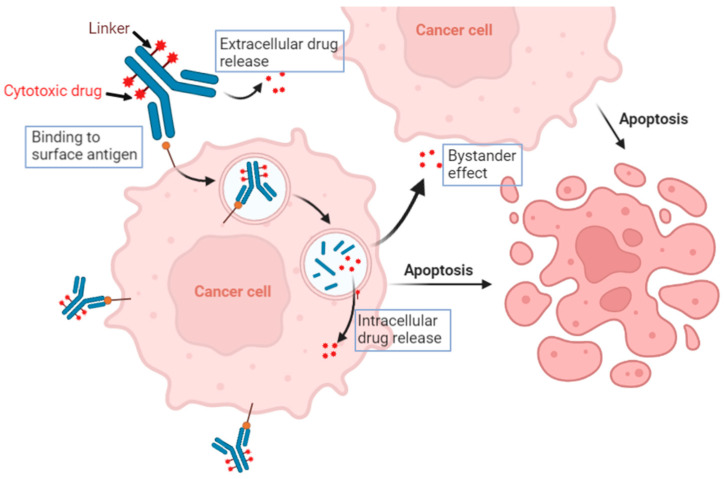
Antibody drug conjugates (ADCs) are novel medications that combine monoclonal antibodies with cytotoxic payloads, enabling the selective delivery of potent drugs to cancer cells expressing specific surface antigens. This targeted strategy seeks to optimize treatment effectiveness while reducing the risk of systemic toxicity, distinguishing ADCs from conventional chemotherapy. The rapid growth in ADC research has led to numerous developments and approvals for cancer treatment, with significant impacts on the management of breast cancer. ADCs like T-DXd for HER2-low disease and sacituzumab govitecan for triple negative breast cancer (TNBC) have provided valuable options for challenging subtypes of breast cancer. However, essential questions still need to be addressed, including the optimal order of ADCs amidst the growing number of newly developed ones and strategies to overcome resistance mechanisms. Preclinical studies have shed light on potential resistance mechanisms, emphasizing the potential benefit of combinational approaches with other agents such as immune checkpoint inhibitors (ICIs) and targeted tyrosine kinase inhibitors (TKIs) to enhance treatment effectiveness. Additionally, personalized approaches based on molecular profiling hold promise in tailoring ADC treatments to individual tumors, identifying unique molecular markers for each patient to optimize treatment efficacy while minimizing side effects.
Keywords: antibody–drug conjugates; breast cancer; drug resistance.
Conflict of interest statement
Y.Y. has contracted research sponsored by Agenus, Merck, Genentech, and Pfizer, is a consultant for Pfizer and Gilead, and is on the Speakers Bureau for AstraZeneca, Daiichi Sankyo, Merck, and Gilead. The other authors declare that they have no competing interests.
Figures
References
-
- Matulonis U.A., Lorusso D., Oaknin A., Pignata S., Dean A., Denys H., Colombo N., Van Gorp T., Konner J.A., Marin M.R., et al. Efficacy and Safety of Mirvetuximab Soravtansine in Patients with Platinum-Resistant Ovarian Cancer with High Folate Receptor Alpha Expression: Results from the SORAYA Study. J. Clin. Oncol. 2023;41:2436–2445. doi: 10.1200/JCO.22.01900. - DOI - PMC - PubMed
Publication types
MeSH terms
Substances
Grants and funding
LinkOut - more resources
Full Text Sources
Medical
Research Materials
Miscellaneous
