


The Fibrinolytic System and Its Measurement: History, Current Uses and Future Directions for Diagnosis and Treatment
- PMID: 37762481
- PMCID: PMC10532028
- DOI: 10.3390/ijms241814179
The Fibrinolytic System and Its Measurement: History, Current Uses and Future Directions for Diagnosis and Treatment
Abstract
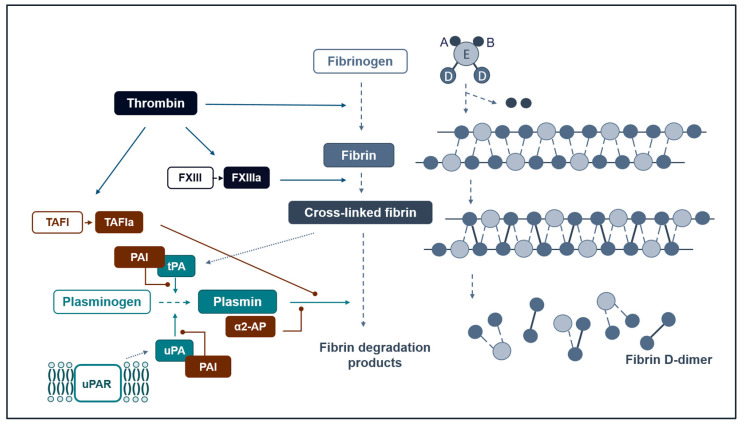
The fibrinolytic system is a key player in keeping the haemostatic balance, and changes in fibrinolytic capacity can lead to both bleeding-related and thrombosis-related disorders. Our knowledge of the fibrinolytic system has expanded immensely during the last 75 years. From the first successful use of thrombolysis in myocardial infarction in the 1960s, thrombolytic therapy is now widely implemented and has reformed treatment in vascular medicine, especially ischemic stroke, while antifibrinolytic agents are used routinely in the prevention and treatment of major bleeding worldwide. Despite this, this research field still holds unanswered questions. Accurate and timely laboratory diagnosis of disturbed fibrinolysis in the clinical setting remains a challenge. Furthermore, despite growing evidence that hypofibrinolysis plays a central role in, e.g., sepsis-related coagulopathy, coronary artery disease, and venous thromboembolism, there is currently no approved treatment of hypofibrinolysis in these settings. The present review provides an overview of the fibrinolytic system and history of its discovery; measurement methods; clinical relevance of the fibrinolytic system in diagnosis and treatment; and points to future directions for research.
Keywords: diagnostic tests; fibrinolysis; plasmin; plasminogen.
Conflict of interest statement
C.L.H. declares no conflict of interest. J.B.L. has no conflict of interest pertaining to the present paper but has the following general conflict of interest: she has received lecture honoraria from Bristol-Myers Squibb and has received travel support from Bayer.
Figures
References
-
- Collaborators C.-T., Shakur H., Roberts I., Bautista R., Caballero J., Coats T., Dewan Y., El-Sayed H., Gogichaishvili T., Gupta S., et al. Effects of tranexamic acid on death, vascular occlusive events, and blood transfusion in trauma patients with significant haemorrhage (CRASH-2): A randomised, placebo-controlled trial. Lancet. 2010;376:23–32. doi: 10.1016/S0140-6736(10)60835-5. - DOI - PubMed
Publication types
MeSH terms
Substances
LinkOut - more resources
Full Text Sources
Medical
