Review
. 2023 Sep 19;24(18):14256.
doi: 10.3390/ijms241814256.

Understanding Glioblastoma Signaling, Heterogeneity, Invasiveness, and Drug Delivery Barriers

Affiliations
Review

Understanding Glioblastoma Signaling, Heterogeneity, Invasiveness, and Drug Delivery Barriers

Nadin Rabah et al. Int J Mol Sci. .

Abstract

The most prevalent and aggressive type of brain cancer, namely, glioblastoma (GBM), is characterized by intra- and inter-tumor heterogeneity and strong spreading capacity, which makes treatment ineffective. A true therapeutic answer is still in its infancy despite various studies that have made significant progress toward understanding the mechanisms behind GBM recurrence and its resistance. The primary causes of GBM recurrence are attributed to the heterogeneity and diffusive nature; therefore, monitoring the tumor's heterogeneity and spreading may offer a set of therapeutic targets that could improve the clinical management of GBM and prevent tumor relapse. Additionally, the blood-brain barrier (BBB)-related poor drug delivery that prevents effective drug concentrations within the tumor is discussed. With a primary emphasis on signaling heterogeneity, tumor infiltration, and computational modeling of GBM, this review covers typical therapeutic difficulties and factors contributing to drug resistance development and discusses potential therapeutic approaches.

Keywords: GBM signaling; blood–brain barrier (BBB); glioblastoma; heterogeneity; invasion; recurrence; targeted therapy.


Conflict of interest statement

The authors declare no conflict of interest.

Figures
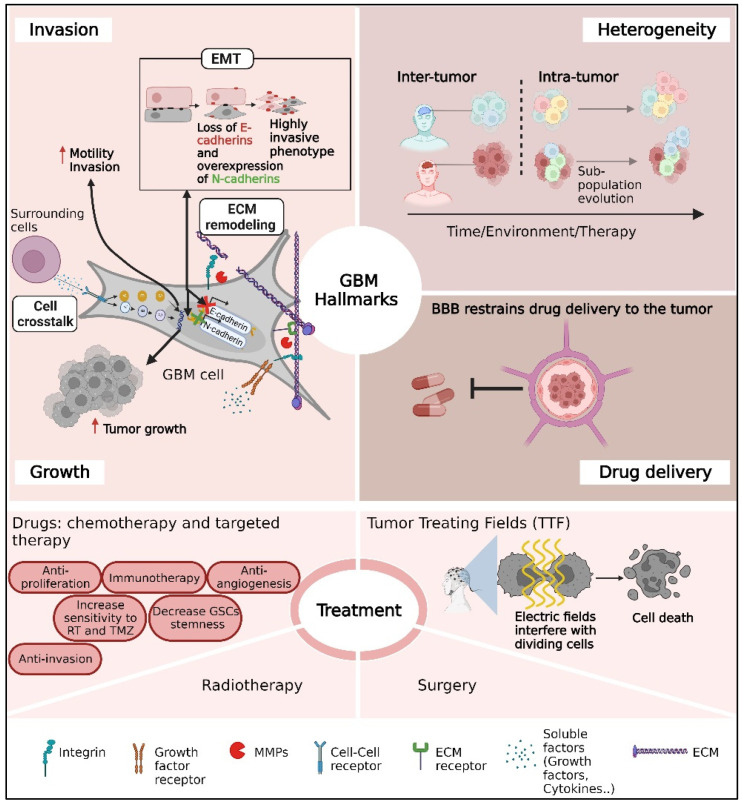
Figure 1
Figure 1
A schematic overview of the main challenges for glioblastoma (GBM) clinical care mentioned in this review. The challenges include the infiltrative nature of GBM tumors, substantial heterogeneity between patients or cells inside the tumor, drug delivery through the BBB, and therapeutic limitations.
Figure 2
Figure 2
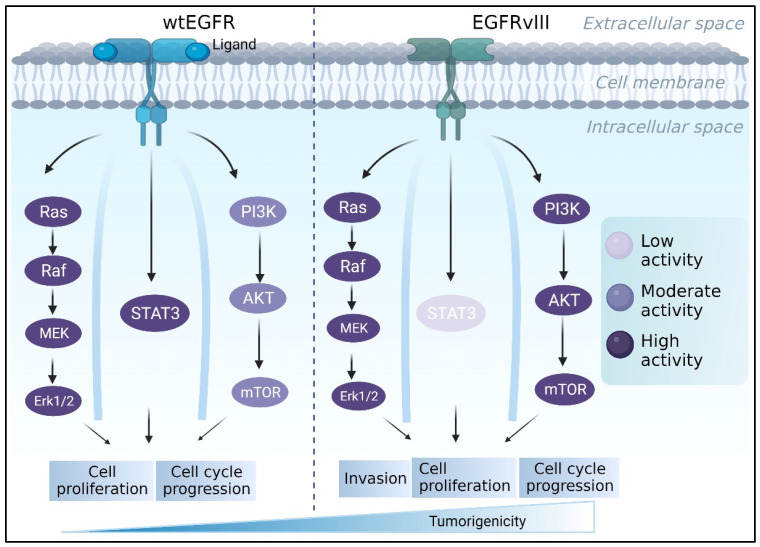
The EGFR/EGFRvIII pathway contributes to the progression of GBM. While PI3K and RAS/MAPK activation is stronger in EGFRvIII-expressing cells, EGFRwt commonly stimulates MAPK and STAT3, encouraging tumor growth. Meanwhile, EGFRvIII is constitutively activated and primarily initiates the PI3K pathway, which is involved in tumor invasion and survival.
Figure 3
Figure 3
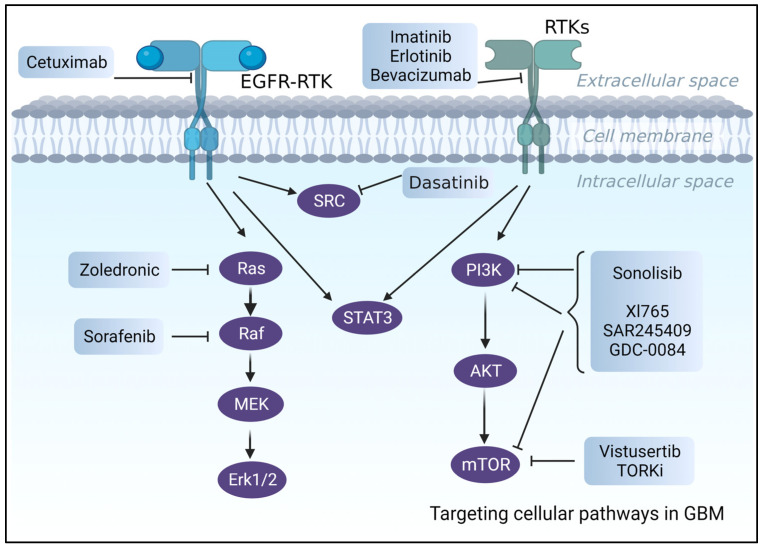
An illustration of the suggested pharmacological treatments and biological targets for the treatment of GBM.
Figure 4
Figure 4
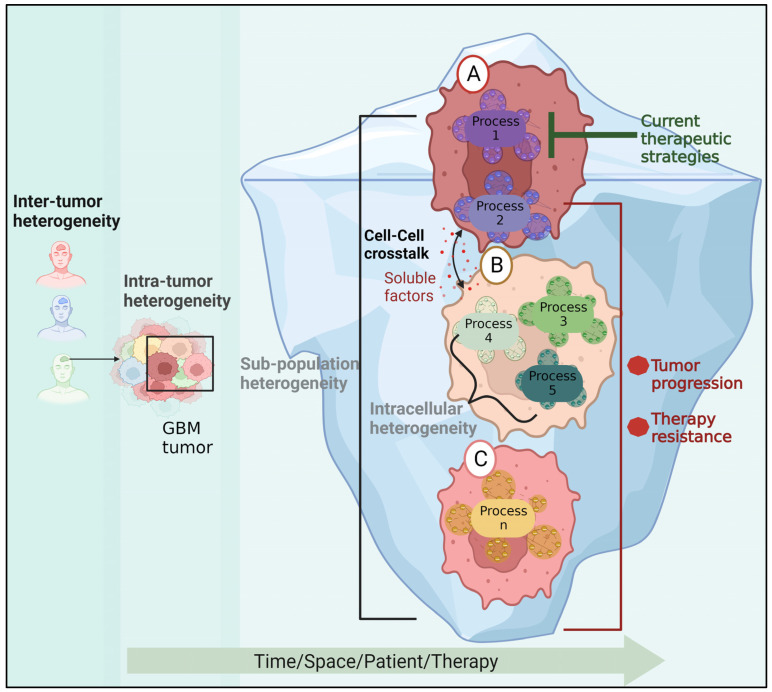
The role of GBM heterogeneity in GBM recurrence. In addition to patient variability, the cells within the tumor may belong to different subpopulations and carry a variety of active molecular processes. An untargeted process in cell (A) may trigger survival molecular mechanisms in cell (B) via soluble factors, resulting in the emergence of a new resistant subpopulation and tumor progression. Cell (C) represents another innately resistant subpopulation.

References

    1. Wu W., Klockow J.L., Zhang M., Lafortune F., Chang E., Jin L., Wu Y., Daldrup-Link H.E. Glioblastoma multiforme (GBM): An overview of current therapies and mechanisms of resistance. Pharmacol. Res. 2021;171:105780. doi: 10.1016/j.phrs.2021.105780. - DOI - PMC - PubMed
    1. Davis M.E. Epidemiology and Overview of Gliomas. Semin. Oncol. Nurs. 2018;34:420–429. doi: 10.1016/j.soncn.2018.10.001. - DOI - PubMed
    1. Gallego O. Nonsurgical Treatment of Recurrent Glioblastoma. Curr. Oncol. 2015;22:273–281. doi: 10.3747/co.22.2436. - DOI - PMC - PubMed
    1. Verhaak R.G.W., Hoadley K.A., Purdom E., Wang V., Wilkerson M.D., Miller C.R., Ding L., Golub T., Jill P., Alexe G., et al. Integrated Genomic Analysis Identifies Clinically Relevant Subtypes of Glioblastoma Characterized by Abnormalities in PDGFRA, IDH1, EGFR, and NF1. Cancer Cell. 2010;17:98–110. doi: 10.1016/j.ccr.2009.12.020. - DOI - PMC - PubMed
    1. Perez-Garcia A., Carrion-Navarro J., Bosch-Fortea M., Lazaro-Ibanez E., Prat-Acin R., Ayuso-Sacido A. Genomic instability of surgical sample and cancer-initiating cell lines from human glioblastoma. Front. Biosci. 2012;171:1469–1479. doi: 10.2741/3998. - DOI - PubMed

LinkOut - more resources