


The TG/HDL-c Lipid Ratio as a Cardiovascular Risk Marker in a Mexican Urban Middle-Class Population: Do We Need a Risk Score Tailored for Mexicans?
- PMID: 37762944
- PMCID: PMC10531773
- DOI: 10.3390/jcm12186005
The TG/HDL-c Lipid Ratio as a Cardiovascular Risk Marker in a Mexican Urban Middle-Class Population: Do We Need a Risk Score Tailored for Mexicans?
Abstract
Introduction: Risk scores are essential in primary prevention to detect high-risk patients. The most common scores exclude hypertriglyceridemia and abdominal obesity in their risk assessment. We examined the triglyceride/HDL-cholesterol (TG/HDL-c) ratio as a cardiovascular (CV) risk marker in a middle-class urban Mexican population sample.
Aim: Our aim was to test the concept of a scoring system reflecting Mexican population characteristics.
Methods: A total of 2602 healthy adults from the Lindavista primary prevention program were considered, evaluating gender, age, blood pressure, smoking, body mass index, waist circumference, lipid profile, and fasting glucose. According to the abnormality, a score from -3 to +3 was assigned.
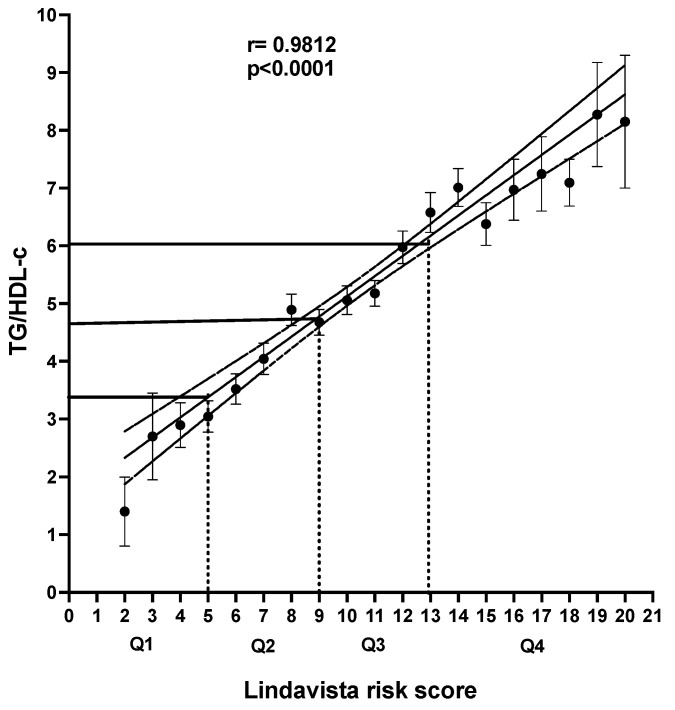
Results: The summation of eleven variables yielded the Lindavista score (LS), which was calibrated versus the TG/HDL ratio and ACC ASCVD Risk Estimator Plus score to determine its correlation with risk categories. The TG/HDL-c ratio had a linear correlation with LS and high-risk ACC ASCVD categories.
Conclusions: Compared with LS and TG/HDL-c, the ACC ASCVD system underestimates the high-risk category. The high prevalence of obesity and lipid triad in the Mexican population requires a scale that considers those traits. The TG/HDL-c ratio is a practical, easy, and economical instrument to categorize risk in Mexicans.
Keywords: Lindavista study; TG/HDL-c ratio; cardiovascular risk categories; risk scales.
Conflict of interest statement
G Ceballos is a stockholder of Epirium Inc., San Diego, USA
Figures


References
-
- World Health Organization The Top 10 Causes of Death. [(accessed on 12 July 2022)]. Available online: https://www.who.int/news-room/fact-sheets/detail/the-top-10-causes-of-death.
-
- Arroyo-Quiroz C., Barrientos-Gutierrez T., O’flaherty M., Guzman-Castillo M., Palacio-Mejia L., Osorio-Saldarriaga E., Rodriguez-Rodriguez A.Y. Coronary heart disease mortality is decreasing in Argentina, and Colombia, but keeps increasing in Mexico: A time trend study. BMC Public Health. 2020;20:162. doi: 10.1186/s12889-020-8297-5. - DOI - PMC - PubMed
-
- INEGI Estadísticas de Defunciones Registradas 2021 (Preliminar) [(accessed on 12 July 2023)]. Available online: https://www.inegi.org.mx/contenidos/saladeprensa/boletines/2022/dr/dr202....
-
- Ramos-Arellano L.E., Matia-Garcia I., Marino-Ortega L.A., Castro-Alarcón N., Muñoz-Valle J.F., Salgado-Goytia L., Salgado-Bernabé A.B., Parra-Rojas I. Obesity, dyslipidemia, and high blood pressure are associated with cardiovascular risk, determined using high-sensitivity C-reactive protein concentration, in young adults. J. Int. Med. Res. 2020;48:0300060520980596. doi: 10.1177/0300060520980596. - DOI - PMC - PubMed
Grants and funding
LinkOut - more resources
Full Text Sources
Miscellaneous
