


Insights into Microbiota in Sjögren's Syndrome
- PMID: 37763780
- PMCID: PMC10535499
- DOI: 10.3390/medicina59091661
Insights into Microbiota in Sjögren's Syndrome
Abstract
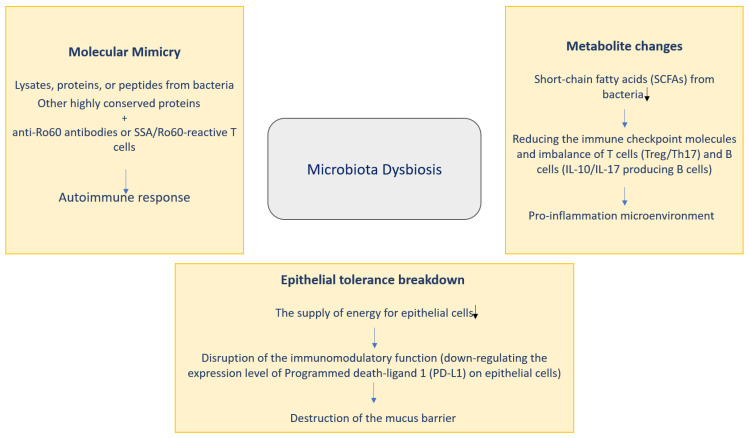
Primary Sjögren's syndrome (pSS) is a heterogeneous chronic autoimmune disorder with multiple clinical manifestations that can develop into non-Hodgkin's lymphoma in mucosa-associated lymphoid tissue. The pathogenesis of Sjögren's syndrome (SS) is not completely understood, but it is assumed that pathogenesis of SS is multifactorial. The microbiota plays a notable role in the development of autoimmune disorders, including Sjögren's syndrome. Molecular mimicry, metabolite changes and epithelial tolerance breakdown are pathways that might help to clarify the potential contribution of the microbiota to SS pathogenesis. This review aims to provide an overview of recent studies describing microbiota changes and microbiota mechanisms associated with Sjögren's syndrome. Data on the microbiota in SS from PubMed, Web of Science, Scopus and the Cochrane Library databases are summarized. Overall, the microbiota makes a major contribution to the development of Sjögren's syndrome and progression. Future microbiota studies should improve the management of this heterogeneous autoimmune disease.
Keywords: Sjögren’s syndrome; autoimmune diseases; dysbiosis; epithelial tolerance; metabolite; microbiota; molecular mimicry.
Conflict of interest statement
The authors declare no conflict of interest.
Figures
References
Publication types
MeSH terms
LinkOut - more resources
Full Text Sources
Medical
